Court postpones decision on 2% tax on digital delivery workers

The judicial decision on the controversial rate is postponed, leaving thousands of digital platform workers in suspense.

The SCJN Postpones the Review of the Tax on Delivery Drivers by Application

The Supreme Court of Justice of the Nation (SCJN) has decided to postpone the analysis of a fundamental recourse for protection that challenges the implementation of a 2% tax applied to the income of delivery people who work for digital platforms. This tribute, promoted by the Morena bench in Mexico City, has generated intense legal and social controversy, culminating in a workers’ demonstration in front of the High Court this Thursday.

During the session, the president of the Court, Hugo Aguilar Ortiz, formally requested the minister rapporteur Lenia Batres Guadarrama to postpone the presentation of his draft sentence. This document is anticipated to propose validating the collection of tax from drivers and delivery people for the use of urban infrastructure. Aguilar Ortiz’s request was based on the commitment of the new integration of the Court to promote dialogue with all the parties involved before issuing a final resolution.

RelatedMinisters of the Court talk with distributors about taxes

“I want to ask Minister Lenia Batres Guadarrama, who is the rapporteur on all these matters, if she allows us to put it on the list or postpone it in order to listen to the parties, that this new Court has offered to have dialogue and listen to all interested parties before making a decision,” declared the presiding judge. Minister Batres Guadarrama agreed to the request, so the debate and potential resolution on this thorny issue remained on hold.

Legal Background and an Canceled Project

The path of this litigation has been complex. Before its extinction as a chamber, the extinct Second Chamber of the Court had rejected a draft sentence prepared by the then minister Alberto Pérez Dayán. Said draft, now without effect, proposed confirming the protection filed by the company Uber Portier México, which would have annulled the collection of the tax. With the disappearance of that room and the invalidation of that project, the controversy was reassigned to Minister Batres Guadarrama, who has prepared a new opinion that, according to indications, is inclined to confirm the legality of the charge to the delivery people.

This shift in potential judicial stance reflects the changing nature of legal interpretation regarding digital taxation and regulation of the collaborative economy. The situation leaves thousands of workers on platforms such as Uber, Didi and Rappi in a state of legal and financial uncertainty, waiting for a ruling that will directly impact their income.

The Voice of the Affected: Protest and Discontent

Parallel to the judicial proceedings, a concentration of deliverers by application took place outside the headquarters of the SCJN. The protesters expressed their strong rejection of the tax, arguing that it represents an unfair burden on their profits, especially considering the precarious conditions of the road infrastructure they must use daily.

The workers’ position was captured in the words of Manuel Gaytán, a delivery driver who during the protest declared: “If they approve this 2% for an infrastructure that is bad, an infrastructure that is killing us with its open drains, with its potholes, they are going to hit us harder. If they approve this tax, they are going to take away 15% of our sweat.” This statement highlights the main complaint: the perception that they are required to pay for the use of public infrastructure that is in poor condition, which adds additional risk to their already demanding work.

The analysis of this case transcends the mere tax debate. It is situated at the intersection between state regulation, new digital business models and the labor and economic rights of self-employed workers. The Court’s final decision will set a crucial precedent for how the Mexican legal system addresses taxation in the so-called gig economy or platforms. A ruling in favor of the tax could open the door to similar taxes in other states, while a resolution against it would reinforce the protection of the income of this growing sector of the economically active population. The position of Minister Batres, and eventually of the majority of the Court, will be a thermometer of the institutional vision on distributive justice in the digital age.

The delay in resolution, although it generates uncertainty, can also be interpreted as an opportunity for a deeper analysis and a constructive dialogue that considers all the aspects of this complex socioeconomic phenomenon. The world watches as Mexico resolves this dilemma between the need for public financing and the protection of the most vulnerable actors in the digital value chain.

Does this topic seem relevant to the digital economy? Share this analysis on your social networks and help us foster the conversation about the future of work and taxation. Explore more content related to technology regulation on our site.
Coahuila vive jornada electoral en paz, asegura Manolo Jiménez

El gobernador destacó el clima de tranquilidad y negó persecución política durante la elección.

El gobernador de Coahuila, Manolo Jiménez, emitió su voto este domingo para renovar el Congreso estatal y calificó la jornada como un ejemplo de paz y tranquilidad. En declaraciones a medios, afirmó que ciudadanos de todas las regiones acudieron a las urnas.

“Está saliendo mucha gente de todas las regiones de Coahuila para votar”, aseguró.

Jiménez garantizó al “cien por ciento” que su administración no intervendrá en el proceso y desmintió las acusaciones de Morena y del Partido del Trabajo sobre una presunta persecución política. Atribuyó esas denuncias a “mala información” y recordó que en la entidad se respeta la ley.

“Salvo 2 o 3 incidentes menores durante la campaña, hoy se concluye positivamente este proceso electoral”, subrayó.

En materia de seguridad, el mandatario detalló que desde las 5:30 de la mañana se instalaron mesas de seguridad en todo el estado con participación del Ejército, la Guardia Nacional, la Marina, fiscalías, policía estatal, el INE y el IEC. Hay 10 mil elementos desplegados para resguardar la tranquilidad.

“Aquí respetamos las instituciones, este es el estado más seguro del país”, recalcó.

Jiménez destacó que al ser la única elección del domingo, Coahuila es observada por todo el país. Por ello, buscaron que fuera una jornada ejemplar, ordenada y con participación ciudadana.

“Es un buen momento para que Coahuila siga siendo ejemplo nacional, porque este es uno de los mejores estados para vivir”, concluyó.

Continue reading

Campaña escolar recupera a 7,846 estudiantes en México

Miles de jóvenes regresan a las aulas gracias a estrategia federal de búsqueda activa.

7,846 estudiantes de vuelta a clases

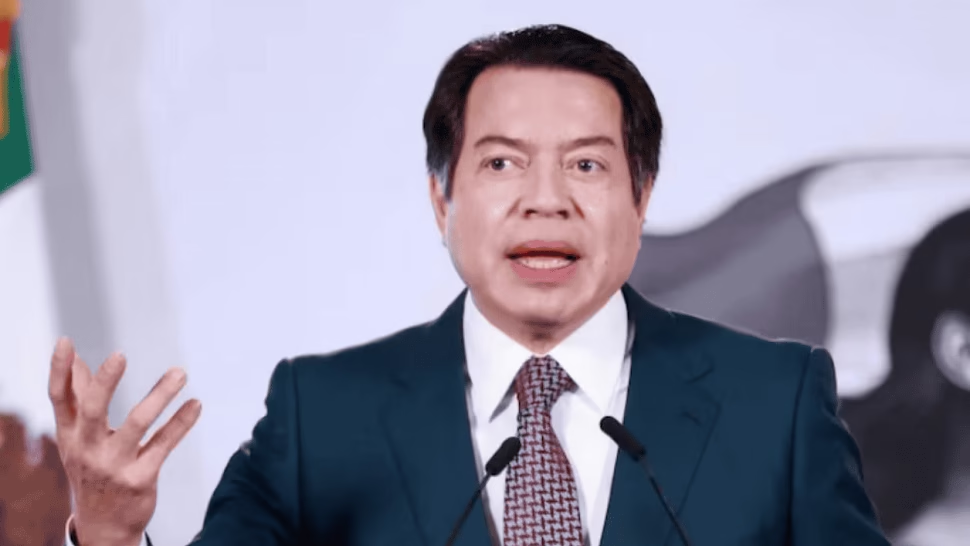
La Secretaría de Educación Pública (SEP) reportó que la campaña nacional “Te extrañamos en el salón” ha logrado reincorporar a 7,846 jóvenes al Bachillerato Nacional en lo que va de 2026. Mario Delgado, titular de la dependencia, señaló que la iniciativa busca frenar el abandono escolar y promover el regreso a las aulas.

Las principales causas de desafiliación incluyen bajo rendimiento, reprobación, desinterés, factores económicos, cambios de domicilio y dificultades de acceso a los planteles. La estrategia se implementa cada semestre: se identifican estudiantes ausentes y se contactan por teléfono, mensajes o visitas domiciliarias para ofrecer alternativas.

RelatedThe SEP launches a revolutionary cyber baccalaureate for 2026

La subsecretaria de Educación Media Superior, Tania Rodríguez Mora, explicó que las acciones son coordinadas por directivos y orientadores, sin recargar al personal docente. Se promueve la flexibilización administrativa y el acompañamiento académico a quienes tienen rezago o materias adeudadas.

Además, se realizó el Primer Foro Nacional “Hacia una estrategia para la permanencia escolar”, donde se analizaron mecanismos de detección temprana y propuestas para fortalecer el retorno a las aulas.

Continue reading

Olinia 1: el primer auto eléctrico mexicano ya es realidad

México presenta su primer auto eléctrico con autonomía de 100 km y un precio de 150 mil pesos.

Desde Zumpango, Estado de México, la presidenta Claudia Sheinbaum presentó el Olinia 1, el primer vehículo eléctrico desarrollado íntegramente en el país. El proyecto, a cargo de investigadores y diseñadores de instituciones públicas, requirió 18 meses de trabajo.

“Olinia significa movimiento; movimiento de ideas, de creatividad; movernos con innovación, con esperanza hacia nuevos horizontes… es una idea sencilla, pero muy poderosa: que la inteligencia y la creatividad de las y los jóvenes mexicanos pueden convertirse en innovación, en desarrollo tecnológico y en bienestar para nuestro pueblo”, afirmó la mandataria.

Características del Olinia 1

El responsable del proyecto, Roberto Capuano Tripp, informó que el automóvil inicia su fase de producción. Como parte de la estrategia, se avanza en la construcción de una planta de baterías de litio junto con la Secretaría de Energía, y en el desarrollo de estaciones de carga a cargo de la Comisión Federal de Electricidad.

RelatedOlinia, the new Mexican electric car, will be presented in 2026

En su versión austera, el vehículo costará 150 mil pesos. Tiene espacio para hasta seis pasajeros o una persona en silla de ruedas. Su velocidad máxima es de 50 kilómetros por hora.

Detalles de producción

La autonomía alcanza 100 kilómetros por carga, mediante una clavija trifásica de uso doméstico. El gasto estimado es de 49 centavos por kilómetro.

El Olinia 1 representa un avance en la movilidad eléctrica en México, impulsando el desarrollo tecnológico y la innovación local.

Continue reading