Didi and SSC launch digital receipt for delivery people

An innovative digital function seeks to streamline verifications and protect platform workers during their shifts.

Strategic Alliance for the Safety of Delivery Drivers

In a significant move for the ecosystem of digital platforms, Didi Food and the Secretary of Citizen Security (SSC) of Mexico City have jointly presented a new technological tool called “Order Receipt“. This innovation represents a crucial advance in the protection of delivery workers, commonly known as riders or delivery partners, by providing an immediate and legitimate verification mechanism during their work activities. The function is integrated directly into the Didi application, facilitating its access and use in real time, which constitutes a step forward in public-private collaboration to solve contemporary urban challenges.

The context of this initiative is not minor. Delivery app workers frequently carry out their work on public roads, being susceptible to various risks, including inspections by authorities that may require justification of their presence and activity at a specific place and time. The lack of an expedited document that proves your status as a worker on a digital platform could generate situations of friction or vulnerability. This new function comes to remedy that need, offering an official digital backup that validates your status instantly and reliably.

RelatedCourt postpones decision on 2% tax on digital delivery workers

Operation and Characteristics of the Digital Receipt

The verification process, carefully detailed by representatives of the mobility platform and the government agency, is designed to be intuitive and highly operationally efficient. To access this receipt, the delivery person must enter the Didi application and go to the specific section called Security Center. Once inside, you will select the “Order Receipt” option, which will automatically display a dynamic digital document.

This digital receipt contains vital and updated information that serves as reliable proof of the delivery person’s activity. It clearly shows the status of the trip or order, indicating whether it is in progress, whether it has been recently completed, or whether the worker is in a waiting period between assignments. Additionally, the document includes the profile photograph of the delivery person and their data registered on the platform, creating an unequivocal link between the person and their digital work identity. This combination of real-time data and permanent record information is the key to fast and secure verification.

The relevance of this tool extends beyond simple verification. By allowing delivery drivers to immediately demonstrate that they are carrying out a legitimate order, it contributes to more fluid circulation in public spaces. SSC agents can carry out their supervisory tasks with a validated instrument that speeds up the process, benefiting both the workers, who see interruptions to their work day minimized, and the authorities, who have a clear and technologically assisted protocol.

Implications and Future Perspectives

The statements of the Secretary of Citizen Security, Pablo Vázquez, reinforce the strategic nature of this collaboration. Vázquez highlighted that this new function “will be a very useful tool that helps us send a clear message of the intention and willingness to use technology to raise quality and safety standards for the inhabitants of our city.” This statement underlines the underlying vision: technological innovation applied to citizen security is not an end in itself, but a means to build more orderly, predictable and safe urban environments for all the actors who inhabit and transit them.

From an analysis perspective, this initiative sets an important precedent in the regulation and operation of gig economy or on-demand services. It establishes a cooperation framework where the technology company is not only limited to operating, but assumes co-responsibility for the safety of its collaborators and the harmony of public space. This management model could be replicated and adapted by other digital platforms whose workers also carry out their activities on public roads, marking a possible trend towards greater integration of digital services in urban security protocols.

The implementation of the “Order Receipt” also addresses a historical demand from the delivery drivers themselves, who have sought greater recognition and protection in the exercise of their profession. By providing them with an official accreditation instrument, their digital labor identity is strengthened and they are provided with a tangible element of legal and personal security. This technological development, therefore, has a direct impact on the well-being of thousands of workers, potentially improving their feeling of security and reducing the anxiety associated with unforeseen interactions during their workday.

The success of this measure will depend largely on its widespread adoption and the effective training of both delivery drivers for its use and security forces for its recognition. However, the joint launch between Didi and the SSC represents a promising development. It is a concrete example of how platform technology can evolve to offer integrated solutions that benefit workers, optimize the work of authorities and, ultimately, contribute to a safer and more efficient city for everyone.

Do you find this innovation useful for the safety of delivery drivers? Share this news on your social networks to publicize how technology and institutional collaboration can generate practical solutions. Explore more content related to digital transformation and citizen security on our site.
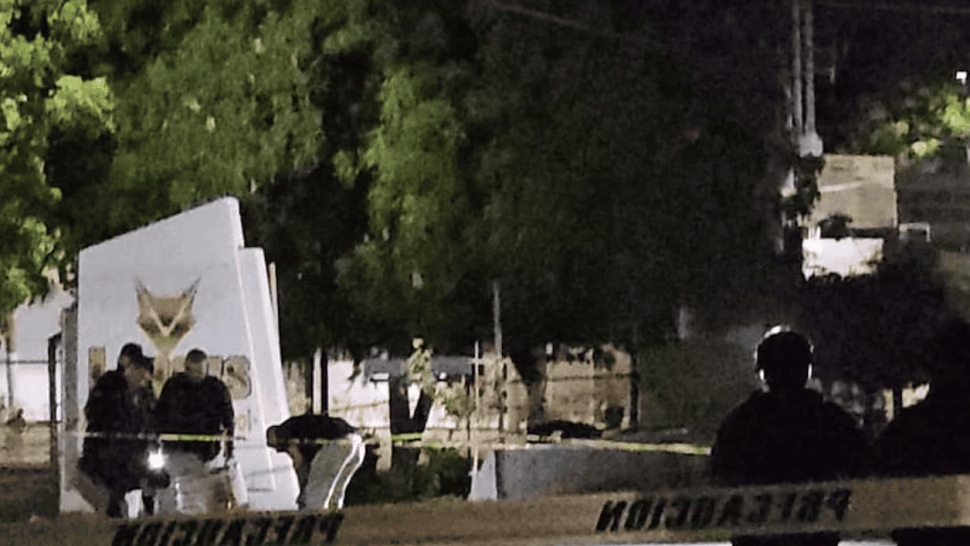
Hallan dos cuerpos con violencia extrema en Culiacán

Localizan dos cuerpos con señales de violencia en distintos puntos de Culiacán; uno con un cerdo atado y otro sin cabeza.

Hallazgos en dos puntos de Culiacán

Durante la madrugada de este sábado, autoridades localizaron los cuerpos de dos hombres en distintos sectores de la capital sinaloense. Ambos presentaban huellas de violencia.

En la colonia Ferrocarrilera, frente a unas canchas deportivas, fue hallado el cuerpo de una persona joven. Tenía disparos de arma de fuego y estaba cubierto con una cobija. Al cuello le ataron un pequeño cerdo. Elementos del Ejército y de la Policía Estatal Preventiva resguardaron el lugar y notificaron a la Fiscalía General del Estado.

RelatedCorona Capital closes era with chaos and nostalgia

En un segundo hecho, sobre la carretera Culiacán-Eldorado, en la comunidad El Diez, fue encontrado el cuerpo de un hombre al que le faltaba la cabeza. Junto al cuerpo había una cartulina con un mensaje.

La víctima fue identificada como Jesús Ramón “N”, de 23 años, vecino del poblado. De acuerdo con los primeros reportes, antes de ser privado de la vida, fue privado de la libertad por personas desconocidas.

A pocos metros del lugar, peritos en criminalística de la Fiscalía localizaron la cabeza del hombre. Las autoridades militares y estatales iniciaron las indagaciones correspondientes.

Continue reading

Inversión histórica de 190 mil mdp en Veracruz para reactivar la petroquímica

Sheinbaum anuncia 190 mil mdp en Veracruz para petroquímica, carreteras, agua y salud hasta 2030.

Inversión histórica en Veracruz

La presidenta Claudia Sheinbaum anunció desde Coatzacoalcos una inversión de 190 mil millones de pesos hacia 2030 para reactivar la industria petroquímica y de fertilizantes, además de obras en carreteras, agua y salud. A esto se suman cerca de 79 mil mdp anuales en Programas para el Bienestar.

“Es una inversión en Veracruz de alrededor de 190 mil millones de pesos en el sexenio”, puntualizó Sheinbaum en la conferencia mañanera.

Plan petroquímico

La secretaria de Energía, Luz Elena González, recordó que la recuperación de la petroquímica es clave para la soberanía energética. Juan Carlos Carpio, director de Pemex, detalló un plan integral con inversión mixta de 93 mil mdp entre 2026 y 2030. El objetivo: aumentar la producción anual a 849 mil toneladas de petroquímicos y más de 4 millones de fertilizantes.

RelatedPemex invertirá 93 mil mdp en petroquímica y fertilizantes

Los proyectos incluyen:

  • Etano-Etileno: 30 mil mdp, 6,296 empleos directos, 520 mil toneladas anuales.
  • Aromáticos: 11 mil mdp, 2,000 empleos directos, 329 mil toneladas.
  • Amoniaco: 13 mil mdp, 1,800 empleos directos, 957 mil toneladas.
  • Fertinal-ProAgro: 13,700 mdp, 7,900 empleos directos, 2.4 millones de toneladas.
  • Escolín: 25,300 mdp, 3,900 empleos directos, 708 mil toneladas.

Otras obras

El secretario de Infraestructura, Jesús Esteva, reportó 18,138 mdp para carreteras, con 54,414 empleos. El director de Banobras, Jorge Mendoza, informó que el tramo Tihuatlán-Tuxpan iniciará el próximo mes y la rehabilitación Córdoba-Veracruz concluirá en abril de 2027.

En agua, Efraín Morales, de Conagua, detalló 12,280 mdp para el Acueducto Coatzacoalcos (32% de avance) y 4,988 mdp para reconstrucción tras lluvias de octubre de 2025: 69 obras de agua potable, 40 de drenaje y 20 de protección.

Salud

Alejandro Svarch, del IMSS Bienestar, destacó que Veracruz tiene 734 centros de salud y 61 hospitales. Se invertirá 245 mdp en el Hospital Regional de Alta Especialidad. Nuevos hospitales en Pánuco (marzo 2028), Tuxpan (junio 2028), Tlapacoyan (diciembre 2028) y Misantla (junio 2029). Además, se implementará internet en clínicas y laboratorios para diagnósticos rápidos.

“Hay 98% de abasto oncológico y 22 millones de piezas entregadas mediante Rutas de la Salud”, agregó Svarch.

La gobernadora Rocío Nahle agradeció a la presidenta por el respaldo conjunto.

Continue reading

Comerciantes exigen retiro de vallas en el Centro Histórico

Pérdidas en más de 300 negocios por restricciones en el Zócalo.

Movilización en Eje Central

Comerciantes y trabajadores del Centro Histórico de la Ciudad de México bloquearon el Eje Central Lázaro Cárdenas para exigir el retiro de las vallas metálicas instaladas cerca del Zócalo. Según los manifestantes, las restricciones han reducido la movilidad y provocado una caída en las ventas.

La protesta ocurrió en el cruce de Eje Central y avenida Hidalgo. Los inconformes cerraron la circulación vehicular para visibilizar el impacto económico. Entre ellos, comerciantes de la zona conocida como “la calle de las novias”, en República de Chile, señalaron que las vallas limitan el ingreso de clientes y proveedores.

RelatedProtests leave millionaire losses to merchants in the Historic Center

De acuerdo con los afectados, al menos dos calles del primer cuadro de la capital continúan con restricciones. Esto ha generado pérdidas en más de 300 establecimientos por la disminución de afluencia.

Los comerciantes pidieron a las autoridades capitalinas retirar las estructuras o implementar medidas que permitan el libre acceso a los negocios. Su principal preocupación es recuperar la actividad económica en el Centro Histórico.

Continue reading