CDMX will activate seismic alert on cell phones during drill 2025

CDMX will test its cell phone alert system during the next national drill. Get ready for the "testing" of the future.

The drill that will make your phone vibrate (literally)

If you live in CDMX and on April 29 your cell phone starts ringing as if it were the soundtrack of a disaster movie, don’t panic (well, just a little). Myriam Urzúa, the head of Civil Protection, confirmed that the National Drill will include the Cell Broadcast system, that technology that turns your smartphone into a mini apocalyptic siren. Because what better way to remind us that we live in a seismic zone than with a digital scare?

Tests, warnings and a touch of preventive drama

According to Urzúa, they have already done the necessary tests so that the system does not fail more than our Wi-Fi on a Sunday. From today until April 28, we will be bombarded with information about how this mobile-alert works. Spoiler: Basically, your phone will scream “shake!” even if nothing happens. Useful? Yes. A little disturbing? Also.

RelatedMexico carries out national drill with massive seismic alert

“It will be included in the drill on April 29,” said the secretary, as if announcing the next Netflix release. Of course, at 11:30 AM, when the seismic alert sounds, there will be no popcorn: only protocols and the hope that, this time, we all know what to do (or at least where to hide).

Ready for the drill? Share this info and make sure even your grandmother knows that it is not a viral meme, but a survival essay. 📲💥 #AlertaQueYesSuena
PRI urges to reinforce prevention in the face of intense rains

PRI senators ask to reinforce warning and preparation for the heavy rain season.

Call from the PRI due to risks of heavy rains

PRI senators requested to strengthen prevention, monitoring and dissemination of early warning actions to face possible emergencies due to heavy rains. The request arises after the failures of federal Civil Protection during Hurricane Otis in Acapulco, where the population and tourists were not adequately alerted.

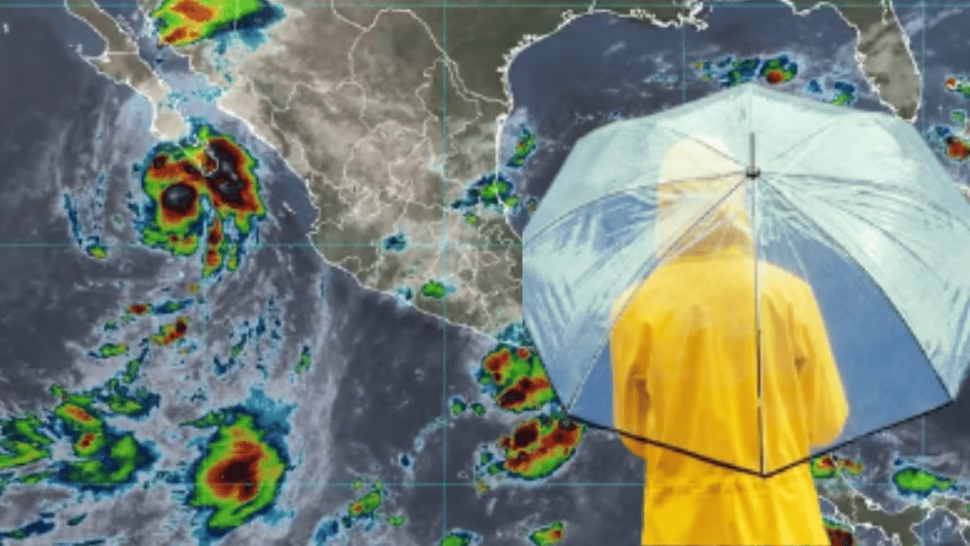
The point of agreement, published in the Gazette of July 22, is based on forecasts from the National Meteorological Service (SMN) of Conagua. For the next few days, the interaction of the Mexican monsoon, low pressure channels, humidity from the Pacific, Gulf of Mexico and Caribbean Sea is expected, in addition to the possible development of cyclonic systems.

These conditions, they warn, will favor intense rains with electric shocks, gusts of wind and high waves. The risk includes urban flooding, overflowing of rivers and streams, landslides in mountainous areas, severe flooding, falling trees and interruptions in communication routes.

Concrete actions requested

The PRI group requests that the National Civil Protection Coordination (CNPC), together with state and municipal authorities with heavy rain forecast, reinforce the identification of vulnerable areas, cleaning of channels, sewers and drainage systems. They also request to enable temporary shelters when necessary and disseminate self-protection measures.

In addition, they propose that the Ministry of Infrastructure, Communications and Transportation intensify the supervision and preventive maintenance of highways, bridges and federal roads susceptible to damage due to rain, floods, landslides or landslides.

Continue reading

Senate will review regulation of militarized schools after fatal cases

Senator promotes review of 1943 regulations after deaths of minors in private military-type schools.

Review of regulations after fatal cases

Given the death of a 13-year-old girl in a private militarized school, Senator Guadalupe Chavira announced that the Senate will review the Regulations for Private Military-Type Academies, in force since 1943. The legislator described the ordinance as anachronistic and incompatible with the current protection of children’s rights.

The regulations allow military instruction from primary to technical levels, including shooting classes in secondary school and the use of grades that grant authority to certain students over others. Chavira pointed out that these are not isolated cases; In 2025, another 13-year-old minor died at the Ollin Militarized Academy, in Morelos, after suffering serious abuse during a camp.

“The tragedy that occurred with Dafne, whose suffocation under water is being investigated, should call us to reflection and action. These schools do not have the power to organize summer camps or to authorize practices such as hazing, which ended in the death of a 13-year-old girl,” declared the senator.

The Ministry of Public Education (SEP) reported that the academy where the case occurred was operating with a 2022 incorporation agreement. After being closed for investigations, the school resumed online classes claiming the students’ right to continue their training. The agency faces at least eight additional complaints of mistreatment.

Chavira demanded a new legal framework that grants the SEP clear regulatory powers, since the 1943 regulation leaves responsibility to the Secretariat of National Defense. Specialists warn that in these private schools discipline is imposed through violence and hierarchical submission, unlike official schools where there are human rights areas and supervision of the CNDH.

Continue reading

Defense distances itself from the academy after death at a young age

The agency cited the Internal Regulations to justify its position

The Secretariat of National Defense (Sedena) disclaimed any responsibility for the “Marina Doenitz” Militarized Academy, in Ciudad Madero, Tamaulipas, after the death of the young Dafne Zapata.

Through a statement, the agency stated that it lacks the power to authorize, supervise, inspect or regulate educational institutions of this type.

“It is reported that the Secretariat of National Defense lacks the power to authorize, supervise, inspect or regulate the operation of educational institutions of this nature, in accordance with the Internal Regulations of this agency, issued by the Presidency of the Republic through its publication in the Official Gazette of the Federation, on December 29, 2008, where any administrative provision that contravenes this order was repealed,” the agency wrote.

He added that, in accordance with these regulations, Sedena “has no relationship with the aforementioned academy, nor with any other establishment of this type.”

No clear supervision

The case has put the operation of private militarized schools under scrutiny. In several states of the country they have proliferated without there being a federal body that explicitly regulates them.

To date, no state or federal authority has assumed the responsibility of supervising these schools. The Tamaulipas Prosecutor’s Office investigates the events.

Continue reading