Sheinbaum announces changes in the seismic alert for cell phones

The government seeks to adjust the volume and message of the seismic alert on cell phones, but does not guarantee changes for the next drill.

Less noise, same rush? The government promises to adjust the seismic alert

President Claudia Sheinbaum confirmed what many already felt in their bones: the seismic alert that sounds on cell phones is going to change. It’s not just the strident volume that’s annoying, but also the message.

But here comes the first but of the morning. When asked directly if these adjustments would be ready for the big drill on February 18, the answer was a classic “it hasn’t been determined yet.”

“Rather it is the volume. We are not sure if the message can still change for the drill, it requires preparation time,” Sheinbaum admitted from the National Palace.

The promise is that the Digital Transformation Agency is already on it. If it doesn’t arrive for this drill, it will be for the next ones. Perfect timing… well, you know.

RelatedMexico carries out national drill with massive seismic alert

Not just earthquakes: also hurricanes in your pocket

While talking about earthquakes, the president dropped another piece of news almost in passing: they are also working on a cellular warning system for hurricanes.

“Remember that we are also working on hurricane warnings and the issue is nothing more than guaranteeing that we actually have all the information to give it with certainty,” he explained.

The possible new messages for earthquakes would be shorter and more direct: “Earthquake” or “Alert.” Fewer words, same scare. The question that remains, as always, is when we will move from announcements to concrete actions. The clock is ticking towards February 18.
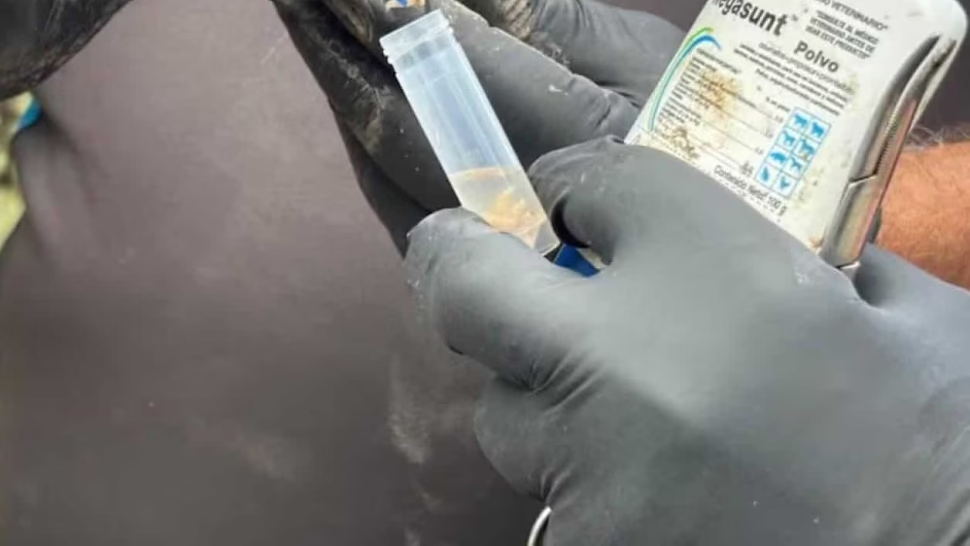
Reopening of borders to Mexican livestock after 14 months of blockade

14 months without selling to the US left losses of 592 million dollars.

End of the blockade of live cattle

After 14 months without being able to export live cattle to the United States, Mexican producers are preparing to resume sales. The gradual reopening will begin on August 24. During the blockade – from May 2025 to July 2026 – 1,974 million head of cattle were stopped being shipped.

According to the Agricultural Market Consulting Group (GCMA), the lost opportunity represented 592 million dollars. Exporters had to sell in Mexico for 900 dollars per head, compared to the 1,200 they would have obtained in the US market.

The damage could have been greater thanks to the increase in beef exports. Between January and June 2026, US$1,618 million worth of this product was sold to the US, although the figure is lower than what was generated before with live cattle.

Effects in the United States

The Mexican cattle shortage hit American feedlots. Meat production fell by 731 thousand metric tons. This skyrocketed prices: ground beef is around $7 per pound; the Sirloin exceeds 14 dollars.

The blockage was due to cattle screwworm. The Mexican Meat Council (Comecarne) celebrated the reopening and highlighted that it strengthens the value chain between both countries.

The National Agricultural Council (CNA) recognized that, despite limited resources, the Ministry of Agriculture and Senasica implemented surveillance and control measures for the worm. He noted that collaboration with US health authorities allowed for a joint Action Plan based on technical criteria.

Key advances: the sterile fly breeding plant in the south of the country, which will accelerate the eradication of the screwworm, according to the CNA.

Continue reading

Sheinbaum defends self-determination in Nicaragua

Sheinbaum defends self-determination in Nicaragua but rules out similar measure in Mexico

Sheinbaum’s position regarding the cancellation of elections in Nicaragua

President Claudia Sheinbaum was questioned about the decision of Daniel Ortega’s government to cancel the elections in Nicaragua, a measure that seeks to prevent the opposition from gaining power.

The Mexican president avoided issuing direct criticism and chose to defend the principle of non-intervention:

“It is the self-determination of the people, what the people of Nicaragua decide, and we always agree with democracy, in all its terms.”

Sheinbaum also responded if he would approve a similar measure in Mexico. His response was clear:

“No, here there is even a revocation of the mandate. Democracy, democracy, democracy. Each country decides, each people decides. We are in favor of democracy, but each country decides how it is organized.”

The presidential position reflects the Mexican tradition of respecting the sovereignty of other nations, although in this case the cancellation of the elections has been condemned by international organizations such as the OAS and the UN. Sheinbaum, however, did not join these criticisms and avoided describing Ortega’s action as a democratic setback.

Analysts point out that the response seeks to maintain cordial relations with the Nicaraguan regime, a historical ally of the Mexican left. The Mexican Foreign Ministry has not issued an official position beyond what the president said.

Continue reading

Wellbeing Calendar: payment to last names with S this July 27

Deposits for surnames with S. Amounts and calendar details.

Welfare Pension Payment for surnames with S

This Monday, July 27, the Welfare Secretariat deposits the resources for the July-August two-month period to beneficiaries whose first last name begins with the letter S. It is the fourth and last week of the staggered payment calendar, designed to speed up delivery and avoid saturation in branches.

The agency reminds that it is not necessary to withdraw the cash on the same day. The money remains on the Wellbeing Card and can be used on subsequent purchases or withdrawals.

During the previous weeks, other letters of the alphabet were covered, thus completing the July calendar.

Amounts in force for July 2026

The financial support maintains the established amounts: Pension for Older Adults provides 6,400 pesos; Women’s Welfare Pension, 3,100 pesos; Pension for People with Disabilities, 3,300 pesos; and the Program for Children of Working Mothers, 1,650 pesos for each registered minor.

The Sembrando Vida program, with a monthly scheme, made its deposit on July 9 for 6,450 pesos.

The alphabetical system facilitates dispersion among millions of beneficiaries enrolled in the social programs of the Government of Mexico.

Continue reading