


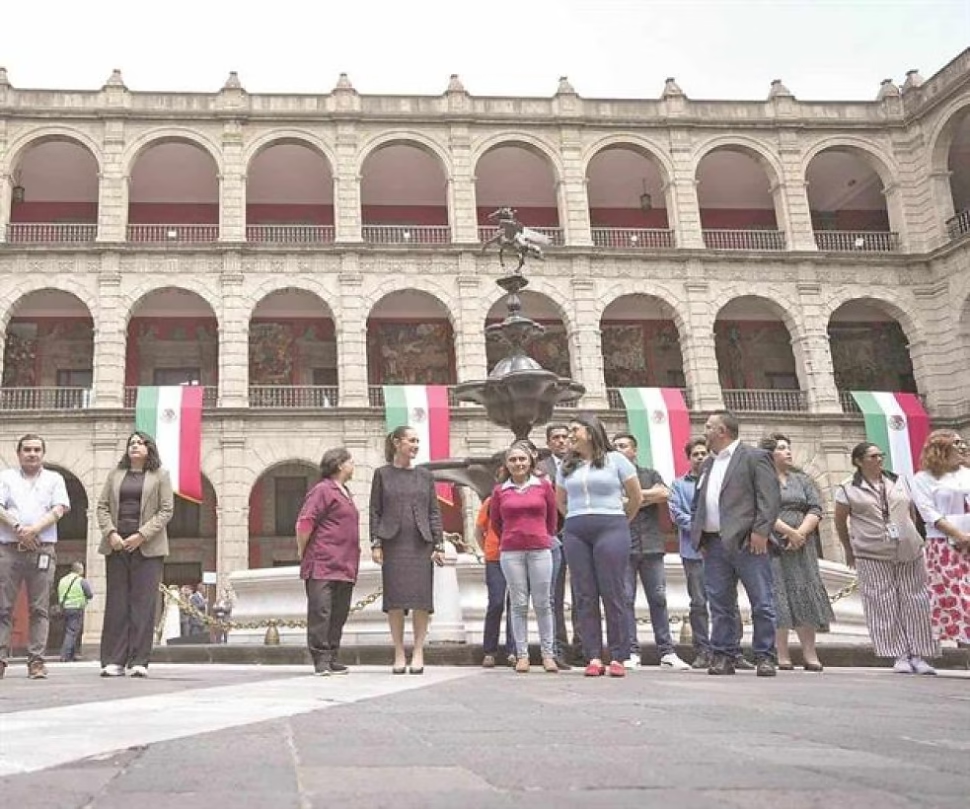
National Drill 2025: A Preparation and Technology Exercise
The Government of Mexico, headed by President Claudia Sheinbaum Pardo, successfully executed the second National Drill 2025. This civil protection exercise, carried out at 12:00 p.m. in the center of the country, was developed under a hypothesis of magnitude 8.1 earthquake with epicenter on the coast of Lázaro Cárdenas, Michoacán. The drill also included three other national risk scenarios: a hurricane, a large-scale urban fire and a tsunami, testing response protocols in various geographies and circumstances.
The day began with a commemorative event in the capital’s Zócalo, where the president raised the national flag at half-mast in honor of the victims of the earthquakes of September 19, 1985 and 2017. Sheinbaum Pardo emphasized that these exercises strengthen the culture of civil protection throughout the national territory, emphasizing that “prevention is our strength”. Likewise, he extended heartfelt recognition to the families who suffered losses in those disasters.
A Milestone in Early Warning: Technology at the Service of the Population
The most notable and innovative aspect of this drill was the implementation, for the first time at the national level, of a mass alert system via cell phone. This cutting-edge technology allowed the dissemination of an emergency message that reached more than 80 million mobile devices throughout the country, marking a historical precedent in risk communication. This tool represents a significant advance to guarantee that alerts reach the population instantly and massively, overcoming the limitations of traditional systems.
During the conference after the exercise, the Secretary of Security and Citizen Protection (SSPC), Omar García Harfuch, detailed the results. He declared that the Mexican State demonstrated that it has the operational and logistical capacity to respond effectively to emergencies derived from natural phenomena. “The Government of Mexico is ready to deploy all the necessary resources in every corner of the country,” said the official, highlighting inter-institutional coordination.
Unprecedented Responsiveness and Citizen Participation
García Harfuch described the exercise as the largest simultaneous social participation in the history of Mexico, which reflects, in his opinion, the growing commitment of citizens to the culture of prevention. The drill was carried out successfully in the 32 states, involving the three levels of government and various sectors of society.
One of the most relevant technical data shared was the notable increase in the national task force for disaster response. The secretary explained that a response force composed of 770,166 elements from various institutions, including armed forces, emergency bodies and civil agencies, has been consolidated. This figure represents a substantial expansion of the State’s reaction capacity in the face of any type of incident, guaranteeing a robust presence throughout the territory.
The combination of cutting-edge technology, improved protocols and an expanded task force sets a new standard in comprehensive risk management in Mexico. This drill not only tested reaction mechanisms, but also served as a powerful reminder of the importance of constant preparation and collective historical memory. The successful integration of these components is essential to build a more resilient and secure nation in the face of unforeseen events of nature.
Did you find this information useful?Share this article on your social networks to help spread the culture of prevention and explore more content related to national security and emergency technology on our portal.


