Bienestar reports historical coverage on social programs

The head of Welfare reveals record coverage figures and an unprecedented financial deployment for the close of the fiscal year.

Analysis of Advances in Welfare Programs and Pensions

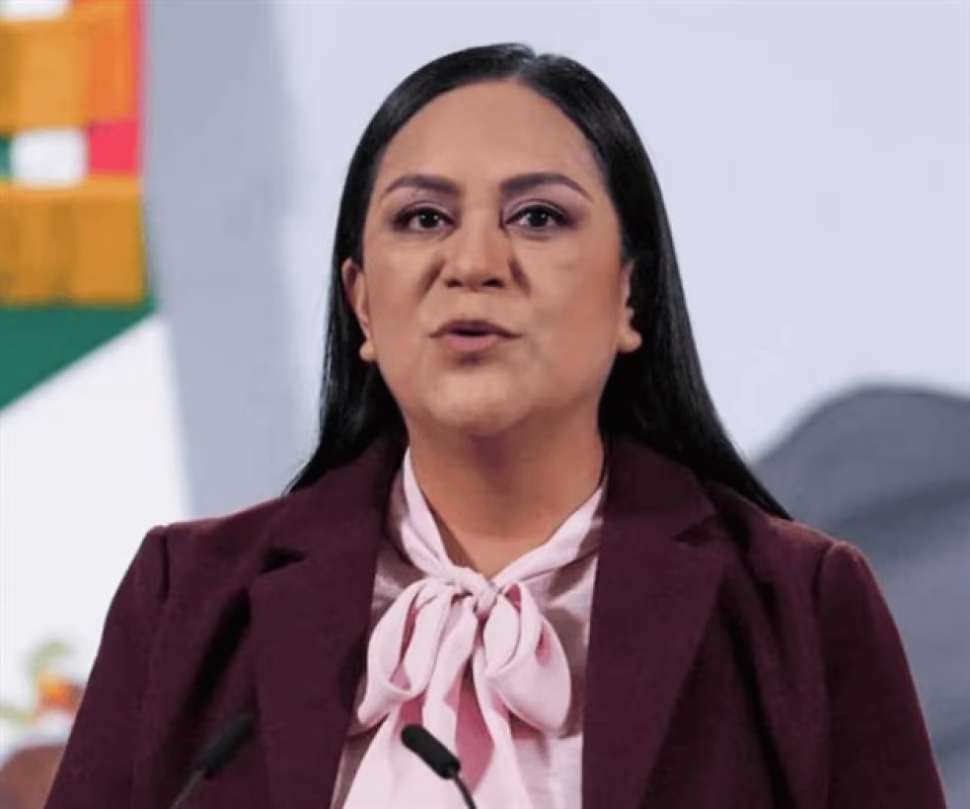
In a detailed report presented at the National Palace, the head of the Ministry of Welfare, Ariadna Montiel Reyes, broke down the quantitative advances and financial impact of social programs under the administration of President Claudia Sheinbaum Pardo. This analysis is framed in the final phase of the year’s payment cycle, a critical period for the evaluation of government social policy.

The data provided indicates unprecedented coverage in the Pension for the Well-being of the Elderly program, reaching 13.5 million beneficiaries. The magnitude of this fiscal effort is reflected in an allocated investment of 82 billion pesos, a figure that underlines the budgetary priority given to this segment of the population. The total aggregate number of citizens who receive some type of subsidy amounts to 18 million 494 thousand, a historical maximum according to official statements. The bimonthly dispersion of resources for the November-December period is projected at approximately 99 billion pesos, consolidating a significant economic flow towards the most vulnerable sectors.

RelatedGovernment allocates trillion pesos to social programs by 2026

Expansion and Goals Met in the Women Wellbeing Program

A close examination of the Women’s Wellbeing program reveals a staggered incorporation strategy by age group. The registration process, which began in January for women aged 63 and 64, has already included one million people. The current phase focuses on the inclusion of women aged 60, 61 and 62, projecting an addition of almost two million new beneficiaries. The official calculation estimates that the total number of beneficiaries for this specific subsidy will amount to 2 million 982 thousand. The investment designated for this two-month period, intended to cover both existing beneficiaries and those newly incorporated, is 8,445 million pesos. Deposits for those registered in August will be made according to the official calendar starting November 18.

Transversal Coverage in Other Social Support Programs

The ecosystem of social support extends beyond pensions for older adults. Official data specify that the support program for Persons with Permanent Disabilities benefits one million 614 thousand individuals, with a bimonthly investment of 5 thousand 182 million pesos. At the same time, the Working Mothers program provides financial support to 256 thousand minors, while the Sembrando Vida initiative, focused on reactivating the countryside and reforestation, reports 409 thousand incorporated planters.

From the Secretary of Labor and Social Welfare, its head, Marath Bolaños, provided relevant information about the Young People Building the Future program. Since its implementation in 2019 and until the projected closure for 2025, this initiative has accumulated 3 million 423 thousand beneficiaries, with a distribution of 58% women and 42% men. A notable indicator of effectiveness is that seven out of ten program graduates manage to enter the labor market. The accumulated social investment for this scheme over seven years of the current administration is estimated at 158 billion pesos.

Finally, the head of the Secretary of Public Education, Mario Delgado, corroborated the extensive coverage of the Benito Juárez Welfare Scholarships system, which exceeds 13 million benefited students, thus consolidating a social protection network that spans from childhood to senior citizens.

This display of information allows us to conclude that the current administration has consolidated a large-scale welfare architecture, with a massive demographic reach and a substantial budgetary commitment. The quantitative evidence presented suggests a systematic effort to formalize and expand the welfare state in Mexico, whose long-term effects on reducing inequalities and energizing the local economy require continuous monitoring and evaluation.

Do you know someone who benefits from these programs? Share this analysis on your social networks to inform more people and explore our site to find more content on public policies and social development.


IMSS Tamaulipas ofrece vasectomía sin bisturí en jornada gratuita

Jornada gratuita de vasectomía sin bisturí del 15 al 27 de junio en Reynosa y otros municipios.

El Instituto Mexicano del Seguro Social (IMSS) en Tamaulipas invita a hombres de 20 a 59 años a participar en la Jornada de Vasectomía sin Bisturí, del 15 al 27 de junio. La actividad se realizará en varias ciudades, incluyendo Reynosa.

Procedimiento ambulatorio y seguro

Laura Patricia Martínez Lima, coordinadora de Primer Nivel de Atención del IMSS, explicó que la estrategia está dirigida tanto a derechohabientes como a la población en general.

“El objetivo es fomentar la planificación familiar responsable y ofrecer a los hombres una alternativa segura, eficaz y permanente para el control de la fertilidad”, afirmó.

La vasectomía sin bisturí es un procedimiento ambulatorio que no requiere hospitalización. Se realiza en pocos minutos y permite retomar actividades cotidianas en un plazo de 48 a 72 horas. Es un método anticonceptivo permanente para quienes han decidido concluir su etapa reproductiva y contribuye a distribuir de manera más equitativa la responsabilidad en la planificación familiar.

“Es un procedimiento seguro, efectivo y de rápida recuperación. Con estas jornadas buscamos acercar el servicio a más hombres, promoviendo una paternidad responsable y una participación activa en la planificación familiar”, añadió Martínez Lima.

Sedes en Tamaulipas

Las jornadas se llevarán a cabo en las Unidades de Medicina Familiar (UMF): número 40 de Reynosa, 17 de Río Bravo, 24 de Ciudad Mante, 33, 36 y 39 de Matamoros, 38 de Tampico, 67 de Ciudad Victoria, 77 de Ciudad Madero y 78 de Nuevo Laredo. También en el Hospital General de Subzona con Medicina Familiar número 7 de Pánuco, Veracruz.

RelatedJulión Álvarez conquers Reynosa with a historic concert

Los interesados pueden acudir al área de Trabajo Social de cualquiera de estas unidades para recibir información y programar el procedimiento. No se requiere ayuno ni estudios previos.

Continue reading

Jóvenes Construyendo el Futuro: 3.5 millones de beneficiarios en ocho años

Sheinbaum detalla los alcances del programa social en Xalapa, Veracruz.

La presidenta Claudia Sheinbaum informó que el programa Jóvenes Construyendo el Futuro ha beneficiado a más de 3.5 millones de personas entre 2019 y 2026. El anuncio lo hizo durante una asamblea en el Museo Kaná de Xalapa, Veracruz.

Cifras del programa

El programa ofrece un año de experiencia laboral pagada por el gobierno. Los participantes son considerados aprendices y reciben un apoyo mensual equivalente al salario mínimo, además de seguridad social.

“Ese año de experiencia a los jóvenes les ha permitido encontrar de mejor manera un empleo”, afirmó Sheinbaum.

La subsecretaria de Empleo, Quiahuitl Chávez Domínguez, precisó que la inversión total supera los 170 mil millones de pesos en los últimos siete años.

RelatedYoung People Building the Future opens 45 thousand training places

Inversión educativa

Sheinbaum también destacó que su administración trabaja en la creación de 200 mil nuevos espacios para Educación Media Superior y 330 mil para Educación Superior, a través de instituciones públicas.

A la reunión asistió la gobernadora de Veracruz, Rocío Nahle García, quien reconoció el impacto de la estrategia en la entidad. El beneficiario Diego Armando Gallardo Castillo agradeció la continuidad del apoyo económico para el sector de las artes escénicas.

Continue reading

70% de alumnas en medicina, pero solo 30% en puestos directivos

Persisten brechas de género en el sector salud pese a la feminización de la matrícula.

La matrícula de la Facultad de Medicina de la UNAM está compuesta en un 70% por mujeres. Sin embargo, en los puestos directivos del sector salud apenas alcanzan el 30%. Así lo informó la directora de esa entidad, Ana Carolina Sepúlveda Vildósola.

Al encabezar la graduación de la primera generación del Programa de Formación de Liderazgos de Mujeres Médicas, señaló que persisten barreras estructurales que limitan el acceso femenino a la toma de decisiones.

“La medicina se está feminizando”, subrayó.

El programa, impulsado junto con Aúna y Roche, capacitó a 48 médicas y profesoras de pregrado y posgrado para fortalecer su liderazgo. Sepúlveda Vildósola las invitó a proyectarse como futuras directoras de hospitales, jefas de servicio y diseñadoras de políticas públicas.

RelatedUNAM protects its Faculty of Medicine from attempted takeover

La directora general de Roche México, Mónica Palomanes Seoane, destacó la relevancia de incorporar más liderazgos femeninos en un sector donde la participación de las mujeres es cada vez mayor. Su directora médica, Maryet Pérez Barahona, señaló que el programa busca mejorar la atención a pacientes y fortalecer equipos de trabajo.

Mónica Tapia Álvarez, coordinadora estratégica de Aúna A.C., consideró que México vive un momento favorable para ampliar la presencia femenina en liderazgo, gracias a generaciones con mayor escolaridad y participación en espacios públicos.

Continue reading