Zelenskyy summons 30 allies as Ukraine hits Russian heartland

As allies search for a way out, Ukraine responds with a show of force that paralyzes Russian airspace.

Diplomacy accelerates, but the drones do not rest

Imagine the scene: Volodymyr Zelenskyy, with that green jacket that is already more iconic than any Met Gala outfit, preparing for a diplomatic marathon on Zoom with 30 countries. Their mission: find fair conditions to end a war that is now almost four years old, a conflict that seems like the longest and most traumatic season of a series that no one asked for. Meanwhile, on the other side of the pond, Donald Trump makes his move, pushing for a “quick deal” with Russia and dropping pearls like Zelenskyy should “be realistic,” which in this context sounds like a euphemism for “resign territory.” The tension is so high that even video calls have the aura of a geopolitical thriller.

The European leaders, whom Trump has classified with his characteristic subtlety as “weak”, are trying to take the reins of the peace negotiations. German Chancellor Friedrich Merz, along with British Premier Keir Starmer and French President Emmanuel Macron, proposed to Trump that they, along with American officials, finalize the proposals this weekend. The crux of the matter, according to Merz, is deciding “what territories and concessions Ukraine is willing to make.” All this while the Russian president, Vladímir Putin, continues his “brutal war” and, according to the Europeans, is playing for time. A total nonsense.

RelatedTrump and Putin meet to define the future of Ukraine

The Ukrainian response: when diplomacy fails, drones come in

But Ukraine does not sit idly by and wait for politicians to decide its future. In a move that mixes desperation and pure strategy, it launched one of its largest drone attacks of the entire war, paralyzing Moscow’s four airports for seven hours and affecting eight other Russian cities. The Russian Defense Ministry said it had intercepted 287 drones, a figure that sounds more like an invasion by robotic bees than a military attack. The show of force was clear: kyiv can strike far away and in the symbolic heart of the adversary.

And if that were not enough, long-range Ukrainian drones hit for the first time a Lukoil oil platform in the Caspian Sea, about 1,000 kilometers from its territory. A blow not only military, but also economic, which stopped the extraction of more than 20 wells. This attack on Russian energy infrastructure is a direct message: Ukraine’s ability to resist and respond is still alive, defying the narrative of an overwhelming invasion.

Meanwhile, on the diplomatic front, the European Union is trying to anchor Ukraine to the Western bloc, giving it in Lviv a list of reforms necessary for its accession, despite the war and Hungary’s objections. EU membership has become the central objective, an anchor in the storm, especially when the prospects of joining NATO appear frozen. At the same time, Russia is trying to appear cooperative with Trump’s peace efforts, hoping to avoid further sanctions, while accusing Europe of wanting to prolong the conflict. A game of mirrors where each person blames the other.

NATO Secretary General Mark Rutte issued a chilling warning to Europe: “We are Russia’s next target.” He also pointed to China as the “lifesaver” of the Russian war effort, providing critical electronic components. The war in Ukraine is no longer a local conflict; It is the epicenter of a global reconfiguration of alliances and tensions where everyone, in one way or another, is involved.

The result of all this chaos? A panorama where talks are at a “critical moment”, according to the Europeans, and actions on the field and in cyberspace continue to define reality. Ukraine is coordinating bilaterally with European countries and preparing for a summit in Brussels, while resisting on the ground and expanding its attack radius. The search for peace has never been so full of noise, shrapnel and diplomatic tweets.

Are you left wanting more analysis of this geopolitical whirlwind? Share this article on your social networks and explore more related content to understand all the layers of this conflict that defines our era. Information is power, and in this case, it is also pure international suspense.
1,430 dead and 3,238 injured left by earthquakes in Venezuela

Official balance reports 1,430 deaths and more than 3,000 injured after two earthquakes in Venezuela.

Official figures after the earthquakes in Venezuela

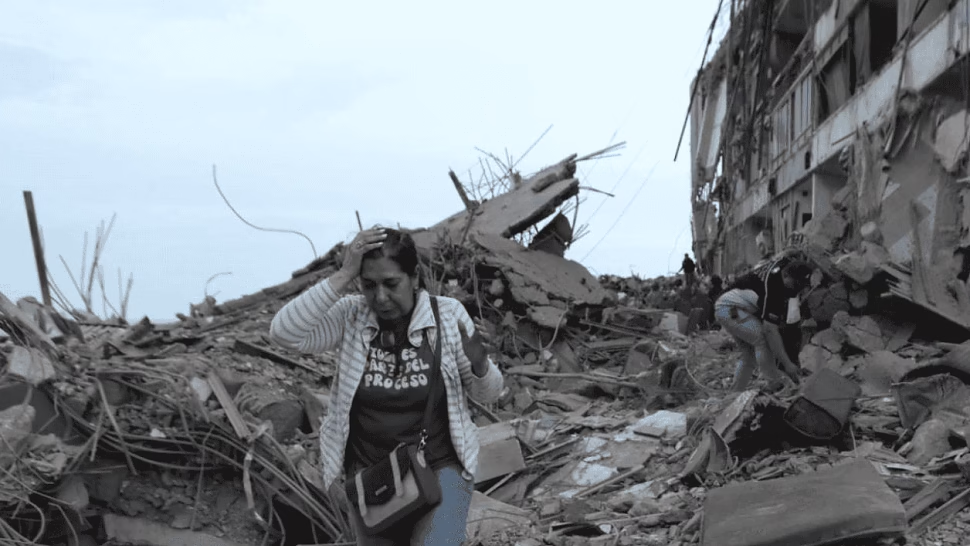
The president of the National Assembly, Jorge Rodríguez, updated the balance of the two earthquakes that shook the country. So far there are 1,430 deaths and 3,238 injuries. Search and rescue efforts continue in the most affected areas.

Rodríguez specified that 3,142 families were affected and are being cared for in shelters distributed in the seven affected states. In addition, 430 aftershocks of the earthquakes have been recorded.

According to the open online platform, the missing number 50,947. The official, brother of interim president Delcy Rodríguez, reiterated the call to citizens not to enter La Guaira and deposit their aid in authorized collection centers.

Continue reading

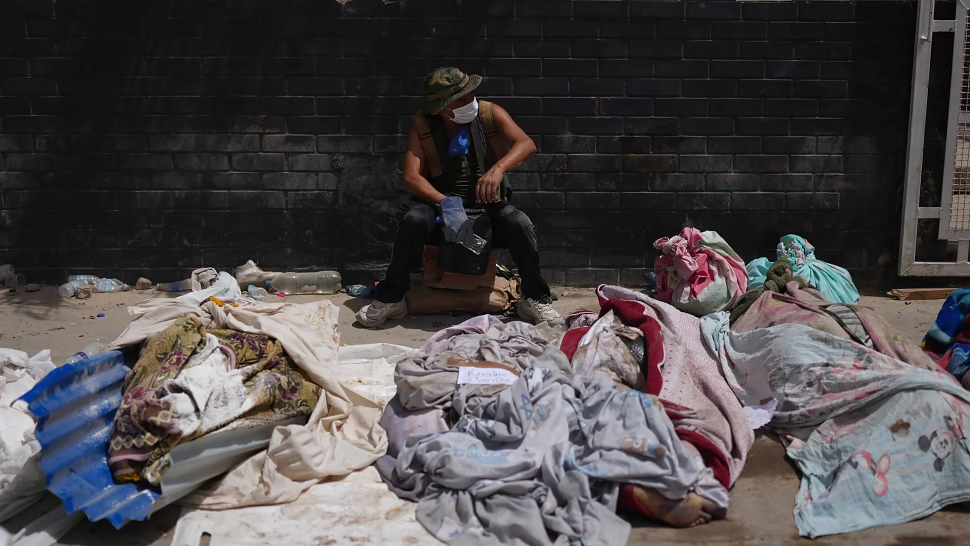
La Guaira: smell of decomposition and slowness in rescues after earthquakes

After 72 hours of the earthquakes, activists report unrecovered bodies and little official response.

La Guaira: 72 hours after the earthquakes

In Caraballeda, a residential area of La Guaira, the smell of decomposition was clearly perceived on Friday night. The first 72 hours after the earthquakes had passed, a key period for life rescues.

Activists from Provea, the oldest human rights NGO in Venezuela, confirmed to ANSA that during a tour of that area “we smelled decomposition (a sign of unrecovered bodies under rubble).” In addition, they pointed out that “there are few body recovery units.”

72 hours after the two earthquakes that devastated the region, activists observed “bodies that have not yet been transferred with dignity.” They recalled that “the State has the obligation to guarantee dignified recovery operations for each victim and their families.”

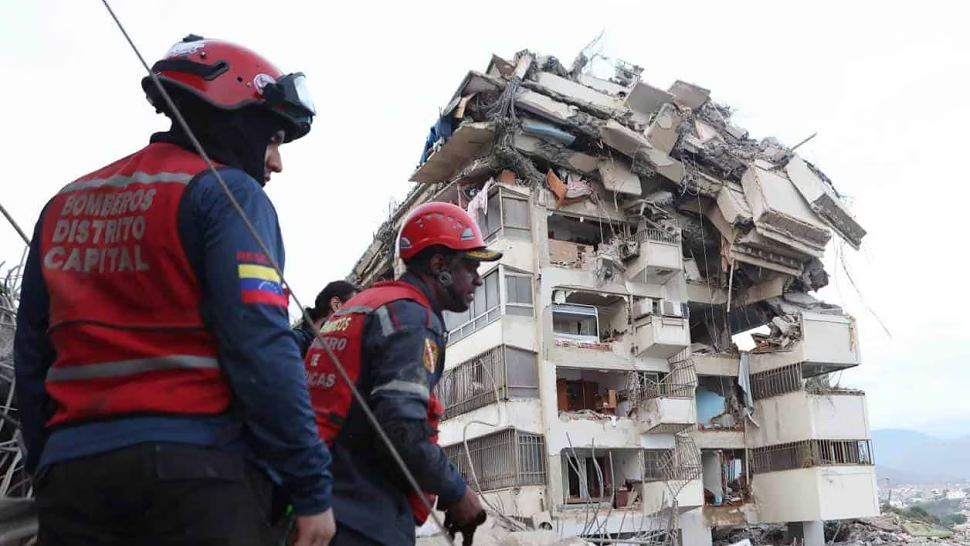
The earthquakes, magnitude 7.2 and 7.5, occurred consecutively this Wednesday, according to the United States Geological Survey (USGS). The epicenter was located in Yaracuy, about 300 km west of Caracas, but La Guaira, just 30 km from the capital, suffered the greatest structural impact.

The head of Humanitarian Affairs of the UN, Tom Fletcher, estimated that more than 50,000 people were missing. Journalists and observers indicated that the majority is concentrated in La Guaira, where images on networks show numerous lifeless bodies.

Journalist León Hernández, who was in La Guaira on Friday, told ANSA: “I was there… there are really thousands. This Friday night the key 72 hours for rescues were completed.” He added that “in many collapsed buildings, only civil servants and volunteers have been in charge of continuing to rescue people.” He explained that “the damage is of enormous proportions, thousands of victims. I saw complete buildings from which only one person was taken alive.”

This Saturday, interim president Delcy Rodríguez said that seven states were affected, but that the catastrophe hit La Guaira. The government reported the sending of machinery and military personnel, and the closure of access to La Guaira since Friday night, justifying it for reasons of order and security. However, local activists and journalists question the prioritization and insufficient response in the first 72 hours.

Thousands of victims remain in makeshift shelters or on the streets for fear of aftershocks. The combination of debris, heat (up to 40°C) and unrecovered bodies creates an increasing health risk. The families demand transparency in the figures, dignified access to the bodies and a state response in line with the scale of the catastrophe.

Continue reading

La Guaira: 72 hours of uncertainty after the earthquakes

The smell of decomposition and few rescue teams mark the area most devastated by the earthquakes.

Rescues in La Guaira: 72 hours of uncertainty

72 hours after the two earthquakes that shook northern Venezuela, the La Guaira area faces a humanitarian crisis. Activists from Provea, the country’s oldest human rights organization, report the smell of decomposition and few body recovery units.

“We smelled decomposition—a sign of unrecovered bodies under rubble—and there are also few body recovery units,” they told ANSA after a tour of the area.

The earthquakes, magnitude 7.2 and 7.5 according to the USGS, occurred consecutively. The epicenter was located in Yaracuy, 300 km from Caracas, but La Guaira, just 30 km from the capital, suffered the greatest structural impact. The UN, through Tom Fletcher, estimated that more than 50,000 people were missing.

Journalist León Hernández, present on Friday, described the magnitude of the tragedy:

“I was there… there are really thousands. This Friday night the key 72 hours for rescues were completed. In many collapsed buildings, it has been only civil servants and in many cases volunteers in charge of continuing to rescue people.”

He added that thousands of victims were left in makeshift shelters or on the streets for fear of aftershocks. Temperatures reach 40 degrees Celsius, combining debris and unrecovered bodies, creating a growing health risk.

Interim President Delcy Rodríguez reported damage in seven states, but the tragedy is concentrated in La Guaira. The government announced the sending of machinery and closing access from Friday for order and security. However, activists question the insufficient response in the first critical hours.

The families demand transparency in the figures, dignified access to the bodies and a state response in line with the catastrophe. The search efforts continue, but the slowness and scarce official presence mark the panorama in this coastal region.

Continue reading