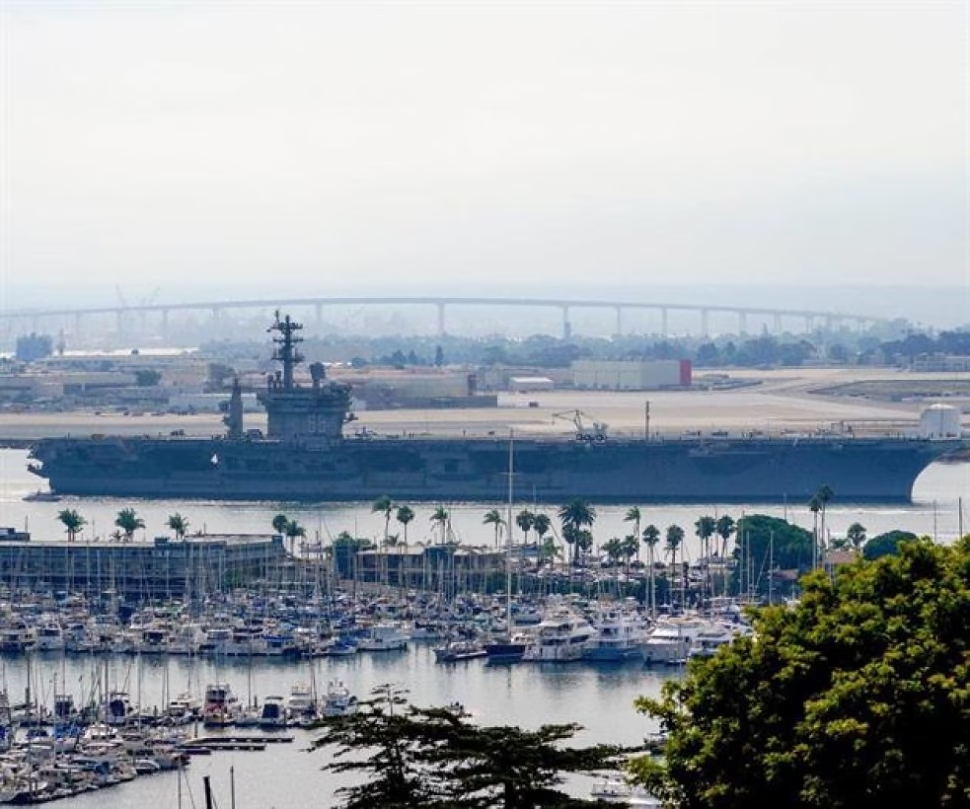
Two US Navy aircraft crash into the China Sea

Two catastrophic falls into the sea just minutes apart. An aircraft carrier on its final mission faces mystery.

An Aircraft Carrier and its Meeting with Destiny in Troubled Waters

In a twist of fate that shocked the highest echelons of military power, the colossus of the seas, the USS Nimitz, found itself involved in a nightmare from which it could barely escape. In the strategic and always tense waters of the South China Sea, the silence was broken not by the roar of war, but by the roar of two tragedies that followed each other with terrifying speed. A fighter plane and a helicopter, two extensions of the aircraft carrier’s power, fell from the sky in an interval of just thirty minutes, unleashing a race against the clock where every second was a battle between life and the unfathomable depth of the ocean.

The news, sent as a whisper of warning from the Pacific Fleet Headquarters, revealed a Dantesque scenario. First, the MH-60R Sea Hawk helicopter, a beast of rotors and technology, was engulfed by the waves. His crew of three brave men braved the fury of the sea, a battle from which they miraculously emerged victorious after an epic rescue on Sunday afternoon. Almost immediately, as if a curse hung over the fleet, the formidable F/A-18F Super Hornet fighter followed the same path into the abyss. His two aviators, in an act of heroic desperation, activated their ejection seats, launching themselves into uncertainty before their ship became their steel tomb. An official statement, cold and calculated, attempted to calm the waters by declaring that the five air warriors were “safe and in stable condition,” but the questions burned brighter than any answers.

RelatedAn F/A-18 fighter falls into the Red Sea from a US aircraft carrier

Mysteries, Declarations and a Fuel that Poisons the Truth

As the investigation teams immersed themselves in the mystery, trying to decipher the causes of these twin air accidents, a powerful voice intervened from above. President Donald Trump, aboard Air Force One heading to Tokyo, dropped a bomb of speculation that electrified the situation. With the forcefulness that characterizes him, he suggested that the root of the catastrophe could be found in something as mundane and at the same time as lethal as “bad fuel.” With this statement, he dismissed any shadow of sabotage or covert action, insisting that there was “nothing to hide.” However, in such a sensitive theater of operations, his words, far from appeasing, only added layers of intrigue to an already convoluted plot.

This dramatic episode marks the last voyage of the USS Nimitz, a naval titan that returns to its home at Naval Base Kitsap, Washington, after a long and grueling mission in the Middle East. Their deployment, a direct response to attacks by Houthi rebels against merchant traffic, is coming to an end, but their legacy will be stained by these hours of uncertainty and danger. It seems as if the ship itself, in its farewell, was fighting a last fierce battle against an invisible enemy.

And here’s the most terrifying twist: the Nimitz is not alone in its misfortune. A similar curse appears to haunt her brother-in-arms, the USS Harry S. Truman. This other aircraft carrier has been the scene of a succession of misfortunes that border on the incredible. In December, a missile launched from the cruiser USS Gettysburg mistakenly shot down a Truman F/A-18. Then, in April, another fighter jet slid from the hangar to become lost in the waters of the Red Sea. And as if fate were not satisfied, in May, a device that was trying to land plummeted into the void after failing to engage with the arresting cables, forcing the ejection of its pilots. That no Marines have perished in this chain of calamities is a miracle that defies all logic, while the world waits, with its heart in its mouth, for the results of investigations that could reveal a much darker truth.

Do you think this story of mystery and survival on the high seas should be known to everyone?Share this shocking story on your social networks and discover more exclusive analyzes about the secrets of the armed forces on our platform.

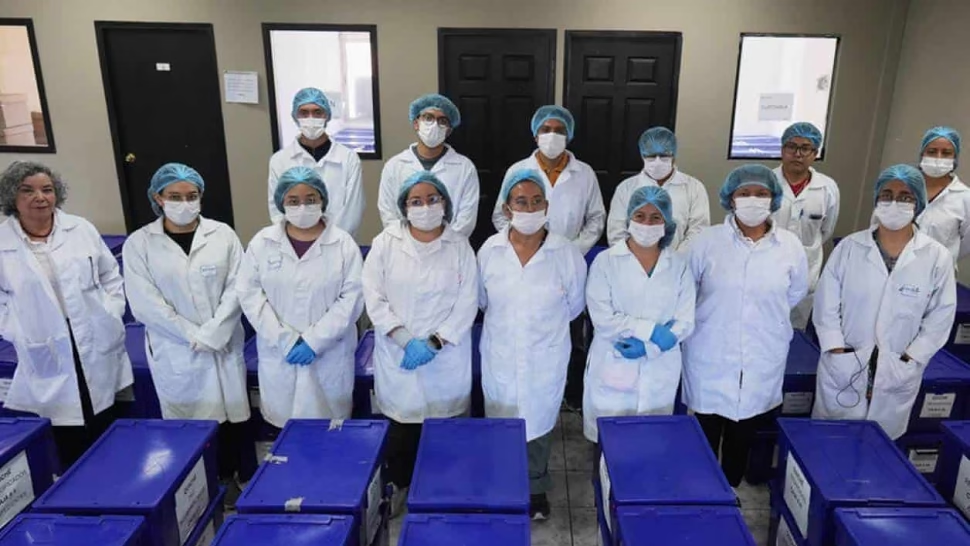
The skeleton of a Triassic giant is restored in Poland

Volunteers restore a 6-meter-long prehistoric amphibian skeleton in Warsaw.

Volunteers restore the fossil of a prehistoric colossus in Warsaw

At the Copernicus Science Center in Warsaw, a team of more than 2,000 volunteers is working on restoring the skeleton of a Mastodonsaurus, a giant amphibian that lived 240 million years ago. With chisels, brushes and protective glasses, they remove the rock that covers the bones millimeter by millimeter.

Visitors watch through a window as the work progresses. The skeleton measures almost 6 meters and weighs 1,300 kilograms. It will be the largest of its kind displayed in a museum in the world, according to Tomasz Sulej, a paleontologist at the Polish Academy of Sciences.

An experience open to citizens

The volunteers are not scientists, but managers, cleaning staff and tattoo artists, among others. They receive training and protective equipment before supervised two-hour sessions. “I imagine that those bones were underground for 240 million years and I am the first human being to touch them,” commented Tatyana Kozyk, team coordinator.

The specimen was discovered in southern Poland in 2023 by Sulej and Wojciech Pawlak. Unlike other finds in Germany and Russia, which measure 2 to 3 meters, this specimen offers new information about the species. “The structure of the body is different from what we knew,” Sulej said.

A message of natural resilience

Dorota Serafín, a 51-year-old manager, described the experience as “relaxing and philosophical, even mystical.” The Mastodonsaurus lived after the largest mass extinction on the planet, just before the rise of the dinosaurs. For Sulej, his story sends a message of hope in the face of climate change: “Nature and life always find ways to survive.”

The restoration will be completed in October or November. The skeleton will then be displayed to the public at the same center.

Continue reading

Guatemala races against time to save 60 thousand testimonies

60 thousand files of victims at risk due to abandonment by previous governments.

Rescue of historical memory

Guatemala faces a race against the clock to protect some 60,000 files of victims of the internal armed conflict (1960-1996). The documents, compiled over a decade by the National Reparations Program (PNR), seek to compensate those who suffered abuse. The government of President Bernardo Arévalo has until January 2028 to achieve this.

The PNR was born in 2003 after the 1996 Peace Accords, but during the governments of Jimmy Morales (2016-2020) and Alejandro Giammattei (2020-2024) the program became inactive and its liquidation was ordered. The testimonies were abandoned.

Workers from a UNESCO-funded project try to recover the archive. Erick Briones, archive assistant, described the conditions: “Damp boxes, piled up, incomplete, broken files.” The goal is for this collection to be declared the world’s documentary heritage.

Among the cases is that of Manuel Botom Uz, who at the age of 4 was disappeared in 1982. According to testimony, he and his four brothers were attacked in Quiché by members of the army and civil patrolmen. His brothers were handed over to relatives, but Manuel disappeared. Twenty years later, his body was located and identified in a clandestine grave.

Elvin Díaz, presidential commissioner of Human Rights, said: “There was an intention by the Morales and Giammattei governments to erase collective memory.” He also explained that the purpose of the PNR was humanitarian aid, but the files contain “relevant information for a criminal investigation.”

The files detail homicides, forced disappearances, sexual assaults and forced recruitment. According to reports, the conflict left some 200,000 dead and 45,000 missing.

Future project plans to digitize the archive for universal access. A UN report on forced disappearances, issued last month, indicated that during the Morales and Giammattei governments “a systematic policy of dismantling institutions for peace and justice” operated.

The files will go to the Reparation and Dignification Plan for victims announced by Arévalo. This seeks to centralize the dispersed information to continue compensation and include cases of disappearance in the Humanitarian Search Mechanism.

Continue reading

ASEAN foreign ministers discuss crisis in Middle East and South China Sea

ASEAN foreign ministers meet in Manila over tensions in the Middle East and South China Sea.

Foreign ministers’ meeting in Manila addresses security challenges

The foreign ministers of the Association of Southeast Asian Nations (ASEAN) began a three-day meeting in Manila on Tuesday. The agenda focuses on the main security challenges in the region, marked by the escalation of tensions between the United States and Iran and the growing differences in the South China Sea.

In a joint statement after their first session, the foreign ministers expressed their concern about the escalation in the Middle East. They called for an immediate halt to hostilities and the safe reopening of the Strait of Hormuz, a strategic route for global oil and gas trade. They also reiterated the commitment to resolve differences between States through dialogue and respect for sovereignty and territorial integrity.

The meeting in Manila becomes a key space for member countries to discuss strategies that promote regional stability. The ministers emphasized the importance of maintaining open communication channels to avoid misunderstandings and major conflicts.

ASEAN has historically been a forum for cooperation and dialogue in Southeast Asia. This meeting seeks not only to address current conflicts, but also to strengthen regional integration and collaboration on security and economic development issues.

Continue reading