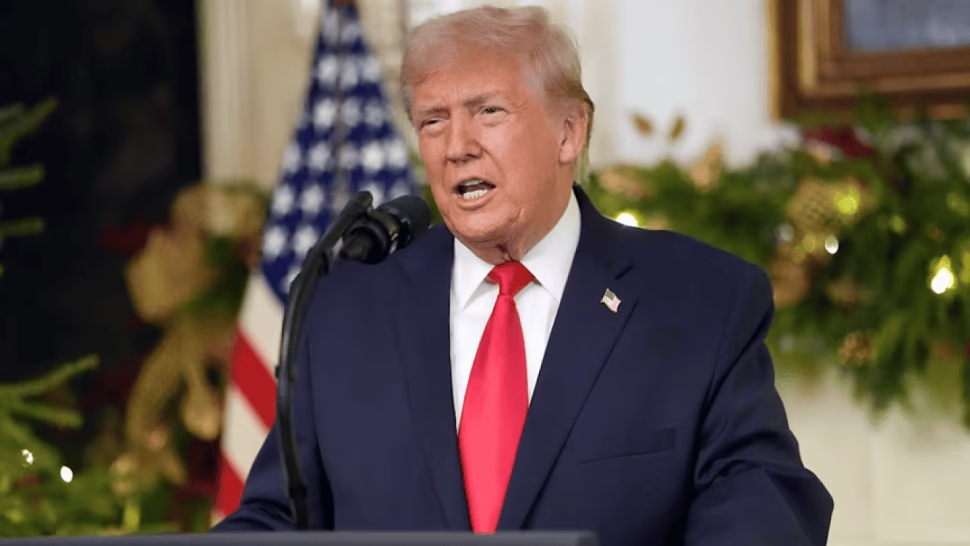
Trump’s security strategy declares the EU a civilization at risk

An official document from Washington adopts the rhetoric of Eurosceptic parties and projects a bleak future for the continent, generating a firm diplomatic response.

Analysis of the Trump Administration’s National Security Strategy

The recent National Security Strategy issued by the Trump Administration has generated a deep shock in European capitals, not only because of its unusually direct tone, but also because of its catastrophic diagnosis about the future of the continent. The official document, signed by the president, projects a scenario in which Europe could face “the disappearance of its civilization” within two decades. This statement, which lacks diplomatic nuances, explicitly aligns Washington’s position with the central narrative of the MAGA movement and various far-right political formations in Europe, representing an ideological interference without recent precedents.

The text identifies the European Union as an entity that erodes the national sovereignty of its member states. As the main causes of the supposed decline, he points out phenomena such as migratory flows, low birth rates and what he calls cultural “censorship” policies. By adopting these theses, typical of parties such as the AfD in Germany or Vox in Spain, the strategy transcends traditional geopolitical analysis to interfere in the internal European political debate. A particularly disturbing aspect is his call to explicitly support the forces he describes as “patriotic”, a euphemism for Eurosceptic movements whose stated objective is to dismantle or substantially weaken the continental integration project.

RelatedYuri relives five musical decades in Texas with his Icónica Tour

Strategic Repercussions and European Response

The institutional reaction in Europe has been one of firm rejection. The German Foreign Minister, Johann Wadephul, stated forcefully that the continent does not require external “advice” on its political trajectory. High-level sources within the community institutions interpret that the document treats Europe “as a rival”, fracturing decades of solid transatlantic cooperation. This stance confirms the strategic shift previously outlined by Vice PresidentJ.D. Vanceat the Munich Security Conference, where he presented a distorted and apocalyptic vision of European reality. The evident affinity of the White House with nationalist sectors and its rhetoric, which sometimes approaches the postulates of the Kremlin, intensifies the perception of a threat to the stability and autonomy of the bloc.

In the field of defense and the economy, the US strategy is equally disruptive. Washington demands from its European allies a substantial increase in military spending, while limiting the expansion of NATO and promoting an openly protectionist trade policy under the umbrella of the America First motto. The document distances itself from the agreed European position regarding the conflict in Ukraine and reinforces the image of a United States less committed to maintaining the liberal international order that it itself helped to establish after the Second World War.

The “Trump Corollary” and its Hemispheric Impact

The doctrine is not limited to the European theater. As far as Latin America is concerned, the document promises a restoration of the Monroe Doctrine, updated under a “Trump Corollary”. This formulation implies a return to an openly interventionist hemispheric vision, which breaks with the approaches of diplomacy and relative cooperation that characterized previous administrations. This shift has the potential to generate significant friction and strain relations with Latin American governments, who perceive this reformulation as a threat to their sovereignty and autonomy in foreign policy.

In conclusion, this National Security Strategy is not a mere foreign policy adjustment; constitutes a fundamental redefinition of the American posture toward its traditional allies. By framing the European Union as a civilization in decline and aligning its goals with disruptive political actors, the Trump administration is driving a reconfiguration of the global order that prioritizes unilateral national interest over multilateral alliances. The long-term implications for collective security, economic stability and geopolitical balance are profound and still unpredictable.

Do you agree with this analysis of the new axis of American foreign policy? Share this article on your social networks to expand the debate and explore more content related to geopolitics and international relations on our platform.
La Guaira: 72 hours of uncertainty after the earthquakes

The smell of decomposition and few rescue teams mark the area most devastated by the earthquakes.

Rescues in La Guaira: 72 hours of uncertainty

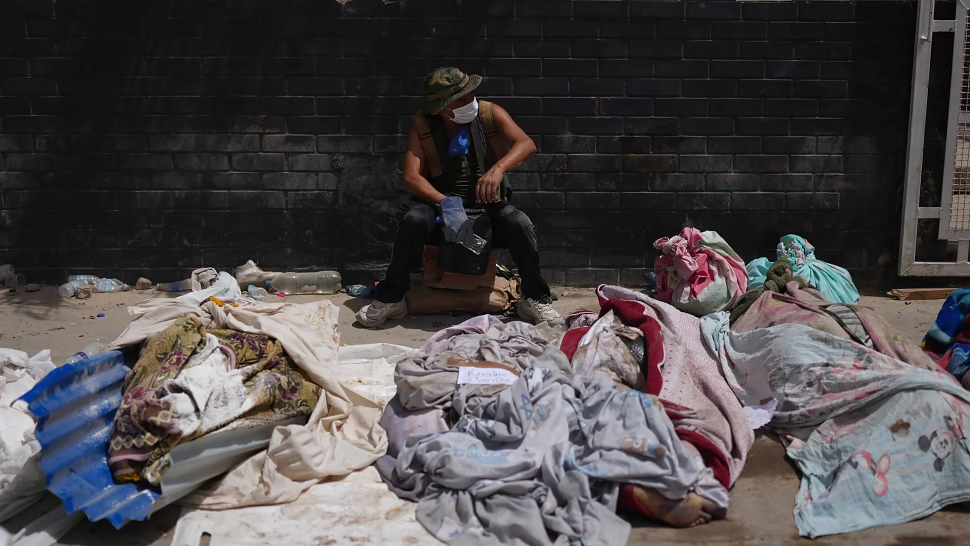
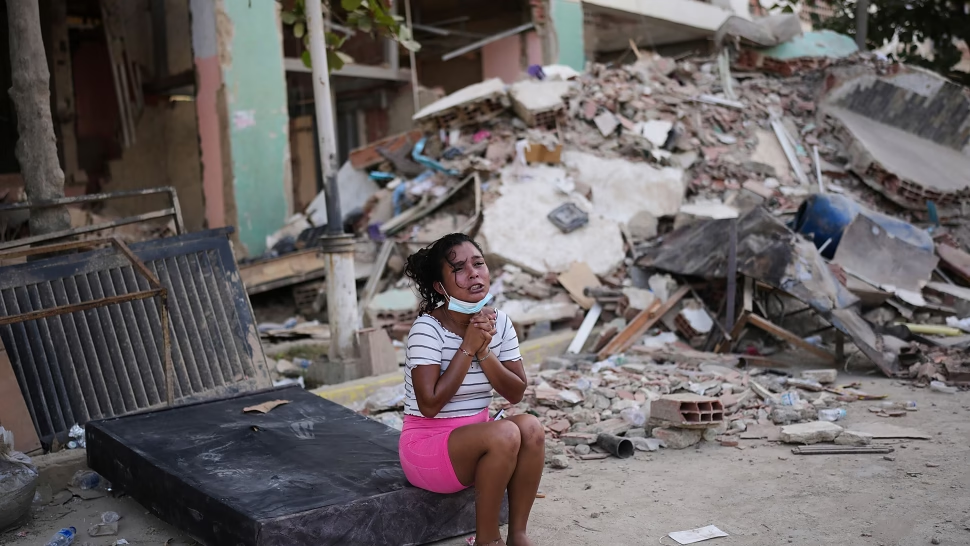
72 hours after the two earthquakes that shook northern Venezuela, the La Guaira area faces a humanitarian crisis. Activists from Provea, the country’s oldest human rights organization, report the smell of decomposition and few body recovery units.

“We smelled decomposition—a sign of unrecovered bodies under rubble—and there are also few body recovery units,” they told ANSA after a tour of the area.

The earthquakes, magnitude 7.2 and 7.5 according to the USGS, occurred consecutively. The epicenter was located in Yaracuy, 300 km from Caracas, but La Guaira, just 30 km from the capital, suffered the greatest structural impact. The UN, through Tom Fletcher, estimated that more than 50,000 people were missing.

Journalist León Hernández, present on Friday, described the magnitude of the tragedy:

“I was there… there are really thousands. This Friday night the key 72 hours for rescues were completed. In many collapsed buildings, it has been only civil servants and in many cases volunteers in charge of continuing to rescue people.”

He added that thousands of victims were left in makeshift shelters or on the streets for fear of aftershocks. Temperatures reach 40 degrees Celsius, combining debris and unrecovered bodies, creating a growing health risk.

Interim President Delcy Rodríguez reported damage in seven states, but the tragedy is concentrated in La Guaira. The government announced the sending of machinery and closing access from Friday for order and security. However, activists question the insufficient response in the first critical hours.

The families demand transparency in the figures, dignified access to the bodies and a state response in line with the catastrophe. The search efforts continue, but the slowness and scarce official presence mark the panorama in this coastal region.

Continue reading

920 dead and criticism for delay in rescues in Venezuela

International rescuers arrive in Venezuela while families dig with their hands.

The toll of the earthquakes of magnitude 7.5 and 7.2 that shook northern Venezuela on Wednesday amounted to 920 deaths and 3,360 injuries this Saturday. Search efforts continue among collapsed buildings, while complaints grow about the slowness in the arrival of rescue teams.

Among the victims is the Italian Francesca Mannina, whose body was identified after she had been missing for two days. His partner was rescued alive the day before.

Criticism points to the initial response of the authorities. Opposition leaders, led by Juan Pablo Guanipa, denounced the lack of heavy machinery and specialized equipment to free trapped people, especially in La Guaira. “We have people alive under the rubble and we need heavy machinery,” said a resident of Catia La Mar in a video broadcast on the networks. Witnesses pointed out that for hours the inhabitants themselves dug with their hands.

Faced with the emergency, the United States deployed one of the largest international assistance operations. More than 250 rescuers — firefighters, doctors, engineers, urban search specialists and 18 trained dogs — were dispatched. The operation includes two military ships, aircraft and a humanitarian aid package for 150 million dollars. Major General Kevin Jarrard arrived in Caracas to coordinate logistics with the Simón Bolívar airport as the main center.

An Italian civil protection mission also arrived.

The health emergency is worsening in Caracas. Hospitals such as Pérez Carreño and Domingo Luciani are working at their limit after receiving hundreds of injured people from La Guaira. Doctors report shortages of supplies and depend on volunteers to maintain care.

The aftershocks continue. Funvisis reported this Saturday a 4.9 magnitude earthquake north of Maracay, also felt in Caracas, La Guaira, Miranda and Carabobo. Since the main earthquake, at least thirteen minor movements have been recorded.

In the midst of the crisis, teams from El Salvador rescued alive, after more than 50 hours, a 15-year-old teenager with her dog, trapped on the ninth floor of a collapsed building in Playa Grande. Hours earlier, the same rescuers saved another woman who had been under the rubble for two days.

Venezuelan sport suffered a loss: the Venezuelan Football Federation confirmed the death of midfielder Yimvert Berroterán, 18, a member of the U-20 team and the Central University of Venezuela, who had remained missing since the collapse of several buildings in La Guaira.

While the search efforts continue, the government of Interim President Delcy Rodríguez restricted access to the most affected areas. The opposition maintains that this measure hinders the arrival of aid and humanitarian work.

Continue reading

Trump issues tariff ultimatum to Europe over digital tax

Trump threatens a 100% tariff on European countries that tax digital services from American technology companies.

Trump’s new trade threat to Europe

Donald Trump warned this Friday that he will impose a 100% tariff on all goods imported from any European country that moves forward with a tax on digital services aimed at US technology companies.

The message, published on its Truth Social network, increases the pressure in the trade dispute with the European Union.

“Numerous European countries are discussing the imminent introduction of a digital services tax against American companies. Anyone who imposes such a tax will immediately see a 100% tariff applied to all goods exported to the United States,” Trump wrote.

The president added that this tax “will prevail over any trade agreement” reached with the country in question. The measure would come into force “with immediate effect” if any of those governments go ahead with the tax.

The threat targets nations such as France, Italy or Spain, which already evaluate or apply taxes to digital services from giants such as Google, Meta, Amazon or Apple. The issue had been left out of the recent bilateral trade agreement that reduced other tariffs. Now, it reemerges as a new focus of transatlantic tension.

Continue reading