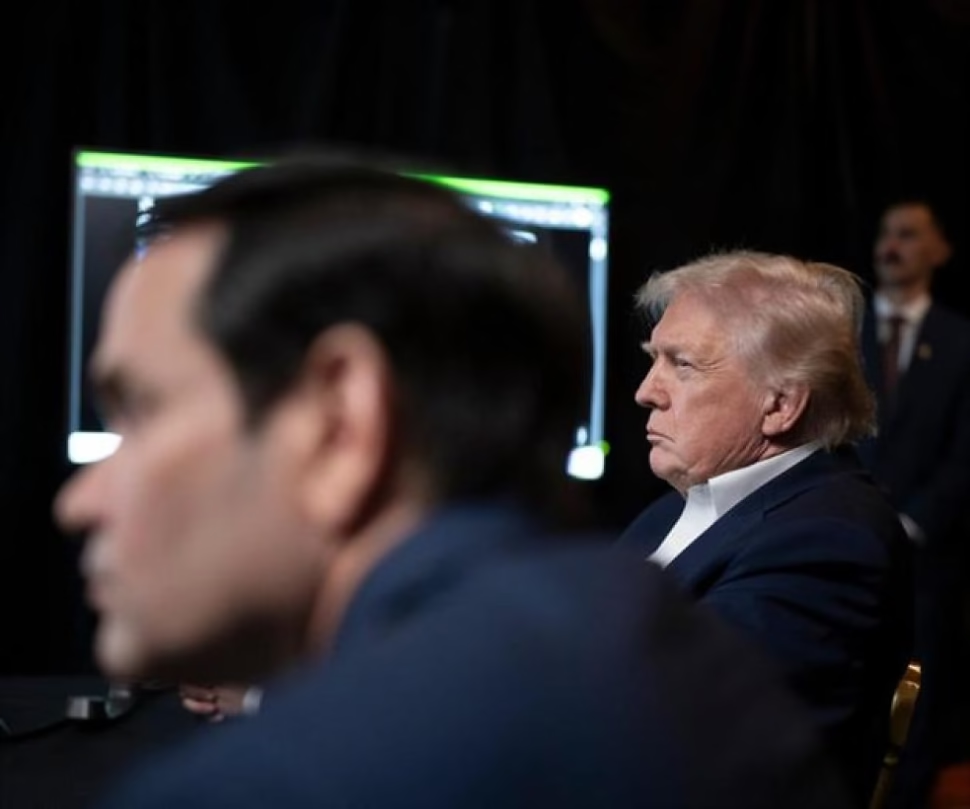
Trump’s hemispheric strategy after the intervention in Venezuela

After the operation in Caracas, the US government expands its rhetoric of power towards allies and adversaries in the region, generating strategic uncertainty.

Analysis of the expansion of US foreign policy in the Western Hemisphere

In a move that has redefined the regional geopolitical landscape, the U.S. military intervention in Venezuela, culminating in the capture of Nicolás Maduro, has functioned as a catalyst for a more expansive and assertive foreign posture by the administration of President Donald Trump. This event, far from being an isolated episode, is part of a deliberate national security strategy that seeks to restore what the official document calls “American preeminence” in the Americas. The sequence of statements following the operation reveals a calculated pattern of pressure that extends its reach from the Arctic to the Caribbean, interrogating the limits of sovereignty and alliance between nations.

Greenland: a strategic objective in the reconfiguration of Arctic power

President Trump’s renewed insistence on the acquisition of the autonomous territory of Greenland, under Danish jurisdiction, transcends mere speculation to become a central component of his national security doctrine. The argument put forward is based on the perception of a strategic vulnerability: the presence of Russian and Chinese ships in Arctic waters. This narrative justifies, according to the White House’s view, a claim for control based on defense interests, dismissing the ability of Denmark, a historic NATO ally, to guarantee such security. The reaction of the Danish government, led by Prime Minister Mette Frederiksen, has been one of firm rejection, defending the territorial integrity of the kingdom and underlining the cooperation agreements already in place. The publication on social networks by a former Trump official, with a map of Greenland in American colors and the word “Soon“, only exacerbated diplomatic tensions and confirmed the seriousness with which this objective is approached, which does not rule out the use of force.

RelatedThe United States negotiates a direct agreement with Greenland in the face of European opposition

Warnings to Cuba and Colombia: the war on drugs as justification

At the same time, the administration has directed its attention towards two key nations in the Venezuelan orbit of influence: Cuba and Colombia. The statements of the Secretary of State, Marco Rubio, accusing the Cuban government of providing bodyguards and control of internal intelligence to Maduro, seek to establish a direct connection between the regime in Havana and the stability of the deposed Chavista government. Trump has predicted the imminent collapse of the Cuban economy, compounded by the loss of subsidized Venezuelan oil, in an attempt to accelerate regime change.

In the case of Colombia, the rhetoric focuses on the global drug trade. President Trump has personalized his warning against the leftist president Gustavo Petro, accusing him of facilitating the production and sale of cocaine. This narrative serves as a potential justification for future actions, after the United States included Colombia on a list of non-cooperative nations in the war on drugs and sanctioned its president. Trump’s evasive but suggestive response to the possibility of a military operation in Colombian territory—”Sounds good to me”—reinforces an environment of constant threat and foreign policy based on coercion.

In conclusion, meticulous analysis of these events reveals a coherent and phased strategy. The intervention in Venezuela was not an end, but a means to reaffirm a doctrine of unilateral power that reinterprets historical concepts such as the Monroe Doctrine and the Roosevelt Corollary for the 21st century. The pattern is clear: establish a precedent of force, then expand strategic demands to allies (Denmark/Greenland), and finally exert maximum pressure on adversary regimes (Cuba) and perceived non-aligned governments (Colombia). This approach, although effective in the short term, generates profound diplomatic instability and questions the foundations of international law and the sovereignty of states in the Western Hemisphere.

Do you consider that this power strategy permanently redefines relations in America? Share this analysis on your social networks to expand the discussion and explore more content on contemporary geopolitics on our site.

Double earthquake shakes Venezuela: more than 200 victims

Two consecutive earthquakes of magnitude 7.2 and 7.5 left 235 dead and thousands injured in northern Venezuela.

Venezuela faces emergency after double earthquake

Two powerful consecutive earthquakes shook northern Venezuela on Wednesday night, leaving at least 235 people dead and more than 4,300 injured, according to Health Minister Carlos Alvarado. The number could rise as rescue teams search for survivors in the rubble.

The United States Geological Survey (USGS) reported a first earthquake of magnitude 7.2 with an epicenter west of Morón, 170 kilometers from Caracas. Barely a minute later, a second magnitude 7.5 earthquake struck at a shallow depth, amplifying the destruction. The combination of surface movements intensified the damage, explained geophysicist Marcos Ferreira.

“It’s like I’m screaming and then someone starts screaming too. That amplifies the vibration and increases the potential danger,” Ferreira said.

The coastal region of La Guaira, north of Caracas, suffered the worst damage. The country’s main airport closed due to damage, complicating the arrival of aid. Residents like Dayana Delgado, a mother of three, asked about heavy machinery that the government had promised. Neighbors dug with their own hands.

“I would like to know where my child is, if he is trapped there or is he hanging around in a shelter,” she said about her 8-year-old son, who is still missing.

The president in charge, Delcy Rodríguez, declared a state of emergency and announced a reconstruction fund of 200 million dollars. He requested heavy machinery from private companies for rescue efforts. Teams from the Dominican Republic were already arriving, and more international help was expected.

The United States, through Secretary of State Marco Rubio, offered search teams, medical resources and logistical assistance. The Treasury Department temporarily waived sanctions until Oct. 23 to facilitate aid transactions. Governments of Mexico, Brazil, Spain, Qatar and others also promised shipments.

In Caracas, hundreds of people spent the night in open spaces for fear of aftershocks. Classes were suspended and some school buildings were converted into shelters. Electricity and cell service failed in several areas. Families began publishing lists of the missing while rescuers continued their work.

Continue reading

France intercepts new ship from the Russian network that evades sanctions

France intercepts another oil tanker linked to the Russian network that evades sanctions in the Mediterranean.

The French Navy intercepted the Cameroonian-flagged oil tanker Deliver off the coast of Sicily on Tuesday. The vessel would be part of the fleet of unregistered vessels that Moscow uses to circumvent international restrictions on its crude oil exports.

“The French Navy carried out an inspection with boarding on the oil tanker Deliver while it was transiting in violation of international maritime law,” President Emmanuel Macron reported on his social networks.

Inspections on the rise

Since September, France has carried out four inspections of ships suspected of belonging to this network. The United Kingdom did the same in June with the oil tanker Smyrtos in the English Channel. Paris and London are leading a stricter application of European sanctions that Russia has until now managed to evade with relative ease.

This Friday, representatives of the 27 EU member states will analyze the twenty-first package of sanctions. Among the proposed measures are maintaining the cap on the price of Russian crude oil, expanding the list of vessels banned from European ports and restricting imports of Russian fishing products.

There is less consensus on prohibiting entry to Russian veterans who have fought in Ukraine. Italy and France expressed reservations about the difficulty of identifying them without generating a general ban on Russian citizens.

At the same time, Ukraine intensified its operations in Russian territory. kyiv claimed to have attacked two refineries in Ufa, 1,500 kilometers from the front. “We are implementing our long-range sanctions plan,” declared Volodymyr Zelensky before authorizing a 40-day operation led by the Ukrainian security services.

The Ukrainian president also obtained the first 3 billion euros of a 90 billion European loan. “It is clear that it is Russia that prolongs the war and ignores all diplomatic proposals,” Zelensky said in conversation with Ursula von der Leyen.

Continue reading

Evacuation paused in the Strait of Hormuz after attack on ship

UN suspends maritime rescue plan after shooting at ship in the Persian Gulf.

The International Maritime Organization (IMO), a UN agency, paused the evacuation of ships stranded in the Strait of Hormuz. The decision was made after the British military reported that a ship was hit by a shell off the coast of Oman.

The Secretary General of the IMO, Arsenio Domínguez, explained that the plan will be suspended until security guarantees are confirmed. The attacked ship was not part of the evacuation effort.

Warnings from Iran and new routes

Hours before the attack, Iran threatened to prohibit passage through the strait without permission from Tehran. The new Persian Gulf Strait Authority, created by the Iranian government, warned in X that transit outside its designated routes “will not be covered by the guarantee of safe passage.”

The United Kingdom’s Maritime Trade Operations center indicated that the ship suffered damage, but with no casualties or environmental impact.

Opening an alternative passage would ease pressure on the global economy and reduce Iran’s influence in peace negotiations. The US Secretary of State, Marco Rubio, assured during a visit to the Persian Gulf that Washington is committed to the new route.

“If that stops, then we’re going to have a problem,” Rubio said.

The price of oil briefly fell below $73 a barrel, a sign that the market is seeing improvement.

Negotiations and regional tensions

The United States and Iran are discussing the terms of a provisional peace agreement, with a period of 60 days to define details such as the passage of ships and the future of Iranian enriched uranium.

Meanwhile, the escalation of fighting in Lebanon threatens the truce. The Lebanese Ministry of Health reported five deaths from Israeli attacks in the last two days. Hezbollah called the actions violations of the ceasefire, but has not responded.

The Israeli army confirmed the death of a reservist soldier and another wounded in southern Lebanon.

Maritime transit in figures

Despite the incident, more ships are crossing the strait, although far below pre-war levels. Shipping company Maersk managed to remove its container ship Maersk Baltimore and another ship on Thursday.

According to Lloyd’s List Intelligence, 125 vessels crossed last week, up from 33 the week before. S&P Global reported 78 transits on Wednesday, the highest number since the conflict began, but still far from the daily average of 130.

Iran considers the new route “unacceptable and completely dangerous.” The naval arm of the Revolutionary Guard warned that “action will be taken against violators.” On Wednesday, they threatened an oil tanker by radio: “they are within range of my missiles,” according to the security firm Ambrey.

Rubio met with Gulf Cooperation Council ministers to ensure their interests will be protected. Bahraini Foreign Minister Abdullatif bin Rashid al-Zayani said the deal brings hope, but it is “critical that Iran fulfills its obligations.”

Continue reading