Trump announces blockade and toll in the Strait of Hormuz

Trump reestablishes blockade in Hormuz and proposes charging ships for safe passage. Iran rejects and warns of retaliation.

Trump announces blockade and toll in the Strait of Hormuz

US President Donald Trump announced that his government will reestablish a blockade on Iran in the Strait of Hormuz. It also plans to charge foreign ships 20% of the value of the cargo for safe passage. This is a change in the position of Washington, which previously defended free navigation without tolls on this key route for the global hydrocarbon trade.

Trump assured on social networks that the United States will guarantee security in the strait and will recover the costs through this charge. Iran rejected the proposal. It maintains that it has the right to manage traffic under the interim peace agreement signed last month. He warned that he will respond to any US interference.

RelatedHormuz: Trump assures it is open, Iran closes it

The announcement occurs amid a military escalation. The US military bombed dozens of Iranian targets – air defense systems, radars, missiles, drones and naval facilities – in response to an Iranian attack on a container ship. Tehran reported bombings in several provinces and confirmed at least two people dead.

The tension spread to neighboring countries. Bahrain activated missile alerts. Kuwait reported attacks on border facilities and an oil platform. Jordan reported that it intercepted four Iranian missiles. There were also actions with drones in Iraqi Kurdistan, without a group claiming responsibility so far.

The International Maritime Organization reiterated that there is no legal basis for imposing mandatory tolls in an international strait. Meanwhile, diplomatic efforts led by Qatar, Egypt and Pakistan continue to avoid a full-scale war.

Iran blamed the United States for the deterioration of regional security. He announced that he will not allow inspections by the International Atomic Energy Agency at previously bombed nuclear facilities.
Houthis impose maritime embargo on Saudi Arabia in regional escalation

The Houthis announce a naval blockade against Saudi Arabia, threatening a key global trade route.

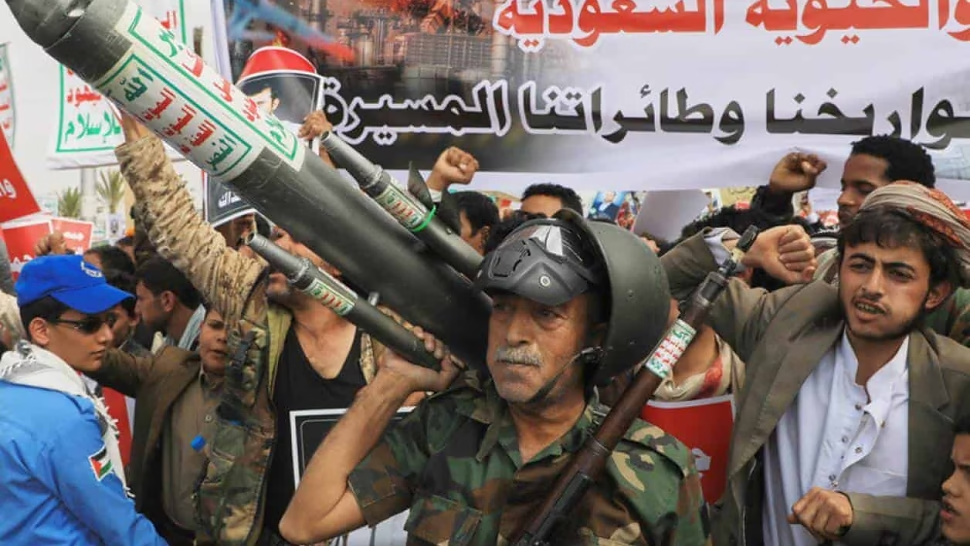
Yemen’s Houthi insurgents announced a maritime embargo against Saudi Arabia on Monday in retaliation for the kingdom’s blockade of Yemen and a recent attack on Sana’a international airport. The move threatens one of the most vital waterways for global transportation and reignites fears of renewed conflict.

The reasons behind the announcement

Yahya Saree, a Houthi military spokesman, said in a video that the naval blockade takes effect immediately, in what he described as a “tit-for-tat equation.” Nasruddin Amer, deputy director of the Houthi media office, said on social network

Bab al-Mandeb, at the southern tip of the Arabian Peninsula, is the gateway to the Red Sea. 12% of world trade and a quarter of global container trade transit to and from the Suez Canal.

The Saudi response and the impact on oil

The Saudi army assured that it will keep the waterway open. Military spokesman Turki al-Malki stated: “All Houthi threats against transiting vessels will be addressed firmly and expeditiously, as these types of threats are a flagrant violation of international law and fall into the category of acts of maritime piracy.”

Saudi Arabia was already facing pressure by using its East-West pipeline to the Red Sea as an alternative to the Strait of Hormuz, controlled by Iran since the February 28 attack. Rystad Energy estimates that about 2.5 million barrels of oil a day could be at risk.

The Houthis demonstrated their ability to disrupt shipping by attacking more than 100 vessels during the war between Israel and Hamas. It remains unclear whether they will resume that level of attacks against Saudi Arabia.

The truce reached in 2022 has been threatened after the Saudi attack on Sana’a airport, according to the Houthis, and the subsequent launch of missiles and drones against Abha airport. By allowing an international flight without Saudi approval, the Houthis seek to impose their control over Yemeni airspace.

Saree insisted: “We reaffirm the right of our great people to respond to the blockade with a blockade,” and warned that they are prepared for a “comprehensive and decisive escalation” against the “reckless Saudi enemy.”

Disrupting transit through Bab al-Mandeb would force shipping companies to go around the Cape of Good Hope, increasing costs significantly. The United States government has indicated that this route would add about 4,345 kilometers to the trip from Saudi Arabia.

Continue reading

Putin receives North Korean foreign minister and praises support in conflict

Putin thanks Pyongyang for its support in the conflict with Ukraine; possible new summit with Kim Jong Un.

Putin and Choe Son Hui: high-level diplomacy

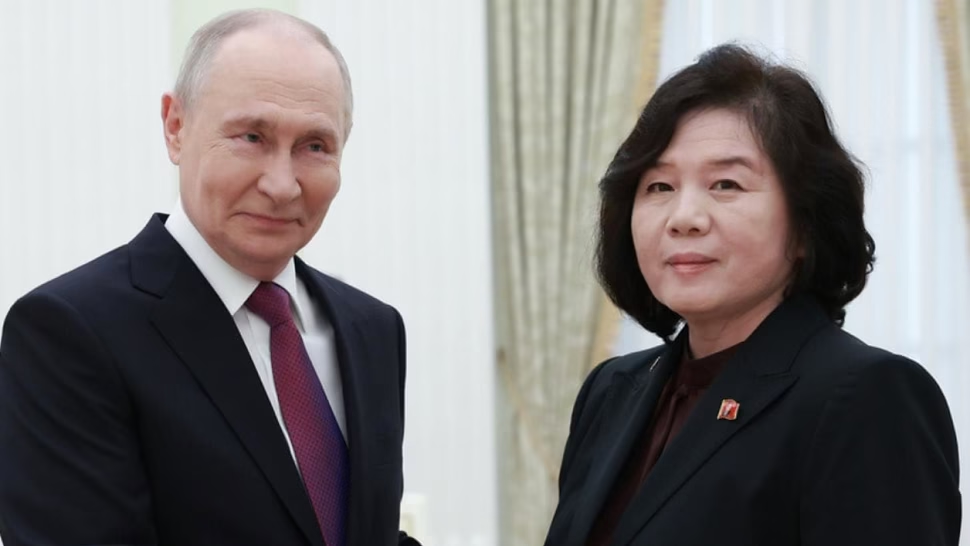
Russian President Vladimir Putin received North Korean Foreign Minister Choe Son Hui this Sunday in the Kremlin. During the meeting, Putin thanked Pyongyang for its support in military operations against Ukraine, according to the state agency Tass.

Choe’s visit occurs for no obvious reason, such as a multilateral summit or an anniversary. This has sparked speculation about a possible new meeting between Putin and North Korean leader Kim Jong Un. North Korean media confirmed that Choe traveled to Russia at the invitation of his counterpart Sergei Lavrov, but did not mention an eventual meeting between the two leaders.

Bilateral talks and mutual support

On Monday, Choe and Lavrov held separate talks. Russia expressed full support for North Korea’s efforts to protect its sovereignty, while Pyongyang reaffirmed its support for Russia in the Ukrainian conflict, the Korean Central News Agency reported.

Putin praised bilateral relations and reiterated his gratitude to the North Korean leadership for supporting his military operations. Choe conveyed that Kim Jong Un remains committed to comprehensively developing ties with Russia.

Cooperation background

Kim visited the Russian Far East for summits with Putin in 2019 and 2023. Last June, during the summit in Pyongyang, the two signed a strategic partnership agreement that promises mutual aid in the face of external aggression.

In recent years, North Korea has prioritized Russia in its foreign policy, sending thousands of soldiers and large supplies of military hardware to support Moscow in Ukraine. In exchange, Pyongyang receives economic assistance and technological transfers that, according to analysts, strengthen its military capabilities.

Kim has also sought to reach out to China, with recent high-level meetings, while promoting the idea of ​​a new Cold War as a united front against the United States.

Impact on the region

Choe’s visit follows diplomatic exchanges between North Korea and China, including meetings between North Korean Premier Pak Thae Song and President Xi Jinping, and senior Chinese official Wang Huning with Kim in Pyongyang.

Kim has suspended all meaningful dialogue with Washington and Seoul since 2019. He is taking advantage of the distraction of the conflict in Ukraine to accelerate his nuclear and missile program, while demanding that the US abandon disarmament demands as a precondition for resuming negotiations.

Continue reading

Petro calls his successor ‘servant’ of the United States

Petro describes his successor as an ally of Washington and warns of mobilizations.

Petro’s last speech: accusations and warnings

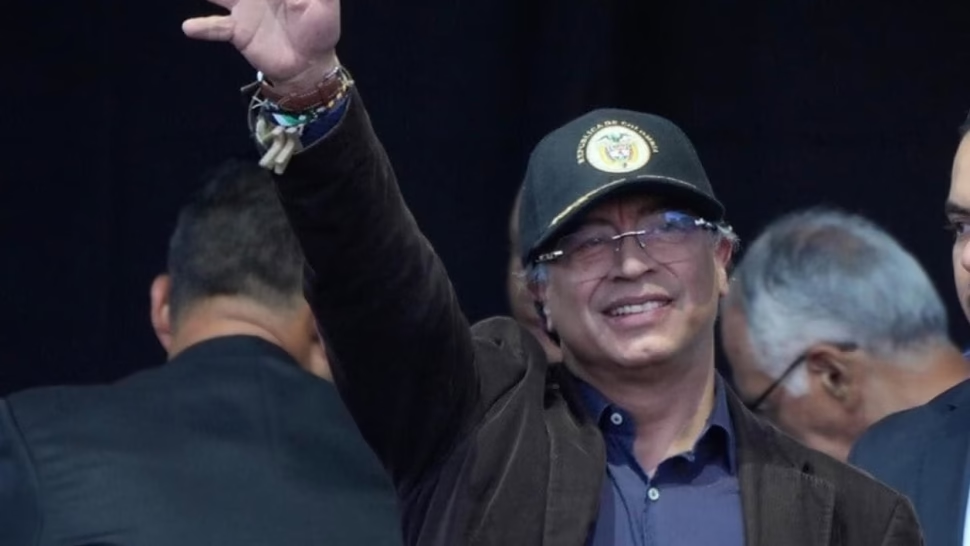
Gustavo Petro delivered his last message as president of Colombia before thousands of followers in the south of Bogotá, during the commemoration of Independence Day. There he described his successor, Abelardo de la Espriella, as a “servant” of the United States.

“The next president of Colombia will be a servant of the rulers of the United States who helped him, in quotes, to elect; then we went from the status of Republic to the status of viceroyalty again,” he stated.

Petro assured that there was “fraud” in the second round of elections and that he will present evidence. He argued that Donald Trump ordered his Secretary of State, Marco Rubio, to take charge of Colombia, and that Rubio acted as a personal friend of De la Espriella.

The response of the president-elect

Hours before, De la Espriella led the patriotic events in Medellín. There he paid tribute to soldiers and police, and stated that the people of Antioquia “decided to defeat tyranny to defend democracy.”

Petro compared the current moment with the independence of Spain in 1810. He said that it was time to give “the second cry for independence” and called for breaking a vase, alluding to the historical episode that triggered the separation of Spanish rule.

The outgoing president warned that if the next government tries to eliminate social reforms from its mandate, it will call for a national strike and protests. He also threatened to break political alliances: no party that votes for De la Espriella’s candidate to preside over the Senate will have support in the 2027 regional elections.

“No ally who votes for fascism in the Senate will have support from the popular force,” said Petro, who will take over as head of the opposition.

Continue reading