Trump issues naval ultimatum to Iran in the Strait of Hormuz

Trump orders to fire on Iranian boats that lay mines in the Strait of Hormuz.

Red-hot tension in the Strait of Hormuz

US President Donald Trump on Thursday ordered his military to “shoot and kill” small Iranian vessels deploying mines in the Strait of Hormuz, he said. This comes a day after Iran once again showed its ability to thwart traffic through the canal.

“I have ordered the US Navy to shoot and kill any vessel, no matter how small… that is laying mines in the waters of the Strait of Hormuz,” Trump posted, adding that US minesweepers “are clearing the strait right now.” “I hereby order that this activity continue, but threefold!” he added.

RelatedIran closes the Strait of Hormuz again and attacks ships

Seizure and retaliation

The publication came shortly after the US military seized another oil tanker linked to Iranian oil smuggling. Images from the Department of Defense show US forces on the deck of the Guinea-flagged oil tanker Majestic X, seized in the Indian Ocean.

This occurred a day after Iran’s Revolutionary Guard attacked three cargo ships in the strait, capturing two. The head of Iran’s judiciary, Gholam Hossein Mohseni Ejei, called the vessels “infringers” and said: “The show of force… is a source of pride.” He claimed that the Americans “do not have the courage” to approach the strait.

Stalled negotiations

Trump also announced an extension of the ceasefire in Lebanon for three weeks. Meanwhile, negotiations between the US and Iran in Pakistan fell through. Iran demands end to port blockade; Washington insists on reopening the strait to international traffic.

Pope Leo XIV called on the United States and Iran to return to the negotiating table and end the war.

Maritime tracking data places the Majestic X between Sri Lanka and Indonesia, heading to Zhoushan, China. In times of peace, 20% of the world’s crude oil and natural gas passes through this canal.

Sheinbaum receives Felipe VI at the National Palace on June 25

Sheinbaum will meet with King Felipe VI amid previous diplomatic tensions.

Bilateral meeting at the National Palace

President Claudia Sheinbaum confirmed that next Thursday, June 25, she will meet with King Felipe VI of Spain. The event is scheduled for 4:00 p.m. at the National Palace, taking advantage of the monarch’s visit to Mexico for the 2026 World Cup. The following Friday, the king will attend the Spain-Uruguay match in Guadalajara.

The meeting occurs after years of diplomatic tensions. During the six-year term of Andrés Manuel López Obrador, the relationship cooled due to the demand for a public apology for the grievances of the Conquest. This generated distance with the Royal House and the Spanish government.

Approach signs

With the new government, efforts have been made to maintain institutional dialogue. Sheinbaum had already taken steps in that direction: at the end of April he carried out official activities in Barcelona and expressed his willingness to build a relationship based on mutual respect.

The meeting with Felipe VI reinforces that line. Both leaders will address issues of common interest, without a specific agenda having been leaked. The meeting is seen as a gesture of diplomatic normalization between both nations.

Continue reading

Vance reports progress in negotiations with Iran in Switzerland

Progress in dialogue between Washington and Tehran due to crisis in the Middle East.

Diplomatic advances in Switzerland

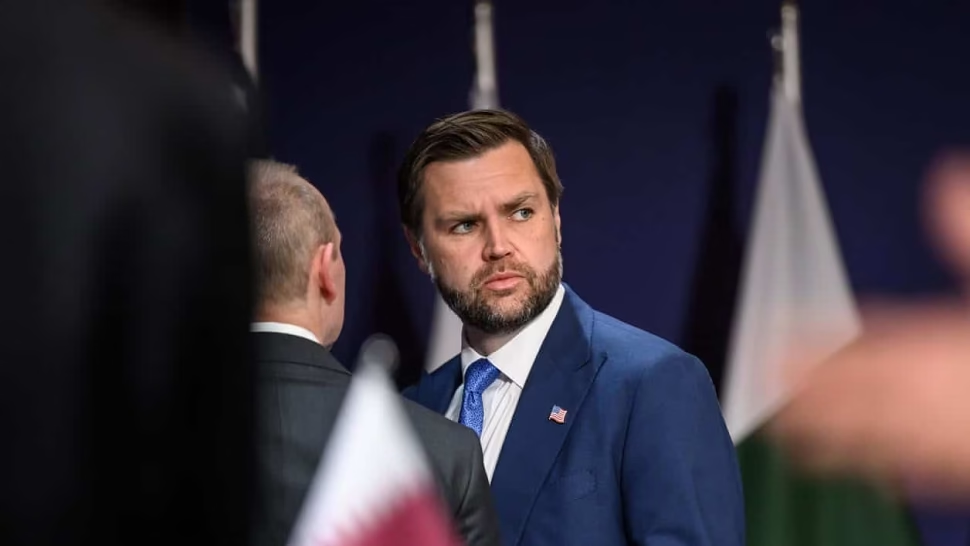
The Vice President of the United States, JD Vance, affirmed that the talks with Iranian representatives in the Bürgenstock complex, Switzerland, achieved relevant progress. According to Vance, the foundations were laid for an agreement that would reduce tensions in the Middle East.

During the meeting – which also included mediators from Pakistan and Qatar – two key issues were addressed: the reopening of the Strait of Hormuz and the conflict between Israel and Hezbollah in southern Lebanon.

The Strait of Hormuz, a strategic route for global oil transportation, had been closed by Iran after attacks by the United States and Israel. This skyrocketed international fuel prices. Although some ships have resumed transit, the main route still faces safety risks.

As part of the process, the US Treasury Department issued a temporary license allowing exceptions to sanctions related to Iranian oil. Technical talks will continue over the next 60 days.

The mediators indicated that there was progress in maintaining a ceasefire in Lebanon, but differences persist over the Iranian nuclear program and other key points of the agreement that Washington and Tehran seek to finalize.

Continue reading

Leo XIV criticizes the ease of financing wars and not hunger

The pontiff warned about the drop in financing for food assistance from 2022.

Call from the pontiff in the face of the food crisis

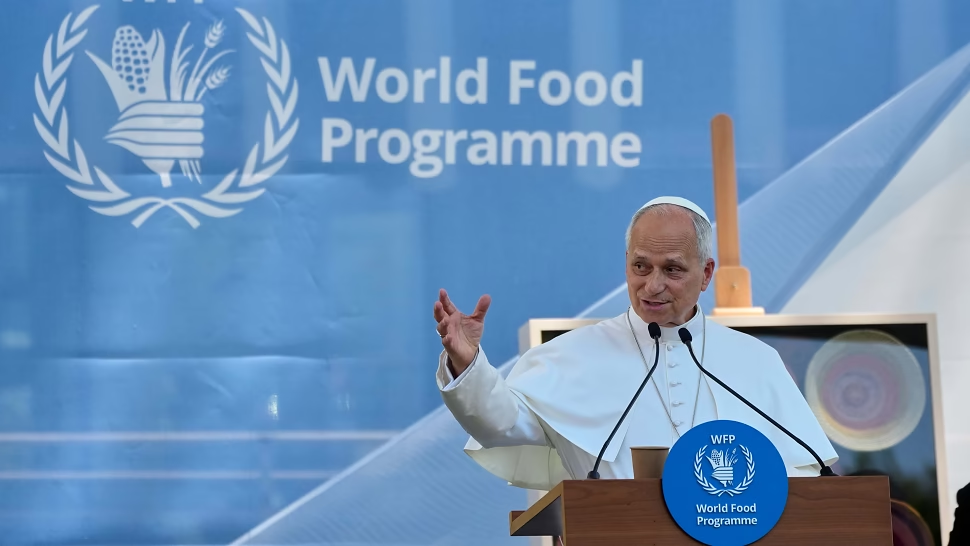
Pope Leo XIV urged governments to allocate more resources to combat hunger. During a meeting in Rome with the UN World Food Program (WFP), he pointed out that it is easier to finance armed conflicts than to guarantee food for millions of people in vulnerable situations.

The pontiff warned that political and administrative obstacles delay humanitarian aid. In contrast, military spending is advancing with fewer obstacles. This paradox reflects a serious inequality in global priorities.

Leo XIV indicated that funding for food assistance has decreased considerably since 2022. Although needs increased due to conflicts, climate crises and economic problems, funds did not grow at the same pace.

He highlighted that recent international contributions, such as the one announced by the United States for the WFP, will benefit millions of people. However, he stressed that there is still a significant gap to cover the necessary resources.

Before the UN body, the pope called on world leaders to place human dignity at the center of their decisions. Strengthening international cooperation is key to confronting hunger and inequality.

Continue reading