Trump accelerates new tariff strategy after court ruling

The White House seeks to replace global tariffs by July 24.

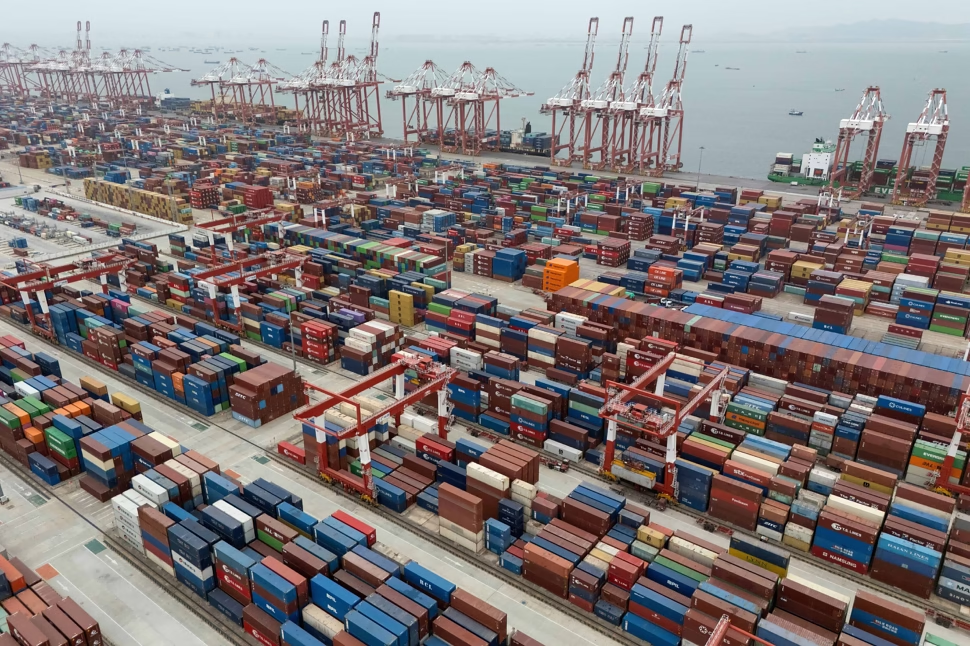
Donald Trump’s government is accelerating a new strategy to maintain tariff revenue. The Supreme Court in February invalidated the broader levies imposed under the International Emergency Economic Powers Act (IEEPA). The decision forced the Treasury to refund billions to importers.

After the ruling, the administration turned to Section 122 of the Trade Act of 1974. This rule allows global tariffs of 10%, but only for 150 days. The deadline expires on July 24. For this reason, the White House is seeking more permanent measures under Section 301, which authorizes sanctions against countries with unfair practices.

RelatedFederal court allows Trump to keep tariffs in place during appeal

International trade specialists believe that the government will manage to implement the new tariffs before the deadline. Trump has already announced 25% tariffs on imports from Brazil. In addition, it maintains investigations into the trade practices of dozens of countries to justify new taxes under the current legal framework.

Revenue from tariffs reached a maximum of $31 billion last October. But they fell after the Court’s resolution. A slight deficit was recorded in May. In June, losses amounted to $25.6 billion, because refunds exceeded the collection of levies still in force.

Section 301 offers a stronger legal basis. However, analysts warn that establishing universal tariffs with this standard could face new legal challenges. Uncertainty over US trade policy continues to cause concern among companies and investors. They expect greater clarity on international trade rules in the coming months.


Charges against 11 for migrant smuggling with 7 dead in Texas

Eleven people face charges in the US for migrant smuggling. Seven died in a container in Texas.

The United States Federal Prosecutor’s Office filed charges against 11 people for their alleged participation in a migrant smuggling network. The case is linked to the death of seven people who were traveling hidden in a railway container in Texas.

The victims, originally from Honduras and Mexico, died in May due to high temperatures while being transported to the interior of the country.

Details of the tragedy

According to authorities, the group boarded a train in the border city of Del Río bound for San Antonio. The smugglers abandoned the container after one of the migrants fell while opening the door.

The next day, a Union Pacific employee discovered the bodies of six people inside the container at a Laredo rail yard. A seventh victim had been left next to the tracks.

The investigation determined that the container remained completely sealed, with no ventilation or cooling system. This caused the migrants to suffer heat stroke. Among the deceased was a 14-year-old teenager.

The prosecution detailed that one of the victims managed to communicate with his relatives while he was dying inside the container.

Actions of the authority

The 11 defendants face charges of conspiracy to transport foreigners and facilitating their transfer resulting in death. Crimes that could lead to life in prison.

Nine of the alleged perpetrators have already been arrested in different operations carried out in Texas. Two remain at large. Authorities reported that those involved include US citizens and permanent residents.

Continue reading

Spain declares national emergency due to forest fires

Spain declares national emergency due to fires. 20 thousand evacuated in the country and 60 thousand in France.

National emergency in Spain due to forest fires

This Friday, the government of Spain activated the declaration of national emergency due to the magnitude of the forest fires. The flames have forced the evacuation of approximately 20 thousand people, mainly in towns near Madrid.

The crisis also reaches the south of France. More than 60 thousand inhabitants have had to leave their homes due to the advance of the fire.

Pedro Sánchez, president of the Spanish government, described the situation as “dramatic” and expressed his solidarity with the affected families.

The declaration of emergency allows the Ministry of the Interior to coordinate response efforts in different autonomous communities. It is expected that in the next few hours air and ground resources will be reinforced to contain the fires.

The authorities recommend that the population stay informed and follow evacuation instructions. So far no deaths have been reported, although the material damage is significant.

Continue reading

Ukrainian drone attacks leave nine dead in Russia

Ukraine attacks logistics centers of the largest Russian retailer, leaving at least nine dead and dozens injured.

Drone attacks against logistics centers

Drone attacks launched by Ukraine against several fulfillment centers of Wildberries, Russia’s largest online retailer, caused large fires. At least nine people died and dozens were injured. The fires affected a significant part of the country’s commercial infrastructure.

Wildberries, founded in 2004 by entrepreneur Tatyana Kim, is Russia’s leading e-commerce platform. It has more than 200 logistics centers and concentrates more than 50% of the country’s online orders. The company also operates in Belarus, Kazakhstan and Crimea, a territory annexed by Russia in 2014, and works with hundreds of thousands of sellers.

These offensives are part of kyiv’s strategy to weaken the Russian economy and hinder the Kremlin’s war effort. The damage is still being assessed, but is expected to have repercussions on the local economy. The magnitude of the impact on Russian commercial infrastructure is significant.

Continue reading