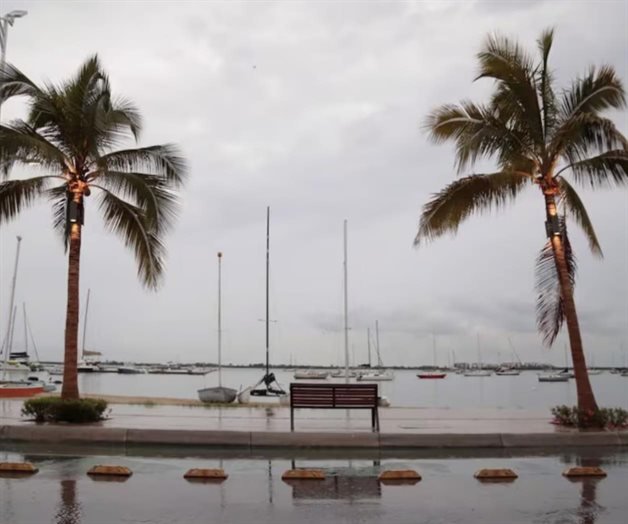
Tropical Storm Raymond threatens the Mexican Pacific coast

The meteor advances parallel to the coast, generating potential chaos with hurricane-force winds and dangerous waves for several states.

Raymond, the stormy guest that no one asked for

It seems that the Pacific Ocean decided that the rainy season was getting too boring and has sent us to Raymond, the tropical storm that walks off our coasts with the elegance of an elephant in a china shop. Meanwhile, poor Priscilla, her meteorological sister, discreetly dissipated to the north of Baja California, probably tired of so much competition for media attention. How convenient, right? One storm leaves to make room for another, like in an atmospheric reality show.

Rain, wind and coastal chaos: the destructive trio

The National Meteorological Service, those scientific fortune tellers who tell us what we are already feeling when the wind tears off our roof, announces with its usual optimism that Raymond will give us heavy rains in Jalisco, Colima, Michoacán and Guerrero. In case anyone had beach plans, know that the waves will reach heights worthy of a disaster movie: up to four meters. Perfect for surfing, except that it also includes wind gusts of 80 km/h that would probably send you flying to Oz.

RelatedTropical Storm Raymond advances off the Mexican coast

And what exactly is Raymond doing right now? According to experts (who have much more expensive radars than our umbrella), at 06:00 its center of circulation was 95 km southwest of Punta San Telmo, Michoacán. It is moving west-northwest at 22 km/h, speed enough to cause problems but not so fast that you cannot enjoy the landscape it is altering. It maintains maximum sustained winds of 95 km/h with gusts of 110 km/h, enough to ruin your hairstyle and probably your day.

Prevention and surveillance: when roles rule more than common sense

The National Water Commission, in its eternal coordination with the United States National Hurricane Center (because apparently we need international validation to confirm that it is raining a lot), has established two areas of special meteorological interest. On the one hand, a prevention zone that extends from Zihuatanejo, Guerrero, to Cabo Corrientes, Jalisco. Basically, an area where it is suggested not to plan picnics or beach days.

On the other hand, they maintain a surveillance zone for Baja California Sur, specifically from Los Barriles to Santa Fe. This translates as: “prepare, but not as much as the other states, because we are still not sure how much chaos Raymond will cause there.” It’s like when your mother tells you “be careful” without specifying exactly what, leaving you with the existential doubt of whether the danger is minimal or apocalyptic.

Meanwhile, on dry land, citizens respond to these alerts with traditional strategies: from those who tie their car with miraculous ropes to those who decide that it is the perfect time to test if their house is really waterproof. Social networks are already full of videos of streets turned into rivers and trees doing impressive tricks, because what better time for viral content than a natural disaster?

The most ironic thing is that, despite all this modern technology and early warning systems, we still react basically the same as our ancestors: looking at the sky with concern and rushing to buy candles and cans of tuna as if the apocalypse were a real possibility. Raymond probably doesn’t even know what a stir he’s causing, happy in his meteorological existence, spinning and moving as if he were the center of the universe. And perhaps, these days, it is.

So there we have it: another tropical cyclone named after a person that comes to remind us who really rules the planet. While meteorologists draw their maps with arrows and isobars, and authorities issue statements full of technicalities, the average citizen wonders if he should have bought that inflatable boat he saw on sale last week. Because in the end, among so much prediction and protocol, the only thing that is certain is that Raymond will pass, leaving his signature of destruction and rain, and we will continue here, drying out and telling anecdotes for the following generations.

Did you like this sarcastic tour of Raymond’s career?Share this article on your social networks so that more people can enjoy our peculiar meteorological approach and explore more content related to natural phenomena on our website. Because laughing at climate adversity is almost as therapeutic as having good home insurance.
Floods in Aguascalientes after intense overnight rains

Storm in Aguascalientes left vehicles stranded and families rescued. Authorities activated protocols.

Rains collapse roads in Aguascalientes

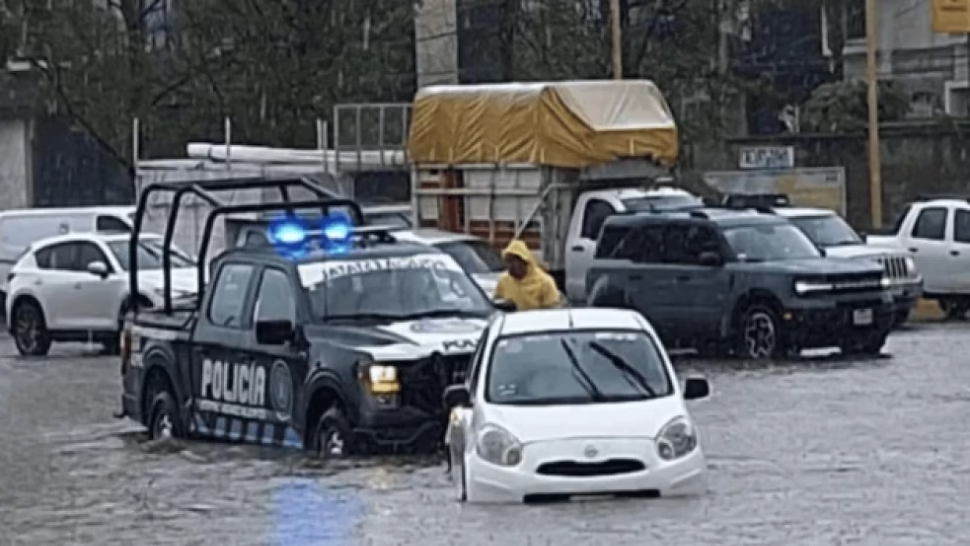
On Saturday night and early Sunday morning, intense rains affected Aguascalientes, Jesús María and Rincón de Romo. Boulevards and avenues were flooded, vehicles were covered in water and entire families were trapped.

Rescues and attention to the population

The greatest impact occurred in the capital. Firefighters and Civil Protection worked for hours to rescue people stranded in different parts of the metropolitan area. They provided assistance to occupants of cars stuck in neighborhoods such as Parques Industrial del Valle, San Francisco de los Romo, the first ring overpass and the exit to Zacatecas.

The overflowing of some channels concentrated the water in the avenues. The State Government reported that security corporations from several municipalities maintain a coordinated operation to provide timely support.

Recommendations and road closures

During the early morning, the authorities asked to avoid driving through flooded areas and to follow official information. The Municipal Public Security Secretariat detailed that the Road Police attended to 42 stranded vehicles and carried out 18 road closures to prevent risks to drivers and pedestrians.

Municipal agents moved entire families, women and minors who could not move due to the storm and flooding to their homes.

Continue reading

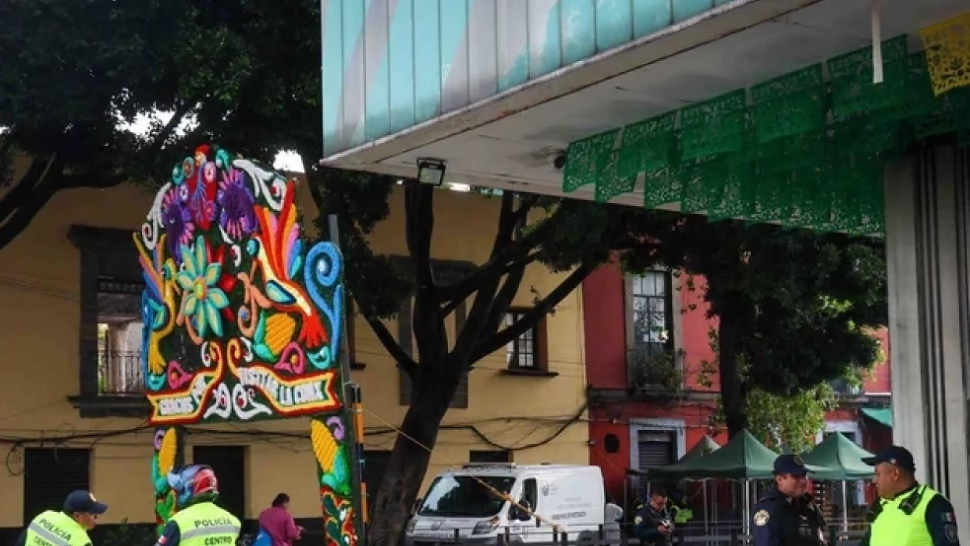
CNTE raises a sit-in after 20 days of protest in the Zócalo

The dissident teachers left losses of 410 million pesos and freed up spaces in the Historic Center.

End of the CNTE sit-in

The National Coordinator of Education Workers (CNTE) ended its national strike this Saturday. For 20 days, the mobilizations and the camp in the Historic Center of Mexico City generated losses of more than 410 million pesos to established businesses, according to sector estimates.

Although it did not achieve the repeal of the ISSSTE Law of 2007 or the repeal of the educational reform, the CNTE obtained commitments, financial resources, places, recategorizations and support for education workers in several states.

The leaders assured that the withdrawal is not a defeat. They advanced a stage of reorganization to strengthen the movement and prepare new actions. They insisted that the federal government did not present a proposal to eliminate the ISSSTE Law of 2007 or to reverse the educational reform, demands that will remain in force.

Starting this Monday, around 1.4 million students who remained without classes will be able to return to classrooms in the entities where the CNTE had suspended activities.

Space release

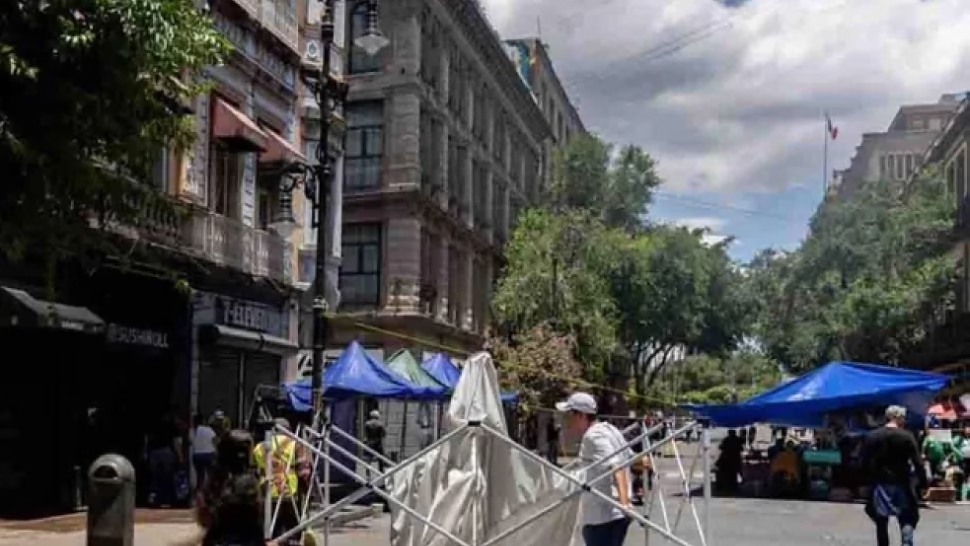
Public space has been gradually freed up. Cleaning workers from the Government of Mexico City removed garbage in streets such as 5 de Mayo, Belisario Domínguez, 20 de Noviembre and República de Cuba. In some areas, the withdrawal was almost total; In others there were still tarps and tents.

A teacher from section 34 of Zacatecas declared: > “We are going to clean it, don’t say that we are going to leave it dirty.”

Merchants expressed relief at the departure of the teaching profession. A worker at the La Blanca restaurant, on May 5, commented: > “It’s good that they’re leaving, it was a very hard month; here we had like a 90% drop in customers.”

A snow seller on the same street indicated that they expected higher sales with the FIFA Fan Fest in the Zócalo, but the arrival of the CNTE reduced their income by 50%.

For his part, the Secretary of Education, Mario Delgado, rejected that the government had “bribed” Section 22 of Oaxaca to hold the sit-in.

Continue reading

Five deaths in bars in CDMX during the early hours of the morning

Two attacks in bars in the capital leave five dead and six arrested.

The early morning left two violent episodes in different parts of the capital

A man lost his life from gunshots outside a bar located in Plaza Garibaldi, Cuauhtémoc mayor’s office. According to the Secretariat of Citizen Security (SSC), the victim was attacked directly in the Lázaro Cárdenas Central Axis and the Republic of Honduras. After the attack, he ran inside the establishment, where he died.

The suspects fled in a gray car, but later returned to the scene along with a blue truck and a subject on a scooter. Agents approached and, after a search, they found packages with one and a half kilos of marijuana and a firearm. They were arrested.

In another incident, an alleged fight inside a bar in the Álvaro Obregón mayor’s office left four people dead and two arrested. One of them was taken to a hospital injured.

Data from the SSC indicate that several people began arguing inside the establishment, in the San Bartolo Ameyalco neighborhood. One of the subjects pulled out a firearm and shot several people. The detainees were placed at the disposal of the authorities.

Continue reading