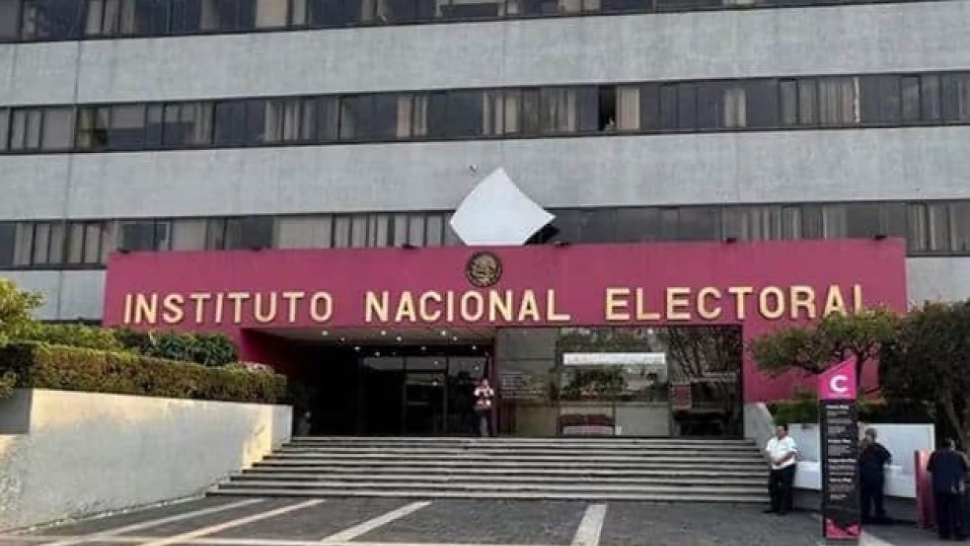
They seek to ensure that airlines do not cancel flights due to non-attendance on a section

Legislative proposal seeks to protect passengers who miss their first flight.

Initiative in San Lázaro against automatic cancellations

Federal deputy Rubén Moreira Valdez presented an initiative to modify the Civil Aviation Law. The proposal seeks to prevent airlines from automatically canceling return or connecting flights when a passenger does not board the first leg of an already paid itinerary.

The coordinator of the PRI bench explained that this practice affects thousands of users for reasons beyond their control: family emergencies, health problems, delays in other transportation or unexpected changes. Missing their initial flight, they discover that their remaining tickets have been cancelled.

“Currently the law allows airlines to cancel subsequent segments if the passenger does not inform within the first 24 hours that they will use the remaining flights,” Moreira Valdez said. “This condition is little known and forces many to buy new tickets at high prices.”

The proposal establishes that airlines must respect the validity of all contracted flights. They may only cancel a section when the passenger expressly states that they will no longer use it. This seeks to eliminate the burden that falls on travelers today.

RelatedMexican airlines abuse overbooking and leave passengers without compensation

The legislator assured that the reform would strengthen consumer rights and generate a more balanced relationship between passengers and airlines. It would also provide greater certainty and avoid additional expenses for a practice that, he considered, harms those who have already paid for the service.

The initiative was turned over to the Transportation Commission for analysis. If approved, airlines will have to adjust their cancellation policies.
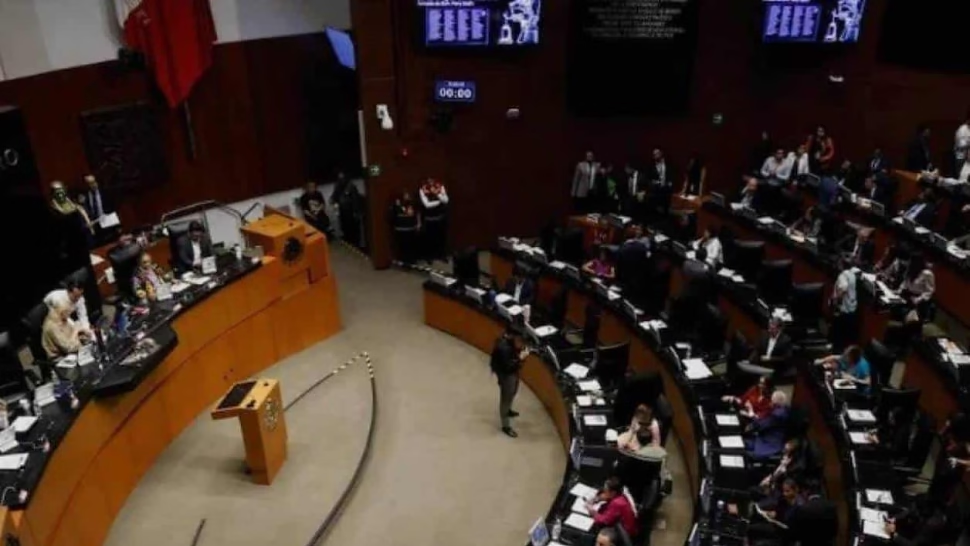

Senate promotes reform to strengthen the country’s municipalities

The Senate seeks to strengthen the capacities of more than 2,462 municipalities in security, infrastructure and development.

Municipal reform seeks to close historical gaps

The Senate of the Republic promotes an initiative to strengthen the more than 2,462 municipalities in the country. The objective: improve their capabilities in security, infrastructure and local development, sectors with historical lag in municipal governments.

Senator Mario Vázquez, president of the Municipal Development Commission, reported that on July 14 he will lead the discussion “The Strategic Role of Multi-stakeholder Cooperation as a Tool to Achieve the Sustainable Development of Mexico.” The event is aimed at municipal presidents from all over the country.

The meeting will bring together legislators, international organizations, cooperation agencies, academia, civil organizations and municipal authorities. They will seek mechanisms to access new sources of financing, training and collaboration in sustainable development projects.

Vázquez highlighted that municipalities are the level of government closest to citizens, which is why they require greater tools to respond to current challenges. He pointed out that international cooperation can be a way to strengthen public management, attract investments and raise the quality of life.

Among the confirmed participants are ECLAC, the Japan International Cooperation Agency (JICA), the Spanish Agency for International Development Cooperation (AECID), as well as representatives of the Chilean Embassy and various civil organizations.

The senator assured that the Commission will continue to promote initiatives that strengthen the autonomy, innovation and development of municipal governments.

Continue reading

Governor supervises search alert command post

The Secretary of the Interior supervises the operation center that operates 24/7 to locate people.

Command post supervision

The Secretary of the Interior, Rosa Icela Rodríguez, supervised the command post of the National Immediate Search Alert this Saturday. This mechanism seeks to expedite the location of missing or unlocated persons in the country. The center operates 24 hours a day, seven days a week.

During the visit to the Segob facilities, she was accompanied by Undersecretary Arturo Medina Padilla and representatives of the National Search Commission (CNB), the Attorney General’s Office (FGR), the Secretariat of Security and Citizen Protection (SSPC) and the National Guard.

The Alert began to operate last February with the entry into force of the National Protocol for the Activation of the National Search Alert. Its objective is to coordinate municipal, state and federal authorities for immediate searches.

The protocol establishes that, once a person is registered in the National Registry of Missing Persons, the search form is automatically sent to prosecutors’ offices, local commissions and other instances. The CNB administers the system, which disseminates tokens and coordinates with national and international institutions.

The authorities warned that improper use of the Alert could generate administrative or criminal liability.

Continue reading

INE prepares new inspection for 2027 elections

INE proposes greater controls on parties for the 2027 elections.

New INE controls

The General Council of the National Electoral Institute (INE) prepares an oversight proposal for the 2026-2027 process. It seeks to establish greater controls over political parties that have already started internal processes to define candidacies.

The measure aims to regulate activities of candidates that, although they are presented as internal exercises, could constitute anticipated campaign events. The electoral body demands more transparency about the resources used in meetings, assemblies and promotional events.

Until now, the only restriction in force for those seeking a candidacy is to avoid direct calls to vote in their favor, according to resolutions of the Superior Chamber of the TEPJF of 2023. But the INE considers it necessary to expand surveillance due to the early start of partisan activities towards the 2027 elections, where various positions will be renewed.

Obligations and sanctions

The proposal establishes that applicants must inform the institute of the origin and destination of the resources used during internal activities. The objective is to avoid irregular financing or undue advantages.

Those who fail to comply could face sanctions and even lose the right to participate as candidates, if it is proven that they used resources without reporting them. With these measures, the INE seeks to guarantee equitable conditions between the parties and strengthen transparency before the formal start of the campaigns.

Continue reading