Senate promotes reform to strengthen the country’s municipalities

The Senate seeks to strengthen the capacities of more than 2,462 municipalities in security, infrastructure and development.

Municipal reform seeks to close historical gaps

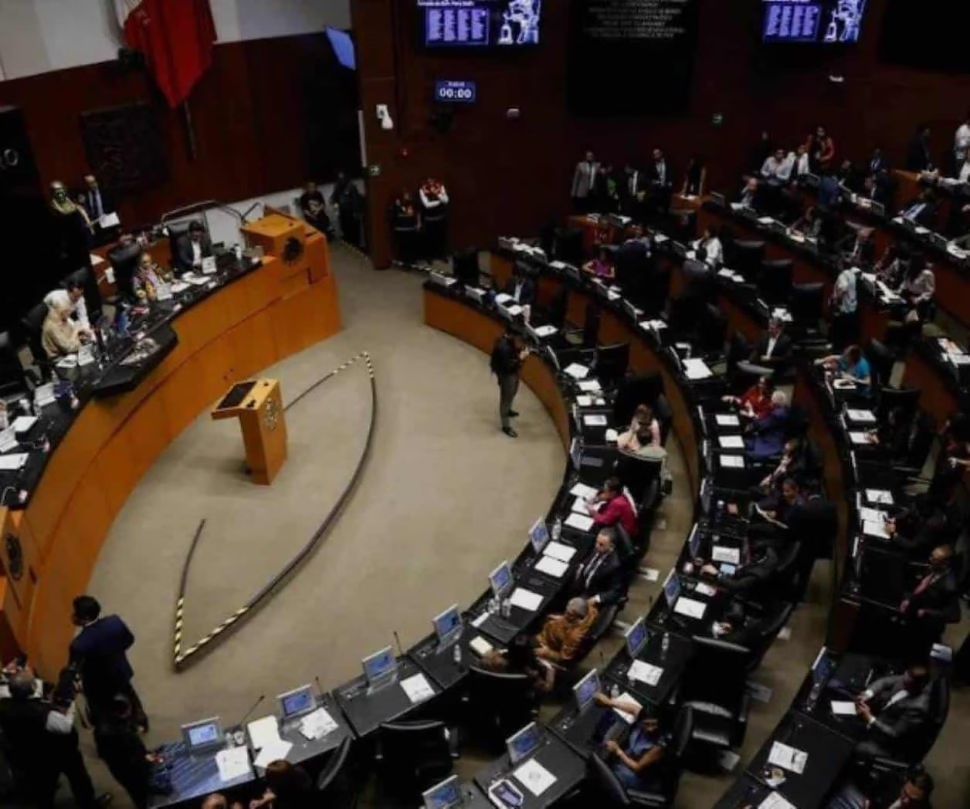
The Senate of the Republic promotes an initiative to strengthen the more than 2,462 municipalities in the country. The objective: improve their capabilities in security, infrastructure and local development, sectors with historical lag in municipal governments.

Senator Mario Vázquez, president of the Municipal Development Commission, reported that on July 14 he will lead the discussion “The Strategic Role of Multi-stakeholder Cooperation as a Tool to Achieve the Sustainable Development of Mexico.” The event is aimed at municipal presidents from all over the country.

RelatedSenate seeks to strengthen municipalities with international cooperation

The meeting will bring together legislators, international organizations, cooperation agencies, academia, civil organizations and municipal authorities. They will seek mechanisms to access new sources of financing, training and collaboration in sustainable development projects.

Vázquez highlighted that municipalities are the level of government closest to citizens, which is why they require greater tools to respond to current challenges. He pointed out that international cooperation can be a way to strengthen public management, attract investments and raise the quality of life.

Among the confirmed participants are ECLAC, the Japan International Cooperation Agency (JICA), the Spanish Agency for International Development Cooperation (AECID), as well as representatives of the Chilean Embassy and various civil organizations.

The senator assured that the Commission will continue to promote initiatives that strengthen the autonomy, innovation and development of municipal governments.
New Utopia in Iztapalapa: services and care for the community

Clara Brugada inaugurates Utopia Acatitla with an investment of 119 million pesos.

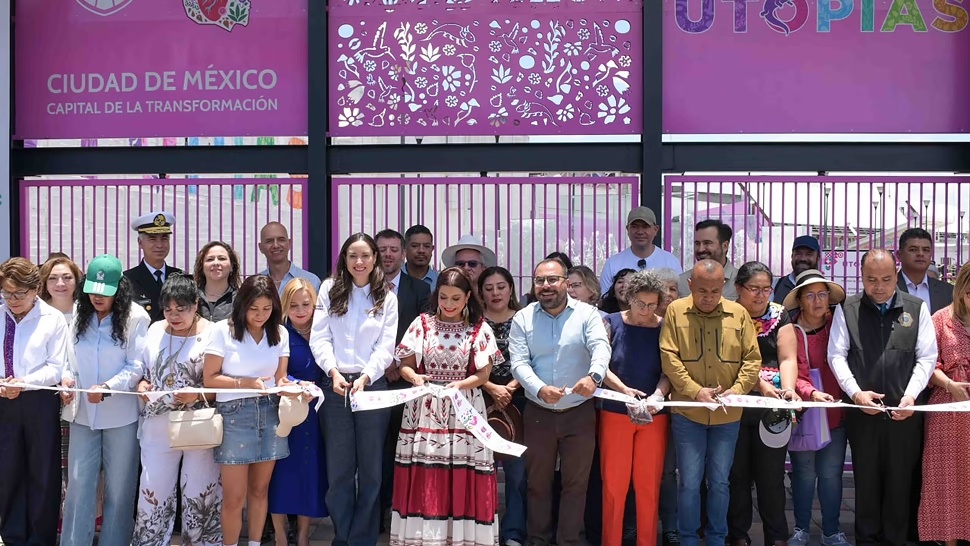
The head of Government of Mexico City, Clara Brugada, inaugurated this Sunday the Utopia Acatitla in Iztapalapa. The space, built on a vacant lot full of garbage, now offers multiple free services.

What does Utopia Acatitla offer?

During the tour, Brugada observed the facilities: mammography machines, health services, semi-Olympic pool, fields, jogging track, dog park, baking, carpentry and screen printing workshops. There are also sculptures of animals with movement, a laundry and a day house, among others.

The Secretary of Works, Raúl Basulto, explained the technical complexity of the project. The ground conditions, with sinkholes and cracks, limited construction to five thousand of the 16 thousand square meters of land. Even so, he said, all the characteristic services of the Utopias were integrated, such as the public care system.

“This is the fifth Utopia to be built from October 2024 to date – Basulto highlighted -, and a thousand jobs were generated for its construction.”

Claudia Curiel, Secretary of Culture of the Federal Government, attended on behalf of President Claudia Sheinbaum. He pointed out that the Utopias model transcends Iztapalapa to the world.

Impact on the community

Clara Brugada highlighted that the Utopias “return home” and that 119 million pesos were invested to transform the space. She stressed that these facilities free women from the burden of care and improve people’s emotional health. They also promote culture and sports.

As an incentive, he announced that the first 300 children registered in the semi-Olympic pool will receive their uniform for free.

La Utopia Acatitla represents another step in the policy of recovery of public spaces in Iztapalapa, with a focus on well-being and equity.

Continue reading

They install a memorial for Ana Amelí under the Angel of Independence

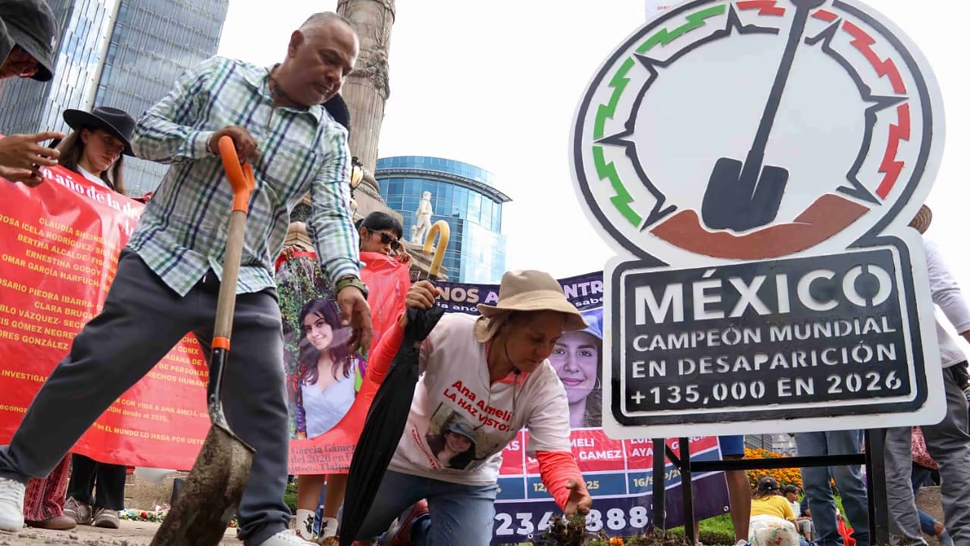
Relatives and groups placed a memorial under the Angel of Independence one year after the disappearance of Ana Amelí.

Memorial in Reforma for a year without Ana Amelí

Search groups and relatives of Ana Amelí installed a memorial on the steps of the Angel of Independence. The structure includes the phrase: “Mexico champion in disappearance, more than 135 thousand in 2026.”

The action occurred after a march along Paseo de la Reforma to commemorate the first anniversary of the disappearance of the 19-year-old girl. Ana Amelí was last seen on July 12, 2025, after hiking in Pico del Águila, in the Ajusco area.

Upon reaching the monument, the protesters crossed the metal fences that restricted access. Personnel from the Secretariats of Government and Citizen Security, as well as the Human Rights Commission of the capital, appeared at the scene.

Vanessa Gámez, mother of Ana Amelí, recounted the moment she learned that her daughter was not returning:

“365 days ago today, a call changed my life as a mother, the life of a family. On July 12, 2025, after seven in the afternoon, we realized that Amelí, a 19-year-old student, who had gone out like any young person to enjoy a walk to a beautiful place in Ajusco, was not answering the phone, we could not see that she was answering any messages, only silence.”

In the presence of the police, the mother defended the memorial as a legitimate act:

“This is a reminder of all the pain that they have caused us in more than 365 days without my daughter (…) This is not a crime, this is a reminder that the criminals who are in the security institutions are them, they are the ones who allow children, women, young people and everyone to disappear.”

A man identified as Arturo Carrasco offered a prayer next to the memorial in reference to Ana Amelí and all the people not located in Mexico.

Continue reading

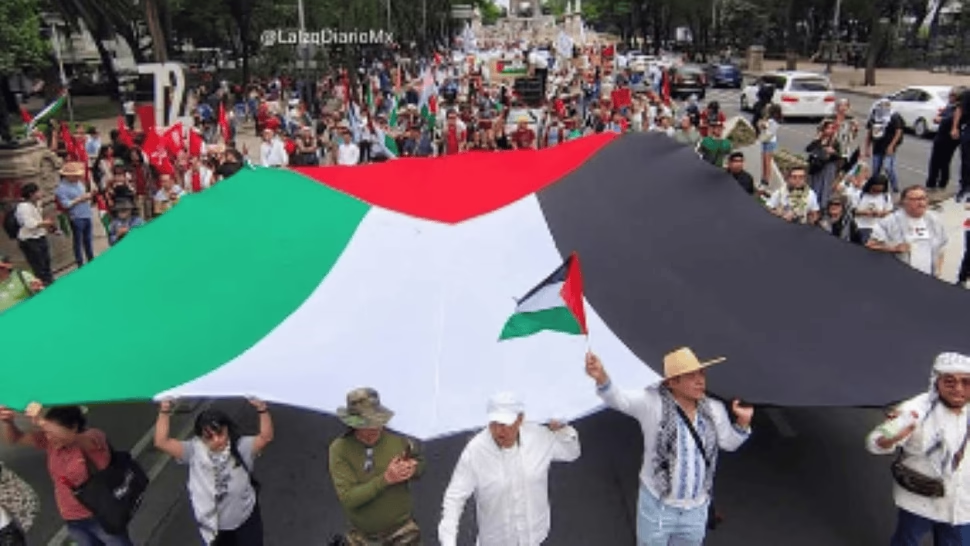
Citizens demand cancellation of water agreement with Israel

Thousands called to demonstrate on August 1 in several cities due to alleged opacity.

Civil unrest around the water cooperation agreement between the Chihuahua Central Water and Sanitation Board (JCAS) and the Israeli Mashav Agency has escalated to the national level. The mobilization, promoted on TikTok by the user @amigamagica, will take place on Saturday, August 1 at 9:30 a.m. in various cities across the country.

Meeting points include from the Estela de Luz towards the Zócalo in Mexico City, to concentrations in Tabasco, Pachuca, Ciudad Juárez and Jalisco. The agreement, signed in 2023 under the government of María Eugenia Campos Galván, is the center of the debate.

The legal vacuum of the agreement

According to Luis Andrés Rivera Levario, spokesperson for Save the Hills of Chihuahua, the Ministry of Foreign Affairs (SRE) confirmed that there are no legal instruments in force between Israel and Chihuahua. This, according to activists, violates the Law on the Conclusion of Treaties, which requires any inter-institutional agreement to be registered with the Foreign Ministry.

“It was left in a situation in limbo where it is impossible to request accounts, since it does not legally exist,” said Rivera Levario in an interview with IMER.

The civil organization maintains that the agreement operates in total opacity as it lacks registration with the Mexican Agency for International Development Cooperation (Amexcid).

Technical concern

Beyond the legal, protesters criticize the proposed technological model. Reverse osmosis, they explain, is not viable for Chihuahua due to the absence of the sea. They point out that aquifer wells are already becoming salinized due to poor management, and the technology would only aggravate soil salinization.

“They are coming to offer us a high-risk solution,” added the spokesperson.

The real solution, they insist, is to protect water recharge areas and carry out agricultural and industrial reconversion. The community demands that the authorities terminate the agreement, which they consider non-existent.

Continue reading