Rubén Moreira demands funds for disasters after Hurricane Priscila

The legislator points out the lack of funds for emergencies after the hurricane and announces a budget battle.

A cry in the storm (and on Twitter)

While Hurricane Priscila was dedicated to its destructive tour through Hidalgo, Veracruz and Puebla, leaving in its wake a landscape that seemed straight out of a post-apocalyptic movie, the Mexican political class, as is tradition, took to its favorite stage: social networks. In a plot twist that no one expected (yes, it’s sarcasm), federal deputy Rubén Moreira Valdez launched an urgent call to the Federal Government. Basically, the message was, “Hey, do you remember the people affected? Could we, I don’t know, help them?” A revolutionary idea, we know.

Through his stories, tweets and whatever people in power use to communicate now, the coordinator of the PRI bench not only asked for immediate support, but, in an act of foresight that seems taken from a fictional story, he requested that the Federation Expenditure Project 2026 include a specific item for these catastrophes. Its stated goal is for aid to arrive quickly and efficiently, a concept that is reportedly considered cutting-edge in crisis management.

RelatedRubén Moreira wants to bury Fobaproa for the third time

The ghost of FONDEN: the character that everyone misses in this soap opera

And this is where the plot gets juicy. Moreira Valdez, with the confidence of someone who knows he has a good *plot twist*, confirmed what many already suspected: “The mistake that meant disappearing Fonden is confirmed.” Ah, the Natural Disaster Fund (FONDEN), that former protagonist of the public administration that was abruptly canceled and that everyone now remembers with nostalgia, like that series that was removed from the platform just when it was getting good.

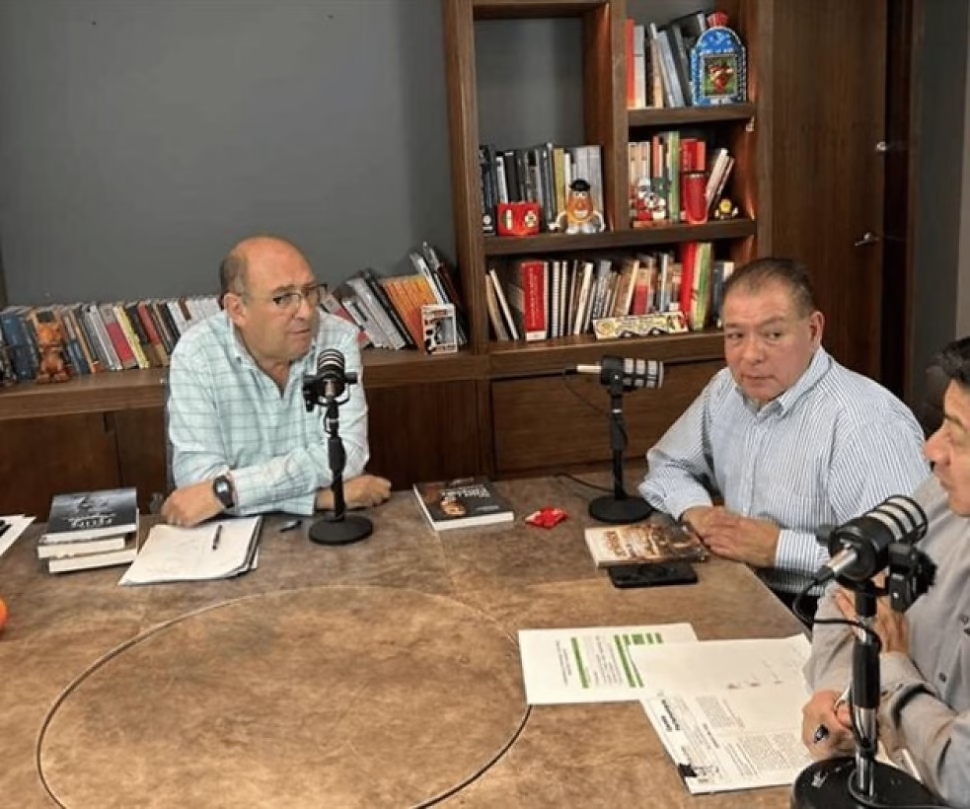
The legislator does not beat around the bush. In his appearances on the program *Con Peras Manzanas y Naranjas* (a title that, it must be admitted, is a mood in itself), he has released information that hurts more than a Sunday hangover. He states that the defunct fund allowed up to 37 billion pesos to be available instantly for emergencies. And now? Well today, in the post-FONDEN era, the portfolio is reduced to 19 billion pesos, and that “if the budget allows it.” In other words, the equivalent of asking your parents for money to go out: maybe yes, maybe not, and always with a sermon included.

But wait, there’s more. Because in this budget thriller, cuts are the villain of the story. Moreira pointed out that the Coordination of the National Civil Protection System and the threat management area have seen their budget disappear by 103 million pesos since 2018, going from 334 to 231 million. It’s as if, in the middle of a pandemic and a climate crisis, they decided to remove airbags from cars to save money. A masterstroke, without a doubt.

The battle plan: when deputies become influencers of reconstruction

Faced with this scenario worthy of a sad meme, the PRI parliamentary group has announced its next mission: to propose modifications to the initiative of the Ministry of Finance and Public Credit (SHCP). Its objective is to guarantee sufficient and extraordinary resources for the reconstruction and care of the affected communities. Basically, it’s the *plot* of the season: deputies trying to put common sense into the budget.

Moreira’s final phrase is to be framed in the section of “things that should be obvious but are not”: “Nature does not warn, but the government’s omission aggravates the damage. It is time to act with responsibility and humanity”. A truth like a temple that, in the current context, sounds as revolutionary as finding a free parking space in the city center.

In short, we are facing a classic Mexican drama with all the ingredients: natural disaster, missing public funds, budget cuts and a politician asking for action on networks. The million-dollar question is whether this time the script will include a happy ending for the affected citizens or if it will simply be another chapter in the series “And so it goes.” The ball, as often happens, is in the court of those who manage the nation’s checkbook. Meanwhile, communities continue to wait, because humanitarian aid, unlike a tweet, cannot arrive in seconds.

Do you think it is important that there be a specific fund for disasters? Share this note on your social networks and help us make the conversation about emergency preparedness viral. Explore more content related to politics and current affairs on our site.

Sheinbaum confirms probable meeting with King Felipe VI

Sheinbaum plans to meet with the king of Spain during his visit to Mexico in June.

President Claudia Sheinbaum stated that the probability of meeting with King Felipe VI during the monarch’s visit to Mexico is high. The reason for the royal trip is the friendly match between the Spanish and Uruguayan national teams, scheduled for June 26 in Guadalajara.

“Yes, it is likely so. He is still in Foreign Relations with the Foreign Ministry of Spain, the representation of the Spanish State. And I already believe that tomorrow or the day after we will inform him,” Sheinbaum responded from his morning conference.

The president announced that the meeting would take place in Mexico City, not in Guadalajara, where the match is played. Diplomatic talks between both foreign ministries continue to define the details.

Bilateral context

If it takes place, it would be one of the highest level meetings between Mexico and Spain in the midst of the redefinition of the bilateral relationship promoted by the Sheinbaum administration. It is worth remembering that the president recently traveled to Barcelona to participate in a summit of left-wing countries, where she met with the president of the Spanish government, Pedro Sánchez.

Continue reading

CJNG maintains operation with regional structure after death of El Mencho

García Harfuch explains that regional leaders avoided a violent escalation after the kingpin's death.

Almost four months after the death of Nemesio Oseguera Cervantes, alias “El Mencho”, the Secretary of Security, Omar García Harfuch, affirmed that the Jalisco New Generation Cartel (CJNG) has sustained its operation through already established regional leaders. That structure, he said, prevented an escalation of violence.

CJNG operation after the death of ‘El Mencho’

During the morning conference at the National Palace, the official explained that the authorities identified a clear territorial division within the group.

“They have very identified regional leaders, with very marked territories. That also allowed in one way or another that there was no lack of control or excessive violence,” he noted.

García Harfuch indicated that after the death of Oseguera Cervantes, the federal forces continued with operations and captures of relevant members.

“Subsequently, there continued to be arrests by the Security, Defense and Navy Cabinet, and regional leaders continue to have arrest warrants; some for extradition purposes,” he explained.

Regarding the links with the Sinaloa Cartel, the secretary maintained that the main connection was “Mencho” himself with one of its factions.

“Mainly it was the leader himself, the main leader, who was the direct link with a faction of the Sinaloa Cartel, specifically with Los Chapos. We have not identified that at the moment,” he stated.

Asked if Juan Carlos Valencia González, stepson of Oseguera Cervantes, assumed leadership – as reported by an American media in April – García Harfuch recognized him as one of the most relevant commanders.

“He is definitely one of the strongest regional leaders that the criminal group has,” he said.

The secretary also presented an assessment of the security operation for the World Cup. He said that it has worked successfully throughout the country, with coordinated work with the federal entities. “At the moment we are doing well in all the states of the Republic and we will continue that way,” he concluded.

Continue reading

Sedena plans to replace F-5 aircraft and acquire new fighters by 2050

The Army updates its air fleet: it will replace the F-5 and evaluate Swedish Gripen fighters.

Short and long term Air Force plan

The head of the Secretariat of National Defense (Sedena), Ricardo Trevilla Trejo, confirmed that the Army, the Air Force and the National Guard have a development plan for aircraft. It includes short, medium and long-term acquisitions, with emphasis on cargo aircraft, personnel transport and helicopters.

“We give priority to cargo aircraft, personnel transport and helicopters. We apply them a lot in the DN-III-E Plan and in operations,” he said during the morning conference on July 16.

The plan also includes a military equipment and industry factory to supply the dependencies. In the long term, until 2050, the replacement of the F-5 aircraft, acquired in 1982, is planned. Of a fleet of 10, only three are still in operation.

Sedena began the search for replacements for the F-5. Federal sources indicated that it plans to acquire 12 new fighters before 2028 to reinforce airspace surveillance. Among the options, the Swedish Gripen E and F fighters, from the Saab company, stand out, with a cost of more than 100 million dollars per unit. The Air Force has already received a presentation of these aircraft, which offer advanced radar technology and low maintenance costs.

The acquisition takes place in a tense geopolitical context, with conflicts such as the war between Russia and Ukraine, and tensions between Israel, the United States and Iran. Sedena evaluates options in the international defense market to meet the established deadlines.

Continue reading