The trophy that Spain or Argentina will lift on Sunday in the 2026 final is much more than a piece of metal. It is a sculpture that, according to its creator, condenses three sporting emotions: the athlete’s struggle, the fan’s joy and the moment of victory.
A design born in Milan
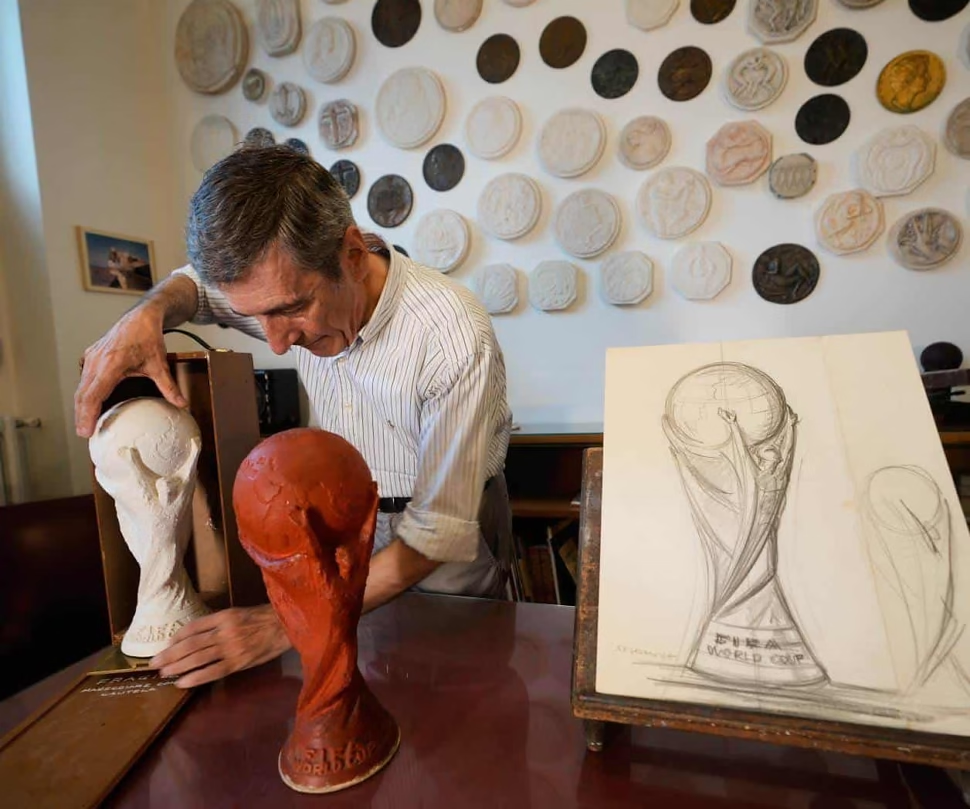
Silvio Gazzaniga, an Italian sculptor, designed the cup in his studio in the Brera neighborhood of Milan. FIFA called an open competition in 1970, after Brazil took permanent ownership of the Jules Rimet Cup by winning its third World Cup.
Of more than 50 proposals, only Gazzaniga presented a complete model. Its design shows two figures swirling towards a sphere that represents the world. “They are like two spirals of DNA that go up,” explained his son Giorgio, who was then a teenager and today preserves the legacy.
The figures are not smooth. “The athlete’s body is rough, rough, because he has suffered, he has had to fight and he has strived for victory,” Giorgio added. The arms resemble wings, symbolizing the triumph and joy of the fan.
The Jules Rimet Cup and its two robberies
The first World Cup trophy, awarded since 1930, represented the Greek goddess Nike. FIFA replaced it when Brazil gained ownership of it. That original cup was stolen twice: first in 1966, in England, and was recovered by a dog named Pickles under a hedge. The second time was in 1983, at the headquarters of the Brazilian Football Confederation. It was never recovered and is believed to have been melted down.
Legacy of Gazzaniga
Gazzaniga, who died in 2016, also designed the UEFA Cup and the European Super Cup. Their World Cup trophy has been used since 1974, when West Germany defeated the Netherlands. “The real explosion of joy came when the German team lifted the cup in Munich and the entire stadium erupted. That was the moment when an object became an icon,” his son recalled.
FIFA decided to keep the design at least until the 2038 tournament. This will be the 14th World Cup with Gazzaniga’s trophy.