The government declares a national emergency due to the lack of beans

The national legume is losing ground in the Mexican diet, while the government launches a fair to rescue it from culinary oblivion.

The epic quest to rescue the bean from oblivion

In a plot twist that no one saw coming, but that we should all have anticipated, the federal government has decided that the real enemy of the people is not insecurity or inflation, but the alarming decrease in the consumption of beans. Yes, you read that right. While the country debates other issues, the final battle for the future of this humble legume is being fought in the National Palace.

The heroine of this narrative is María Luisa Albores, director of Food for Wellbeing, who, with the solemnity of someone announcing a peace treaty, presented her war report on the state of food self-sufficiency. His diagnosis is clear: we Mexicans are betraying ourselves by stopping eating so many beans. Could it be an international conspiracy of quinoa producers? She didn’t say it, but rhetorical questions are useful.

RelatedMexico reaches self-sufficiency in beans and expands support

A fair to save what time took away

Faced with this bleak panorama, the government’s solution has been as great as it is predictable: a National Bean Fair. Because nothing says “food revitalization” like a two-day event at the Monument to the Revolution, where producers from Zacatecas, Durango and Nayarit will try, with the strength of their smile and their sacks, to win back the hearts and stomachs of the capital’s residents. The event is on November 14 and 15, because saving the national culinary identity is a matter that, apparently, only requires one weekend.

Mrs. Albores, with the passion of an evangelical preacher, broke down the credentials of the “blessed bean.” It turns out that of the 150 species in the world, 57 are found in Mexico and 31 are endemic. A fascinating fact that will undoubtedly make diners who have abandoned beans for a low-carbohydrate diet beat their chests in regret. “Beans are the best there can be for the people of Mexico,” he declared before a president Claudia Sheinbaum who, I suppose, agreed with the seriousness of someone who receives a national intelligence report.

The most moving part of this epic was the official lament: in 1980, consumption per person was 16 kilos per year, but by 2021 it had fallen to only 9 kilos. Shakespearean tragedy unfolds on our tables. What dark force has distanced the Mexican from his gastronomic partner par excellence? Is the avocado taking you on a spree? The official did not go into those details, but “dissemination” is, apparently, the silver bullet.

The final solution: branded beans and a bag

The master plan for this reconquest is as simple as it is brilliant: a bagging plant that will allow the grain to be packaged directly with the Bienestar brand. Because we all know that what an ancient food really needs to regain its splendor is good packaging and an official logo. The mechanism is so virtuous that it hurts: the producer is paid a “fair price”, the government buys it, bags it and displays it in the Wellness Stores at the modest price of 30 pesos per kilo.

One can’t help but wonder if, in the midst of this fab crisis, a rehabilitation program has been considered for recovering bean-addicts, or perhaps a hotline to report those who replace their charro beans with a bowl of oatmeal. The situation is, without a doubt, serious. Meanwhile, in an act of almost poetic synchrony, the government invites us to rediscover the pleasure of the basic, the native, what has always been there, but now with an official seal and in a plastic bag.

So now you know, dear reader. The next time you sit down at the table, remember that you are not simply enjoying a meal, you are participating in a patriotic act. Or betraying the country, if it occurs to you to order a Caesar salad without the side order of beans. The revolution, it seems, will be bean or it will not be.

Do you think this is the food strategy that Mexico needs or is it just another anecdote in history? Share this gem of gastronomic politics on your social networks and discover more analysis of curious national priorities on our site.
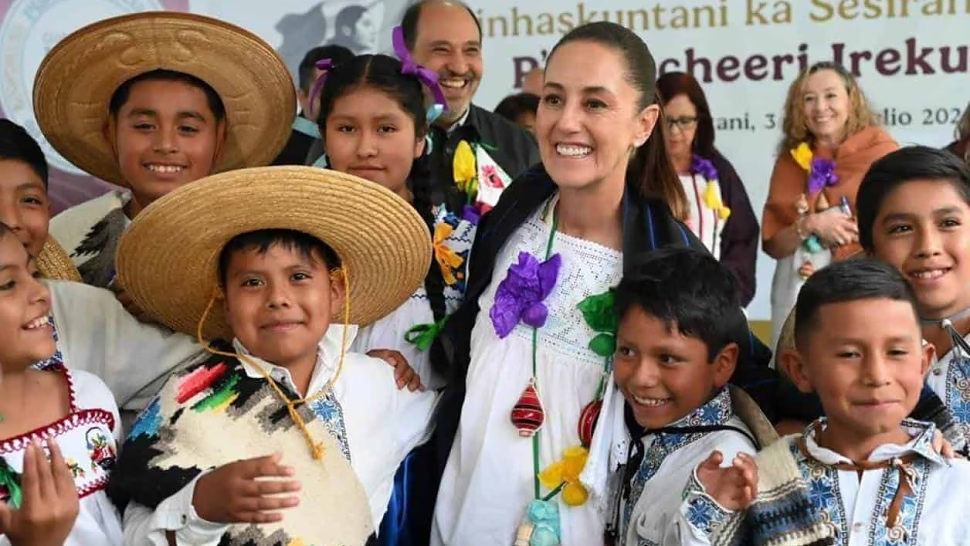

Sheinbaum announces more than 4 thousand million pesos for p’urhépecha communities

The federal government allocates more than 4 billion pesos in health, education and roads for Cherán and the region.

Historic investment from the community assembly

President Claudia Sheinbaum visited Cherán, Michoacán, to present the balance of the Justice Plan of the P’urhépecha People. One year and two months after its start, the federal government reports an investment of more than 4 billion pesos.

Sheinbaum stressed that decisions are not made from desks, but in community assemblies. The inhabitants themselves define the priorities.

“This scheme is not defined from bureaucratic offices, but through direct community assemblies,” stated the president.

The new commitments include:

  • Modernization of the Cherán Hospital with a hemodialysis room.
  • Rehabilitation of the local Sports Unit.
  • Opening of the Medicine and Nursing degrees.
  • Strengthening of community businesses.
  • Meeting in CDMX with an indigenous commission to create a C2 video surveillance center.

Details of resources and their impact

Adelfo Regino Montes, director of INPI, explained that the budget has been distributed as follows:

  • Building of 27 artisanal roads (485 million pesos).
  • School cafeterias for indigenous children.
  • 21 Indigenous Language Community Houses.

A National Guard barracks was also installed, 27 thousand efficient wood stoves were delivered and credits were granted for artisans.

Sheinbaum recalled that, thanks to constitutional reforms, indigenous communities are subjects of public law. The Contribution Fund for the Social Infrastructure of Indigenous and Afro-Mexican Peoples amounted to 13,500 million pesos this year.

Governor Alfredo Ramírez Bedolla and the Greater Council of Cherán agreed on the importance of institutional respect to maintain self-determination and the autonomous model of indigenous government.

Continue reading

Gilda Lozoya accuses political motivation in her arrest

Emilio Lozoya's sister describes his arrest as a political act to pressure her brother.

Gilda Susana Lozoya Austin, sister of former Pemex director Emilio Lozoya, was detained at the Mexico City International Airport upon returning from Europe. During the initial hearing, he called his arrest a political matter.

Before the control judge Nora Ileana García Peralta, at the Federal Criminal Justice Center of the North Prison, the woman stated:

“I believe that this is a political case, where my mother, my sister-in-law and I, that is, the women in my family, have been used to pressure my brother.”

Statements at the hearing

Dressed in a blouse and jacket, Lozoya Austin explained that she left the country for a week to attend to a family matter. “And I returned because my family is here and I am here with the desire to cooperate,” he said. He added that when he left the country he had not been notified of the arrest warrant, and reiterated: “I am here to cooperate.”

At the end of the hearing, the place to which she would be transferred for safekeeping was not reported while her legal situation is resolved.

Continue reading

Three digital media in Chiapas are sanctioned for political gender violence

The IEPC applied fines and public apologies for sexist attacks against female deputies on Facebook.

The IEPC sanctions

The Institute of Elections and Citizen Participation (IEPC) of Chiapas sanctioned those responsible for three Facebook pages for political violence against women. Those affected were two deputies of the 69th Legislature.

The pages “Portal Revolución”, “Ruleta Política” and “Expediente Chiapas” modified and disseminated images out of context. The objective, according to the IEPC, was to construct a sexist narrative that discredited the career of the legislators, attributing their political advancement to an alleged personal relationship.

The electoral authority stressed that these actions exceed freedom of expression. They do not constitute valid criticism, but rather digital, psychological and symbolic aggression.

“The offenders modified, disseminated and presented images and messages out of context… attributing a personal relationship with another person and building from it a narrative aimed at publicly disqualifying them,” the IEPC said.

The body explained that freedom of expression protects criticism of public exercise, but not when the message focuses on private life with a gender focus.

The measures imposed

Sanctions include: a public written apology that must remain on each page for 30 days; individual fines of 200 UMAs (between 22,628 and 23,462 pesos); and registration in the National and State Registry of Persons Sanctioned for Political Violence against Women for one year and four months. In addition, those responsible must take a specialized workshop on gender.

The IEPC highlighted that this type of violence affects not only the direct victims, but also discourages the participation of other women in public life, by reinforcing surveillance over their private lives and sexualizing their relationships.

Continue reading