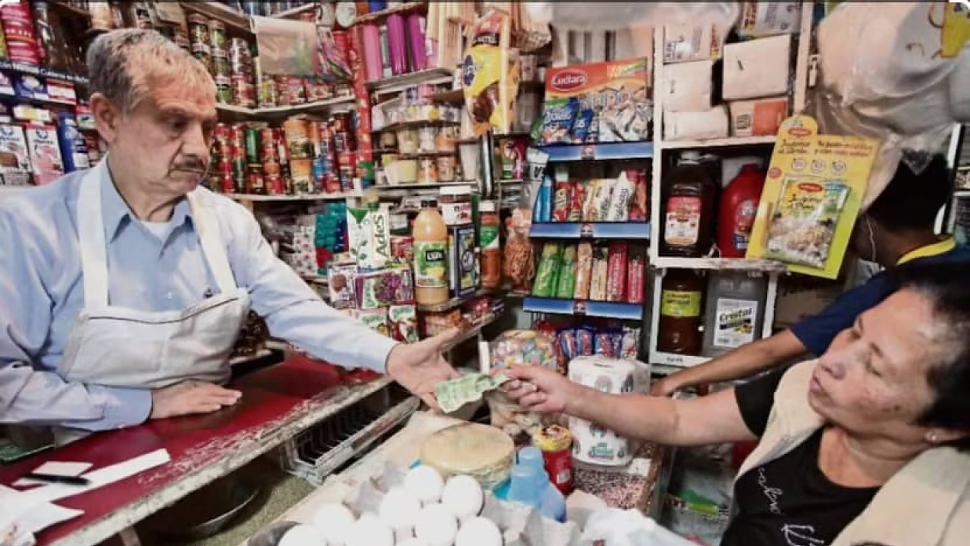
Federal government announces chocolate factory in Tabasco for Wellbeing

The government announces a state chocolate factory while promising fair prices for Tabasco cocoa producers.

Because nothing sweetens a tour more than promising a chocolate factory

In a move that will surely solve all the problems of the Mexican countryside, or at least the cravings for sweets, President Claudia Sheinbaum Pardo has announced with great fanfare the construction of a federal chocolate factory in Tabasco. Yes, you read that right: the government will get into the chocolate business with its new crown jewel, “Wellness Chocolate”.

Because when you think about a country’s priorities, obviously the first thing that comes to mind is… chocolate. Infrastructure? Security? Health? No thanks, we prefer the sweet route to development.

RelatedTabasco builds the first Bienestar Chocolate Plant

Tabasco cocoa: so good that it needs a government rescue

During her visit to the Tabasco capital, our federal president revealed a revolutionary discovery: the best cocoa in the world is produced precisely in Tabasco. What a coincidence that this botanical discovery occurs just when a new state company needs to be justified.

“Next year, because now we manufacture the chocolate, but next year we are going to build here, in Tabasco: the chocolate factory, so that the Wellness Chocolate can be produced right here,” declared Sheinbaum with the conviction of someone who has just solved the equation of world peace through chocolate bars.

Of course, this ambitious project does not come alone. It will join the prestigious “Food for Wellness” line, that collection of products that sound like they were invented by a marketing committee that only had five minutes. Next to the “Well-being Chocolate” we will find the “Well-being Milk”, the “Well-being Honey” and the “Well-being Coffee”. How creative, right? Surely the next product will be “Wellbeing Water” or perhaps “Premium Wellbeing Air”.

These bureaucratic delights will be sold in the more than 26 thousand Wellness Stores that exist throughout the country. Imagine: from Tijuana to Cancún, Mexicans will be able to access chocolate produced by the same government that brings us permits, paperwork and… well, chocolate apparently.

The cocoa economy, now with a taste of well-being

The logic is impeccable, as they explain to us: “You buy the cocoa, it becomes Wellness Chocolate and it is sold in all the Wellness Stores throughout the country.” That’s how simple modern economics is. There is no way for it to fail.

And so, the president tells us, “there in Chihuahua they buy chocolate, the best chocolate in the world, produced by the hands of the person who produces the cocoa: by the hands of Tabasco.” How beautiful. You can almost taste the irony of the federal government becoming a commercial intermediary for a product that producers could sell directly.

The declared objective is noble, yes: “to grow so that all small cocoa producers in the state can have enough profits to live well.” Because apparently the solution to low prices is not to improve marketing channels or add value through independent cooperatives, but for the government to set up its own factory and become the sole buyer and seller.

The justification is as delicious as the chocolate itself: “because many times cocoa is sold very cheap and is not enough to generate ‘well-being’.” Of course, because we all know that the best way to increase the value of a product is by adding layers of state bureaucracy.

And so, with each tablet of “Wellness Chocolate“, we will be contributing to the great word of the Fourth Transformation. Because in this new Mexico, well-being is not a goal, but a flavor of chocolate that you can buy at your favorite government store.

Will this be the economic model of the future? A government that produces everything from chocolate to hope? Time will tell. Meanwhile, Tabasco’s cocoa producers will wait to see if this sweet promise doesn’t melt like chocolate in the sun.

Did you like this irreverent look at the news? Share this article on your social networks and sweeten your friends’ timelines with a bit of informed sarcasm. Explore more content related to current political and economic events in our analysis section.

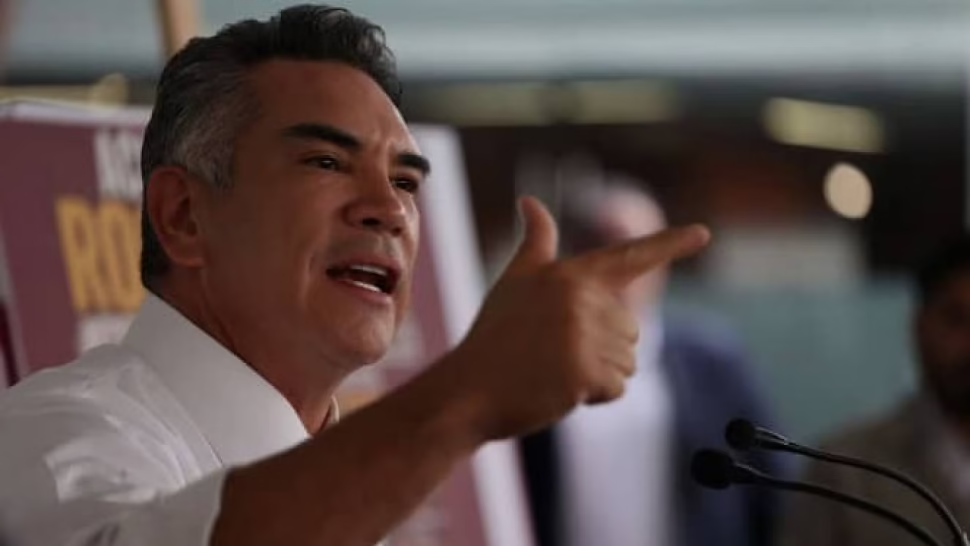
Controversy over an interview with Monsiváis reaches the Senate and the Palace

The republication of a 1999 interview unleashes accusations between the Executive and legislators.

The republication of an old interview attributed to Carlos Monsiváis climbed to the center of the Mexican political debate this Wednesday. The issue was discussed both in the Senate and in President Claudia Sheinbaum’s morning conference.

The original text was written by journalist Edmundo Cázares in 1999 and recently republished by El Universal. It contains statements about the then head of Government Andrés Manuel López Obrador. Its veracity and context have been questioned, generating conflicting positions.

Sheinbaum describes the content as “grotesque”

During her conference, the president harshly criticized the publication. He described the content as “grotesque” and accused the medium of generating a controversy that distorts the tribute to the Mexican intellectual.

Reactions in the Senate

The issue also reached Congress. Senator Lilly Téllez read fragments of the text on the platform. In response, Gerardo Fernández Noroña rejected its use and maintained that it was a false publication with the intention of political attack.

The exchange reflects the polarization around the figure of López Obrador and the use of historical documents as partisan weapons.

Continue reading

PRI demands urgent action against violence in Guerrero

They denounce an incursion of armed civilians in Coyuca de Catalán; party calls for state intervention.

The national leadership of the PRI demanded that the Mexican State intervene urgently in response to the complaint by inhabitants of the Guajes de Ayala ejido, in Coyuca de Catalán, Guerrero. The residents reported the incursion of armed civilians into their community in the Sierra.

Call for safety

Alejandro Moreno Cárdenas, president of the party, asked the authorities to guarantee the safety of the families. He warned that these events should not be normalized due to the risk they represent for the civilian population.

The leader pointed out that in various communities in Guerrero they live under siege by armed groups. This has caused displacement, confinement of inhabitants and a constant climate of fear and uncertainty. He considered an immediate response from the State necessary.

Moreno Cárdenas also criticized the federal government for minimizing the situation of violence in the country. He affirmed that the population faces conditions of insecurity that require priority attention to restore the rule of law in the region.

Continue reading

Inflation in Mexico slows down and remains at Banxico’s goal

Inflation drops to 3.55% in the first half of June, within Banxico's target range.

Inflation in Mexico continues to decline. According to Inegi, it stood at 3.55% annually during the first half of June. This represents a drop of 0.11 percentage points compared to the second half of May.

With three consecutive months of deceleration, the indicator remains within Banxico’s target range (3% plus/minus one point). This level is key for purchasing power.

Pressures on core inflation

However, pressures remain. Core inflation—which reflects medium and long-term trends—was at 4.12%, with a biweekly increase of 0.19 points. Within this category, merchandise rose 3.65% annually and services, 4.57%.

Non-core inflation and seasonality

In contrast, non-core inflation slowed to 1.61% annually, driven by the drop in agricultural prices. Products such as tomatoes, eggs and poblano peppers recorded significant decreases.

The report also reflected seasonal movements in tourist services, related to the summer and the Soccer World Cup. Air transportation, hotels and tour packages increased. Despite this, analysts foresee a favorable trend towards the end of the year.

Continue reading