Earthquakes in Venezuela: humanitarian crisis and political struggle

Earthquakes in Venezuela unleash political and humanitarian crisis as Delcy Rodríguez's interim mandate expires.

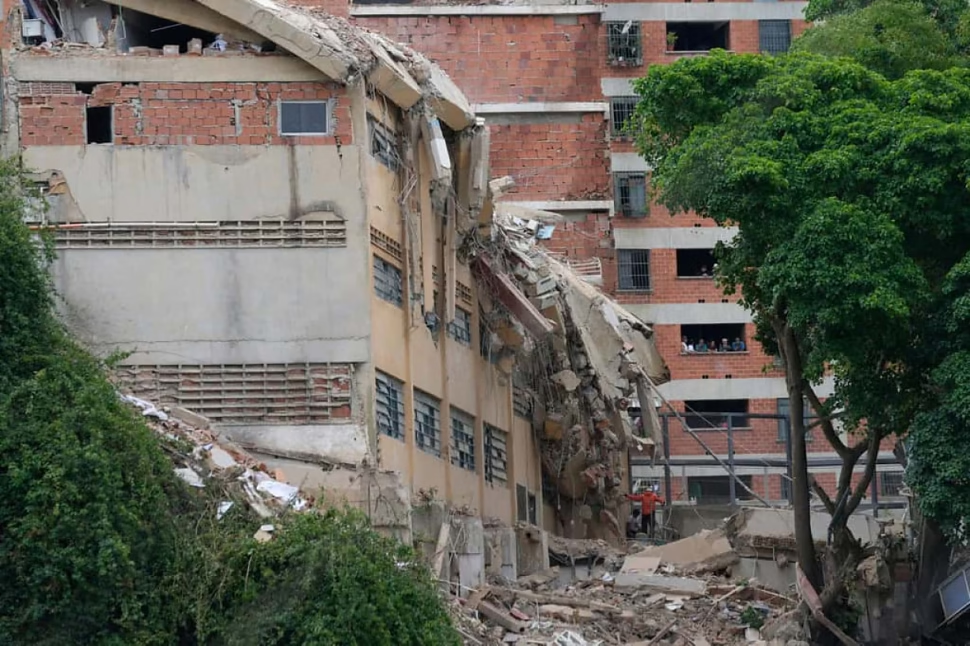
The consecutive earthquakes that shook Venezuela on June 24 left at least 2,645 dead and more than 12,500 injured, according to official figures. The catastrophe has tested the interim president, Delcy Rodríguez, whose interim term expires this Friday. While she defends her government’s response, exiled opposition leader María Corina Machado – Nobel Peace Prize winner – seeks to return to the country to press for a democratic transition.

Government response and political tensions

In his first press conference after the earthquakes, Rodríguez attributed the criticism to “media prepared in laboratories” and stated that rescue teams were deployed immediately. However, residents reported that during the first 48 hours there was no official support or heavy machinery. The government claims to have sent thousands of rescuers and 11 international field hospitals, and approved a reconstruction fund.

RelatedThe United States carries out a military operation and captures Maduro in Venezuela

Machado, from Panama, maintained that the government response showed “the total absence of the State” and called for trust in alternative leaderships. His party has created a database with 36,000 missing people and mobilized volunteers to collect donations. Machado was prohibited from running in 2024, when Nicolás Maduro claimed victory, although opposition counts show that Edmundo González, his candidate, won by more than 2 to 1.

The United States has backed Rodríguez since Maduro’s capture in January, praising his oil sector reforms. Two U.S. officials, speaking on condition of anonymity, told The Associated Press that Washington discouraged Machado from returning after the earthquakes, fearing he would lead protests. Rodríguez closed commercial air traffic to Caracas, canceling humanitarian aid flights.

Expiry of mandate and uncertain future

The Venezuelan Constitution establishes that the president’s temporary absences can be covered by the vice presidency for up to 90 days, extendable for another 90. That period expires today, but the authorities have not announced what they will do. The National Assembly, controlled by Rodríguez’s party, can call early elections if it declares the position vacant.

International organizations have pledged hundreds of millions of dollars in aid. Doctors Without Borders warns that the magnitude of the suffering is still emerging. “We know there are still bodies under the collapsed buildings,” said Andreas Spaett, the group’s Venezuela coordinator. “This is one of the great natural disasters in human history.”
US celebrates 250 years of independence amid record heat and political tension

Extreme heat and political divisions overshadow the celebration of the 250th anniversary of American independence.

The United States commemorated the 250th anniversary of its independence on Saturday amid a heat wave that affected millions and political polarization that marked the day. President Donald Trump spoke on the National Mall in Washington, before a fireworks display touted as historic. On Friday, at Mount Rushmore, he gave a somber speech about the threat of communism.

The celebrations spread throughout the country. In Chicago and New York there were fireworks; The Big Apple began the holiday with a midnight ball drop, similar to New Year’s, and sailboats paraded in front of the Statue of Liberty. However, much of the East Coast suffered temperatures exceeding 100°F (38°C). In Washington, a rodeo and the main parade were canceled; only a smaller parade moved down Capitol Hill as spectators sought shade.

Extreme heat and tight events

In the District of Columbia, an extreme heat warning was issued, with rates that could reach 46 °C (115 °F). National Mall organizers monitored the weather. Temperatures above 38°C were forecast from the southeast to New England, with possible relieving thunderstorms. Despite the heat, a Guinean-born Marine was naturalized at George Washington’s Mount Vernon estate in Virginia, wearing his dress uniform. In Brattleboro, Vermont, a 7-year-old girl ran to pick up candy during a parade. In Louisville, Kentucky, people signed a copy of the Declaration of Independence with a handmade pen.

Polarization and ultranationalist presence

Dozens of members of the white nationalist group Patriot Front marched in Washington wearing masks and Confederate flags. No arrests were reported, according to the Metropolitan Police. In Philadelphia, the birthplace of the nation, fireworks began at noon near Independence Hall. Hundreds of visitors endured the heat as they awaited the celebrations, which coincided with a World Cup match between France and Paraguay.

“It’s a big party here,” said Carlos Alban, who traveled from Chicago to see the game, upon arriving at the stadium. He added that he saw a fan dressed as one of the Founding Fathers.

In Houston, before another World Cup match, astronauts from the International Space Station sent a message alluding to the holiday. The 250th anniversary, which was supposed to be a reflection on the history of the superpower, was marked by extreme weather and deep political divisions.

Continue reading

AfD ratifies its leaders amid massive protests

Alice Weidel and Tino Chrupalla were re-elected amid strong demonstrations in Erfurt.

Convention amidst tensions

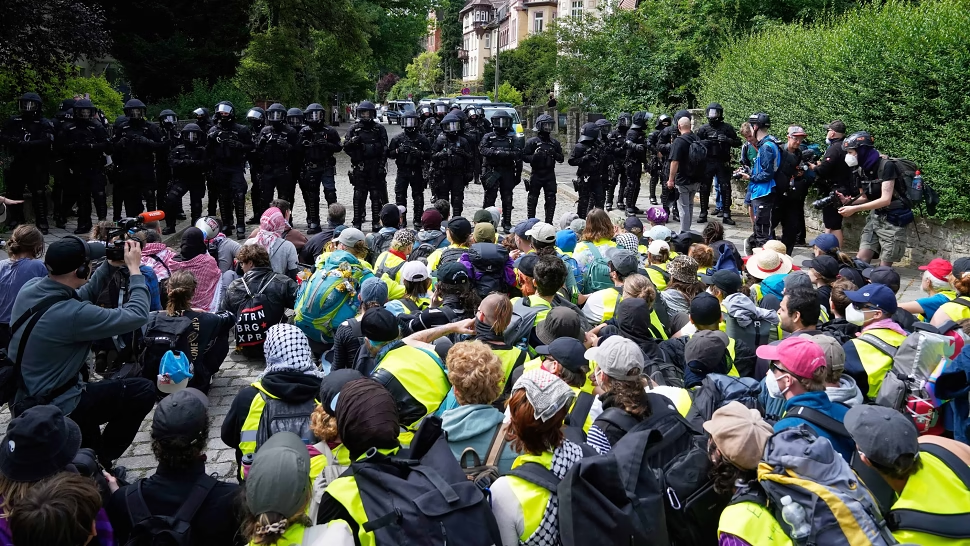
The Alternative for Germany (AfD) party held its national convention in Erfurt, where it re-elected its main leaders. The day was marked by massive demonstrations and some incidents between attendees and the police.

Alice Weidel was confirmed as co-leader with 81% of the votes. Tino Chrupalla obtained the support of 70% of the delegates. Both ran unopposed for a new two-year term, seeking to project unity in the upcoming elections.

The party arrives strengthened after consolidating itself as the main opposition force in Germany, with significant support in several regions in the east of the country. The protests reflect the polarization that political formation generates in German society.

Continue reading

Largest naval parade in history brought together sailboats from 20 countries in New York

More than 40 sailboats from 20 countries sailed down the Hudson in an unprecedented event.

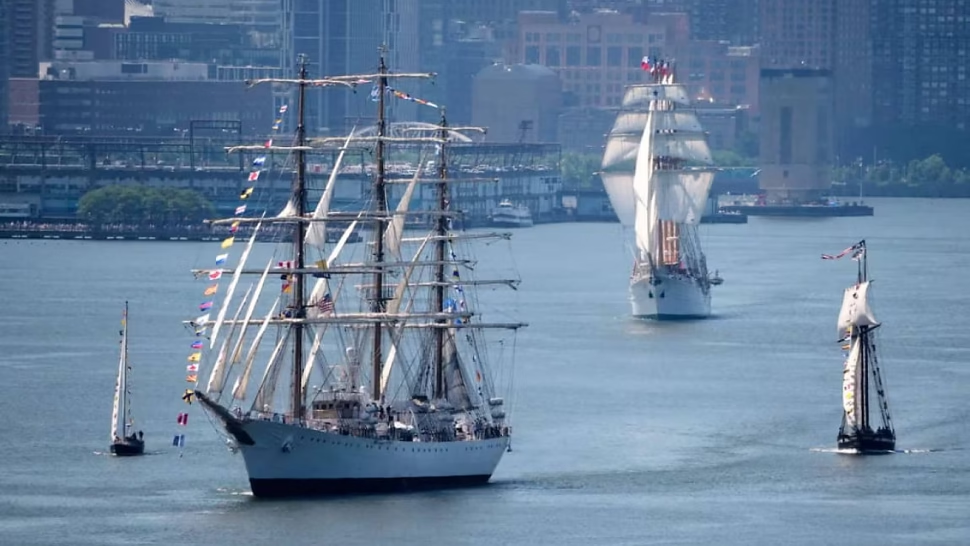
The Hudson River became the scene of a historic naval rally this Saturday. On the occasion of the 250th anniversary of the independence of the United States, more than 40 tall ships and training ships from twenty countries participated in the parade. Organizers called it the largest meeting of its kind ever recorded.

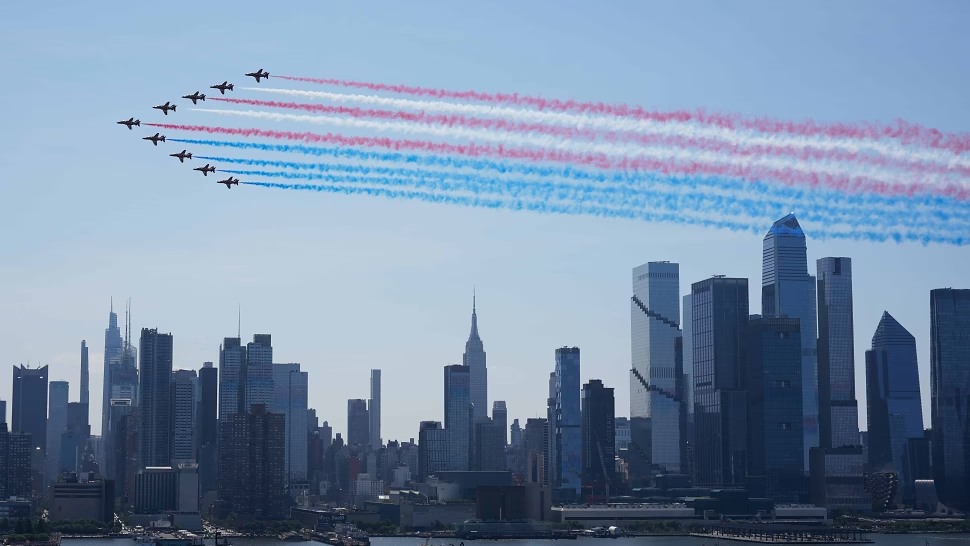
Vice President J. D. Vance headed the boat review. The flotilla sailed between the Statue of Liberty and southern Manhattan, accompanied by overflights of military aircraft and a large attendance of tourists and residents.

Among the most notable ships were the Peruvian BAP Unión, the Spanish Juan Sebastián Elcano and the Chilean Esmeralda, recognized as some of the main training ships in the world.

The celebration occurred in the midst of an intense heat wave that affects New York, in addition to the damage caused by a storm recorded the previous night. Due to those conditions, organizers canceled access to one of the viewing areas on Governors Island to ensure the safety of attendees.

Continue reading