The federal government launches soluble Wellbeing Coffee

A new federal bet transforms the morning of millions of Mexicans, connecting the field with the table at an unprecedented price.

A Revolutionary Dawn in the Mexican Mug

In a move that promises to shake the foundations of the market and redefine a nation’s breakfast, the Federal Government has unveiled, with the pomp of a state secret finally revealed, its most powerful weapon: the 100 percent soluble Wellness Coffee. This is not a simple product; It is an emblem, a declaration of intent that resonates with the echo of the thousands of small producers who have seen how their sweat and dedication are transformed into hope. María Luisa Albores González, the General Director of Mexican Food Safety, became the herald of this new era, announcing not only the elixir itself, but the future construction of a plant dedicated exclusively to its production, a modern temple where grain will become gold for the communities.

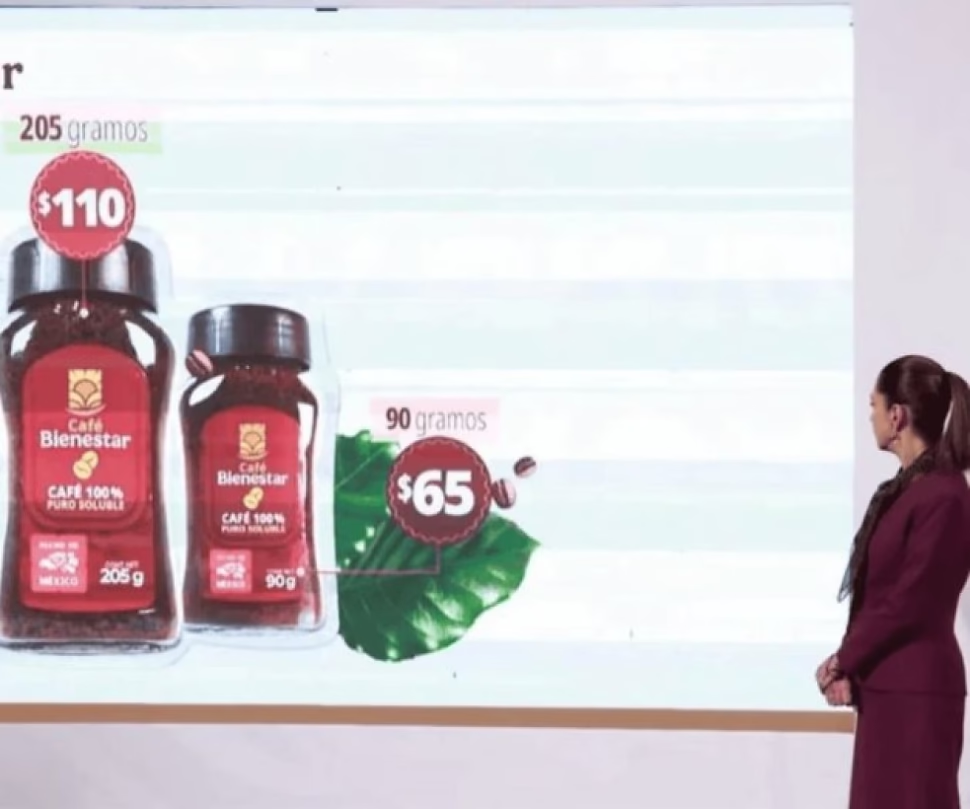
With the precision of a general deploying his final strategy, the official broke down the prices of the different presentations, each bottle a promise of accessibility. The 50 gram one, a pocket talisman at 35 pesos; the 90 grams, a medium option for 65 pesos; and the giant of 205 grams, a strength of aroma and flavor for 110 pesos. Each figure uttered was a direct blow to inflation, an oath that well-being is not a luxury, but a right.

RelatedCoffee growers denounce punishment to the price of coffee and increase in robusta imports

The Heartbeat of the Mountain in Every Grain

But the true epic is not written on the shelves of the Wellness Stores, but in the highlands and fertile slopes of Mexico. The history of this coffee is the story of 6,646 anonymous heroes, small producers of Oaxaca, Puebla, Veracruz and, in a stellar way, of the wild and noble Guerrero. From this last entity, from its mountainous heart, an astonishing 55 percent of the collected grain springs. It is the hands of the original peoples—Mixes, Mixtecs, Nahuas, Otomíes—that cultivate, harvest and deliver the fruit of their land, weaving a network of social investment that already reaches the monumental figure of 59.4 million pesos for 913.56 tons of coffee.

And in this human drama, a powerful narrative twist: the face of the production is mostly female. 44% of direct producers are women, warriors of the land who challenge stereotypes. In the dramatic and deep Montaña de Guerrero, the balance tips even more, with six out of ten producers being companions, women who stand as pillars of their communities and of this national project. They are the true architects of this dream, demonstrating that equity and fair price are the foundations of a true transformation.

The coverage of this epic program extends like a network of light over 72 municipalities, covering 465 remote localities. Fourteen collection centers and eight mobile points are the bastions from which this revolution of taste spreads, ensuring that not even the most remote community is left out of this new pact between the countryside and the consumer. Guerrero, once again, is crowned as the epicenter of this feat, with the region of La Montaña and Costa Grande leading a collection that feeds the soul of the country.

This Soluble Wellness Coffee is more than a drink; It is a symbol of resistance, a pact of honor with those who work the land and a promise of quality for those who inhabit it. Each cup is an act of justice, a sip of food sovereignty and a tribute to collective effort. The message is clear and resonant: Mexico’s morning has changed forever.

Did this story move you? Share it on your social networks and let others discover the taste of the transformation! Explore more content about how Mexico’s initiatives are changing lives.
More than eight million apocryphal cigarettes seized in Manzanillo

Joint operation in Manzanillo detected shipment of counterfeit cigarettes.

Operational in the port of Manzanillo

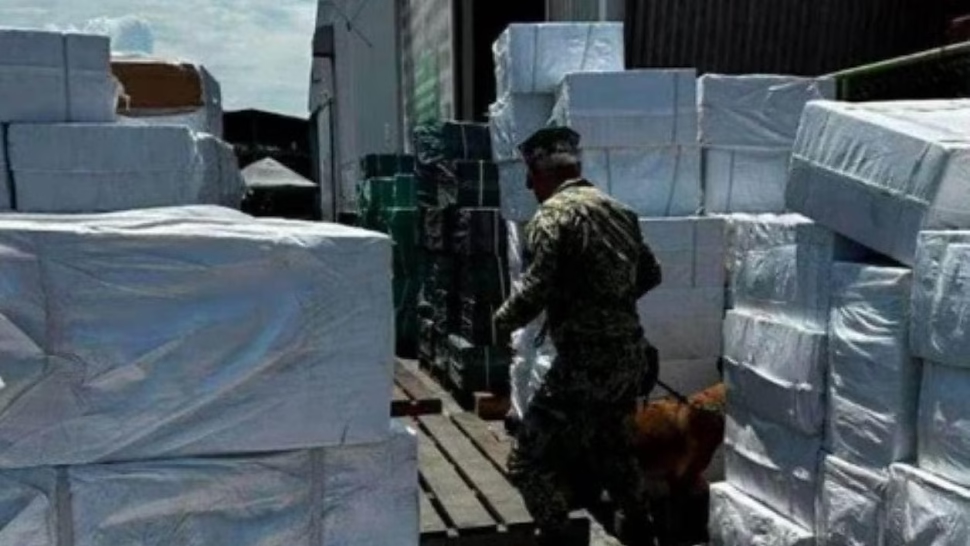
Federal authorities seized more than eight million allegedly apocryphal cigarettes in the port of Manzanillo, Colima. The operation was coordinated by agencies of the security cabinet and the National Customs Agency of Mexico (ANAM).

Personnel from the ANAM and the Administrative Unit of the Manzanillo Customs detected inconsistencies in an operation to import cigarettes from abroad. This led to a specialized review.

As a result of the inspections, the authorities located 8 million 436 presumably counterfeit cigarettes. The merchandise was insured with the support of the Secretary of the Navy (Semar).

The ANAM reported that this type of operations are part of the permanent mechanisms of operational intelligence, risk management and strategic analysis. The objective is to strengthen security in foreign trade operations and detect documentary irregularities or goods of illicit origin.

The comprehensive analysis of the operation made it possible to reinforce documentary traceability, operational review and validation of commercial profiles. The authorities maintain surveillance at entry points into the country to combat illegal trade.

Continue reading

Perception of insecurity drops to 59.8%: Sheinbaum

Perception of insecurity in Mexico drops to 59.8%, the lowest figure since 2018.

ENSU results

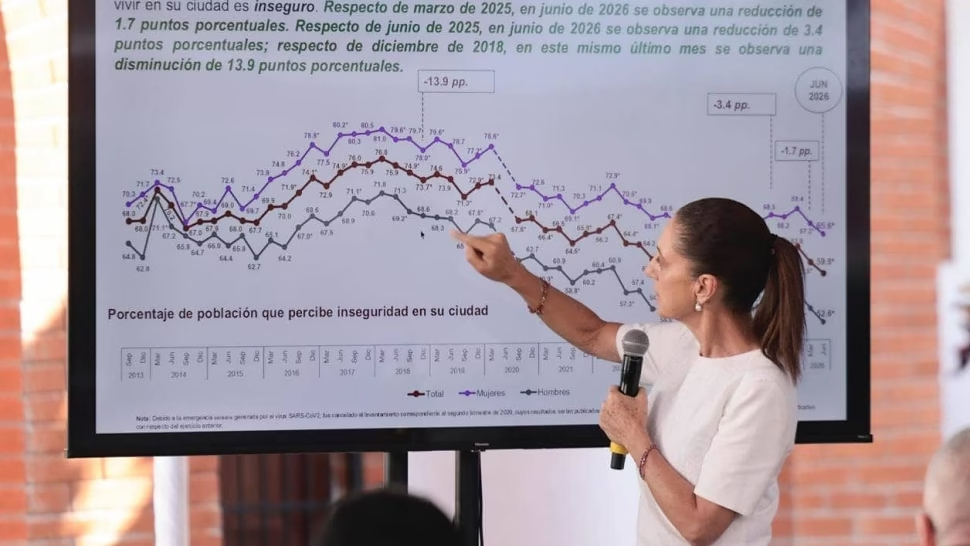
President Claudia Sheinbaum reported that the perception of insecurity in urban areas fell to 59.8% in June 2026, according to the National Urban Public Security Survey (ENSU) of the INEGI. In December 2025 it was 63.8%, which represents six consecutive months of decline.

“The important thing here is that we are giving results in the security indicators and people are beginning to notice this decrease,” he said during the morning conference in Cuernavaca, Morelos.

Historical comparison

Sheinbaum recalled that in December 2018, under the government of Andrés Manuel López Obrador, the perception of insecurity was 73.7%. The previous lowest point was reached in September 2024 at 58.6%. The president attributed the improvement to the National Security Strategy.

The ENSU measures citizens’ feeling of insecurity in their environment. Recent data reflects a positive trend, although the challenge remains to maintain the reduction in crime. The authorities continue to implement actions to consolidate these results.

Continue reading

Sheinbaum delivers 43 homes in Morelos through the Housing Plan

President delivers homes, settlements and deeds in Xoxocotla, Morelos.

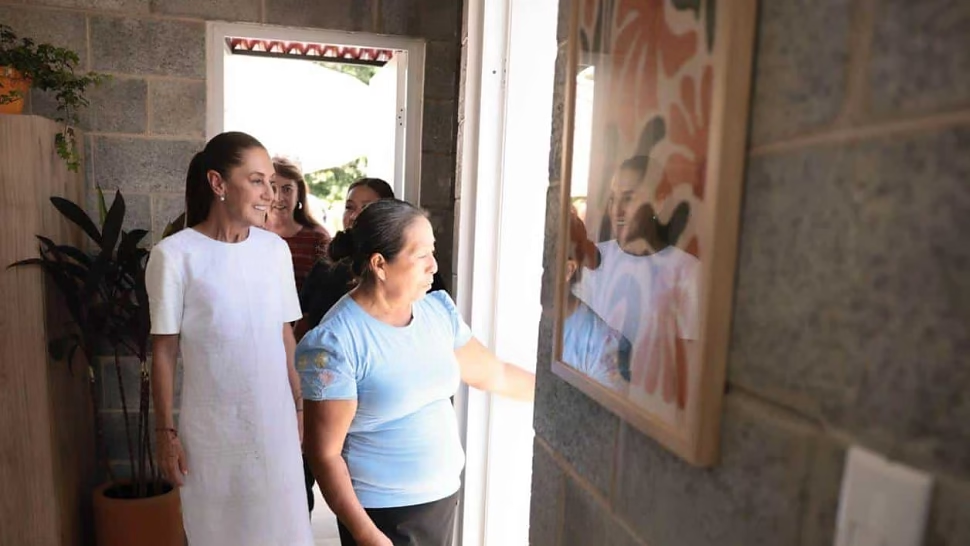
President Claudia Sheinbaum led in Xoxocotla, Morelos, the delivery of 43 new homes from Conavi, 348 settlement certificates from Fovissste and 79 deeds from INSUS. It’s all part of the Housing for Wellbeing Program.

“Previous governments took from the people, we increased the minimum wage, we are providing homes with accessible loans and we are removing debt from families,” said the president.

“Those from before governed for a few, the governments of the Transformation govern by the people and for the people of Mexico,” he added.

Plan details

Sheinbaum recalled that the program contemplates the construction of 1.8 million new homes in the country; the forgiveness and restructuring of unpayable loans for 5 million families; and the delivery of one million deeds to guarantee legal certainty.

The homes are aimed at people with incomes of one to two minimum wages. The land for new houses is already available throughout the national territory.

The Secretary of Agrarian Development, Edna Elena Vega Rangel, explained that in Morelos the goal was expanded from 10 thousand to 24 thousand new homes. Of these, 3,893 are already hired. In addition, 8 thousand families will receive deeds and more than 35 thousand will improve unpayable loans. Nationally, the program will benefit more than 10 million families.

The director of Conavi, Rodrigo Chávez Contreras, reported that of the 500 thousand homes under his charge there are already 320 projects to build 150 thousand houses. Of them, 75 thousand have already been assigned in 119 municipalities. In Morelos, 2,000 homes are being built in seven municipalities; 90 of them for Xoxocotla, of which 43 were delivered today.

Governor Margarita González Saravia thanked the president and confirmed that the state already has land for the 24 thousand houses in eleven municipalities.

One beneficiary, Araceli Pacheco López, thanked the delivery of her home, which she described as “very nice.”

Continue reading