A month to look up
February 2026 will not be just any month for those who enjoy observing the sky. According to experts, we will have a special combination of events that will allow us to better understand how everything moves up there.
“These phenomena have value beyond the aesthetic,” explains the Institute of Planetary Sciences. “They directly show us the dynamics of the Solar System and how its bodies interact gravitationally.”
The heavenly agenda starts strong
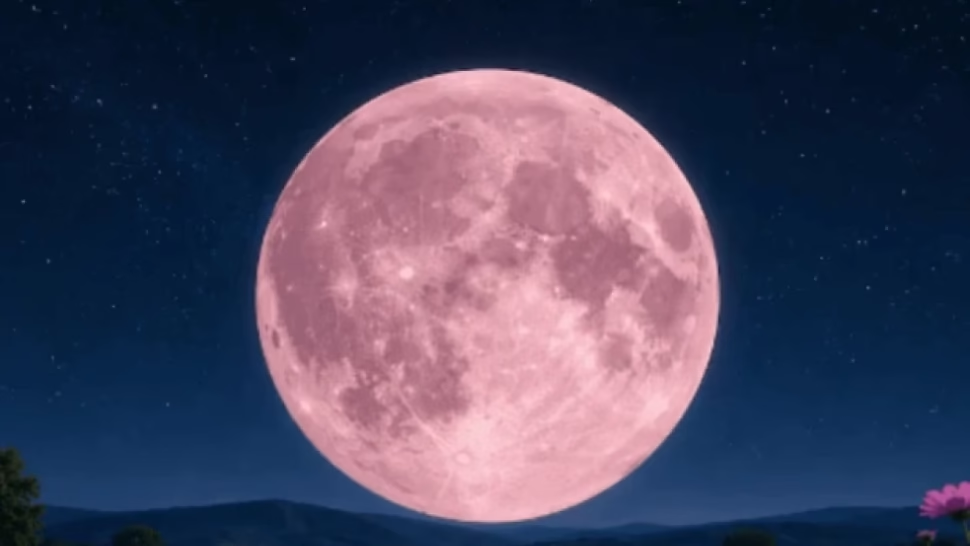
On day 1 we have a full moon, specifically the so-called Snow Moon. NASA clarifies that this historical name comes from the heavy snowfalls in the northern hemisphere, but from Mexico we can appreciate its brightness next to the Manger star cluster.
The main course: a special eclipse
On February 17 something happens that we don’t see every day: an Annular Solar Eclipse. Here the Moon covers the center of the Sun but leaves that characteristic ring of light visible.
“The main strip of the eclipse passes over Antarctica and southern oceans,” details the American Astronomical Association. “In other areas, including Mexico, it will be seen as a partial eclipse through specialized transmissions.”
Planets in perfect position
The 19th is a key day for Mercury lovers. The planet reaches its maximum elongation, that is, its greatest apparent separation from the Sun. According to the European Southern Observatory, it will be one of the best times of the year to observe it at sunrise or sunset.
On the 24th, the Moon visually approaches the Pleiades, that famous star cluster that astronomers have studied so much. The International Astronomical Union points out that these apparent approximations allow comparison of nearby objects with distant stellar structures.
And we reach the grand finale
On February 28, the most striking thing happens: six planets and the Moon appear aligned in the same strip of the sky. The Max Planck Institute clarifies that it is not a real physical alignment, but a visual coincidence from our terrestrial perspective.
This month also commemorates scientific milestones such as the birth of Galileo Galilei and the discovery of Pluto. Timely reminders of how observing the sky has changed our understanding of the universe.
The truth is that these events confirm something fundamental: the sky is never still. Each look upward connects us with the cosmic dynamics that surround us.