The earth moved twice in Iztapalapa this morning

Two small earthquakes shook Iztapalapa this morning, according to the official report from the Seismological Service.

Two microseisms in Iztapalapa: Routine or signal?

Early Wednesday morning had its own telluric alarm clock in Mexico City. According to the always reliable National Seismological Service (SSN), the ground shook twice in Iztapalapa.

The first movement came at 2:02 hours. Magnitude 2.3, epicenter in the same municipality, only 6 kilometers deep. Shallow enough for some to feel it, weak enough for authorities to classify it as ‘safe’.

Related4.0 magnitude earthquake is recorded west of San Marcos, Guerrero

The second, at 4:38. A little stronger (2.5), a little deeper (7 km). Same coordinates, same official narrative.

“The National Seismological Service continues to monitor seismic activity in the region, ensuring that these earthquakes are of low magnitude and do not represent a significant risk for the population.”

There is the usual statement. The master formula for public tranquility. Low magnitude, no risk, go about your day.

And so far, it works. There are no reports of material or personal damage in Iztapalapa. The official recommendation is the obvious one: be attentive.

But here’s my cynical question from a journalist who has covered too many natural disasters: How many safe ‘microseisms’ do it take before someone asks why it shakes so much at the same point? The data is there: almost identical coordinates (19.37, -99.10 and 19.37, -99.09). Almost twin depths.

The SSN does its technical work impeccably: they measure, locate, report. What they don’t do is contextualize historically or speculate on patterns. That’s up to us.

Meanwhile, Iztapalapa woke up intact. Collective memory records two nighttime shakes and little else. The official version once again prevails over any uncomfortable geological concerns.
More than a ton of cocaine seized on a merchant ship

Joint operation prevents more than two million doses from reaching the streets.

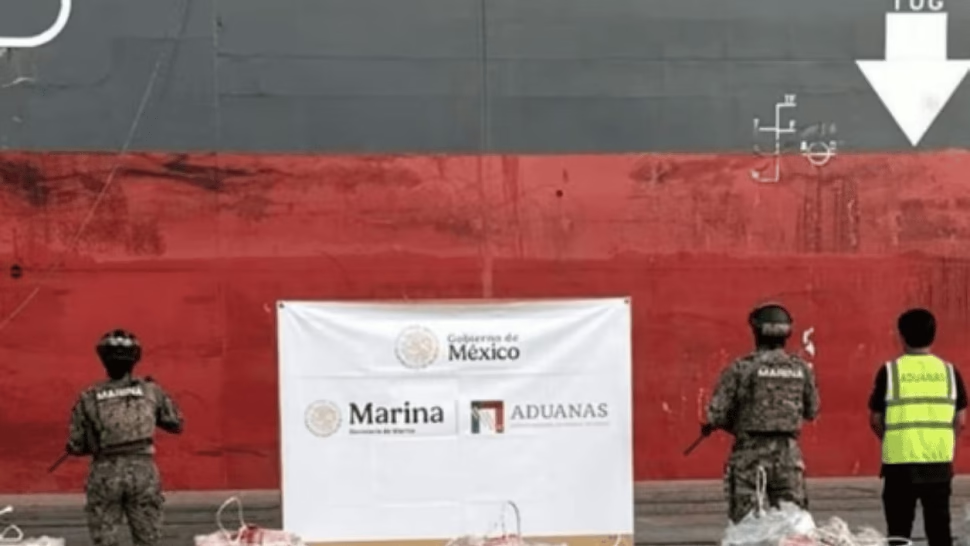
Elements of the Secretariat of the Navy (Semar) and the Maritime Customs of Lázaro Cárdenas, Michoacán, located and seized 20 packages with more than a ton of cocaine on board a merchant ship.

The inspection was carried out with the support of canine teams specialized in detecting illicit substances. The packages with possible cocaine were made available to the Public Ministry, which will be part of the investigation folder.

With this assurance, more than two million doses, with a value of more than 250 million pesos, were prevented from reaching the streets. The Attorney General’s Office (FGR) and the Secretariat of Security and Citizen Protection (SSPC) also participated in the operation.

Inter-institutional coordination

The Security Cabinet highlighted that the result reflects the effectiveness of the coordination between maritime and customs authorities to strengthen security in national ports, through permanent maritime, port, air and land surveillance operations.

The Wan Hai A20 merchant ship docked at the Multipurpose Terminal II. His possible link with a criminal organization is being investigated. The troops inspected 36 containers with the same shipping origin of the alerted container in Puerto Quetzal, Guatemala.

Continue reading

Reform against sexual abuse takes effect in 24 states

24 states have already published the reform that unifies the crime of sexual abuse at the federal level.

The Women’s Secretariat reported that 24 federal entities have already approved, enacted and published the reform to harmonize the crime of sexual abuse in their local legislation. He described it as a “transcendental advance” within the Comprehensive Plan against Sexual Abuse.

What changes with this reform?

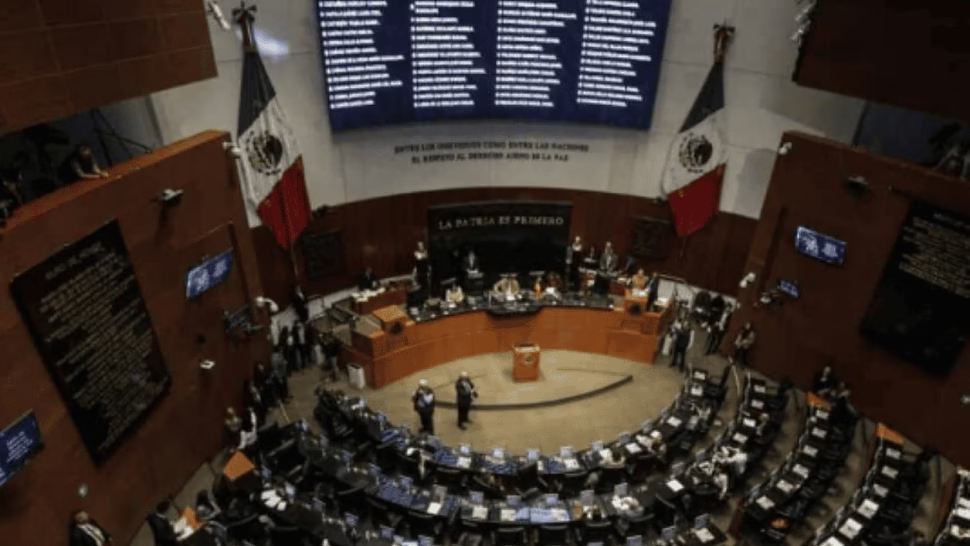
The initiative was approved by the Senate, the Chamber of Deputies and published in the DOF on March 13, 2026. By unifying the criminal type, the disparity in criteria between states is eliminated. The actions considered as sexual abuse in both the public and private spheres are clarified.

The decree, presented by President Claudia Sheinbaum, reforms articles 260 and 266 Bis of the Federal Penal Code. It defines sexual abuse as any act of a sexual nature without the consent of the victim and without the purpose of copulation. Includes touching, caressing, body rubbing, exhibitions or explicit sexual representations. It is also considered sexual abuse when the victim is forced to expose her body.

Consent cannot be presumed from silence, passivity or lack of physical resistance. The penalties range from three to seven years in prison, a fine of 200 to 500 times the UMA, and the obligation to attend re-educational workshops with a gender perspective or provide social service. Compliance with this obligation is key to the conditional suspension of the process.

The crime will be prosecuted ex officio. The penalties increase by a third if circumstances such as physical, psychological or moral violence occur; participation of two or more people; unpopulated place; relationship of trust, sentimental, work or educational between the aggressor and the victim; when committed by a public servant, professional or religious minister taking advantage of his position; when the victim is under the influence of alcohol or drugs; in a state of pregnancy or postpartum; due to sexual orientation, gender identity or expression; or when the victim is in a state of defenselessness.

In the case of public servants, dismissal and disqualification are added for the same term of the sentence. For professionals and ministers of worship, disqualification from exercising their profession or position.

Continue reading

UN-DH: freedom of expression at risk after the death of two journalists

UN-DH and Amnesty condemn murders of two journalists; They demand justice with a gender perspective

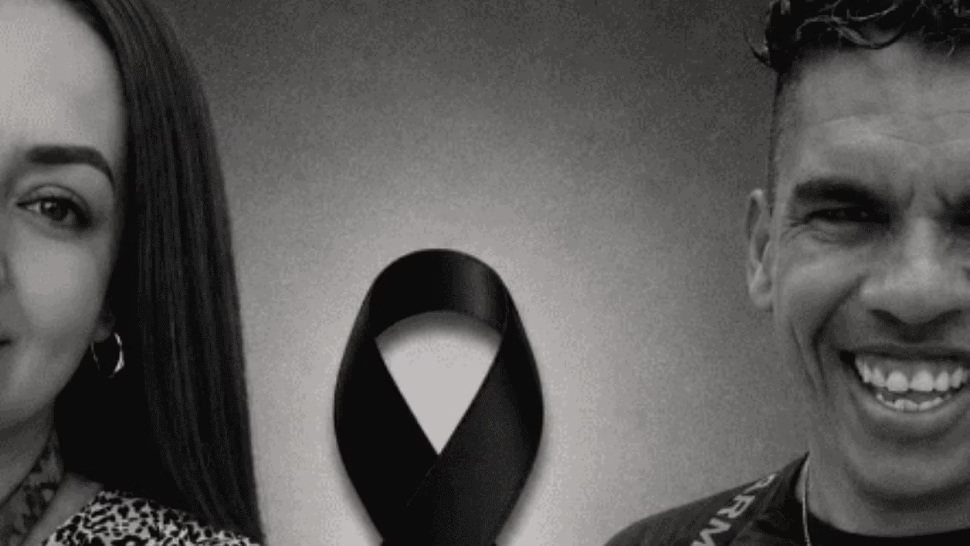
The Office in Mexico of the UN High Commissioner for Human Rights (UN-DH) expressed its dismay at the disappearances and subsequent lifeless findings of journalist Roxana Guzmán and journalist and environmental activist Alex Serna, which occurred in June in Veracruz and Guerrero. The organization called on the authorities to clarify the facts, considering the exercise of freedom of expression as a line of investigation.

The case of Roxana Guzmán

Roxana Guzmán ran a digital media outlet and was allegedly the only woman who covered the police source in the south of Veracruz. The UN-DH highlighted the need to protect freedom of expression with a gender perspective, due to the differentiated risks that women journalists face. The Veracruz Prosecutor’s Office confirmed on July 3 the identification of his remains through expert evidence. Eight people were arrested for their probable participation in his kidnapping and deprivation of life.

The case of Alex Serna

Alex Serna investigated environmental issues on the Costa Grande of Guerrero and defended water and land, in addition to denouncing possible acts of corruption. His disappearance was reported at the end of June; He was later found dead in Zihuatanejo. Human rights organizations indicated that he had reported threats arising from his investigations into projects with environmental impact.

The UN-DH stressed that clarifying both cases is essential to combat impunity and guarantee comprehensive reparation to the families.

Amnesty International condemned the deprivation of Roxana Guzmán’s life and demanded an exhaustive investigation with a gender and human rights perspective. The organization warned that in Veracruz at least three journalists have been killed this year.

“No attack against the press can go unpunished,” the organization emphasized.

He also called to adopt effective security measures for those who practice journalism and to investigate the structural causes of these attacks.

“Each murdered journalist is a voice that is being tried to be silenced,” said Amnesty International when reiterating its demand for guarantees of non-repetition.

Continue reading