Rigoberta Menchú receives emotional tribute at Filgua 2026

The International Book Fair in Guatemala opens with a recognition of the Nobel Peace Prize and German literature.

Tribute to the Nobel Peace Prize winner

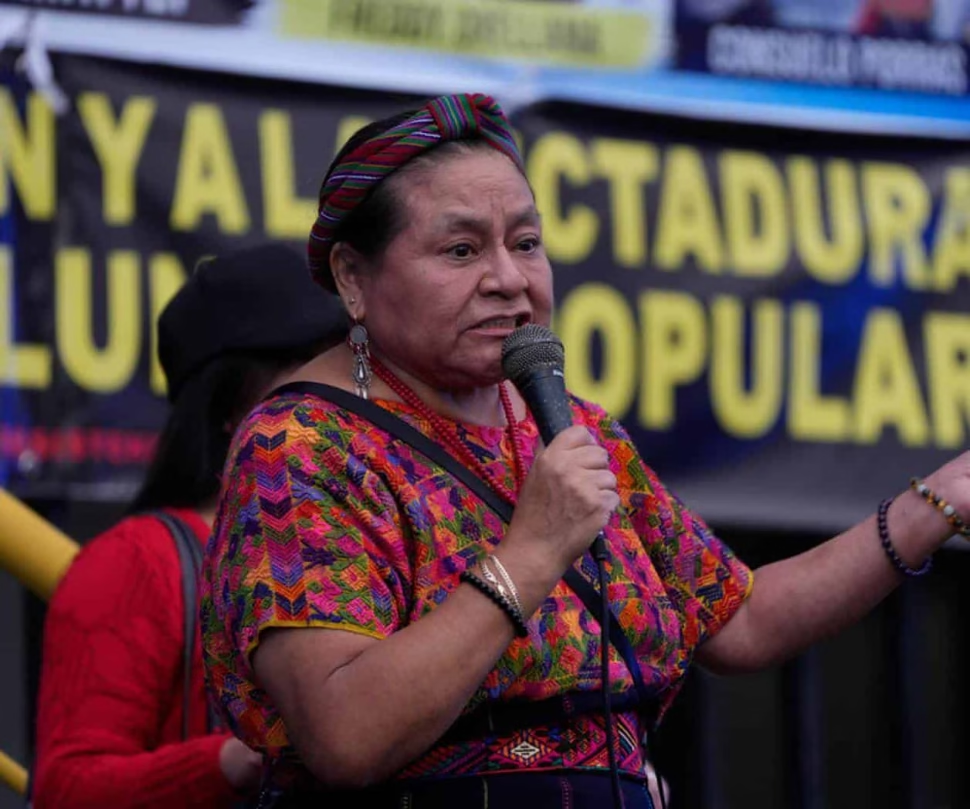
The International Book Fair in Guatemala, Filgua 2026, started on Tuesday with a special recognition to Rigoberta Menchú Tum, Nobel Peace Prize winner in 1992. Germany is the guest country of honor in this edition.

“I felt like a peacock, I felt worthy,” Menchú said through tears. “Receiving a tribute here is not only worth a Nobel Peace Prize, diplomas and keys of honor… this is a very important plus.”

The Quiché Mayan activist recalled her book “My name is Rigoberta Menchú and this is how my conscience was born” (1982), which narrates the army’s persecution of the indigenous population during the internal armed conflict (1960-1996). Menchú pointed out that this work transformed the perception of the Mayan civilization.

RelatedRigoberta Menchú, new foreign policy advisor in Mexico

With more than 20 honorary doctorates, Menchú has published several books, including “El baúl deños” (2016), co-written with Dante Liano.

President Bernardo Arévalo inaugurated the fair under the motto “Let’s go for a country of more readers.” He stressed that Menchú’s life “is a book that the world reads.” Arévalo also mentioned the Popol Vuh, “the essential book of our culture” and “the grandfather book from which other books come.”

The Minister of Education, Anabella Giracca, described Menchú as “a book made of earth, forest, river, star, hug, struggle and fortitude.”

Filgua 2026 will offer more than 800 activities and will remain open from July 7 to 19. It is the second tribute that Menchú receives from the fair; The first was in 2017, when the 50th anniversary of Miguel Ángel Asturias’ Nobel Prize was also celebrated. The remains of Asturias, who died in Madrid in 1974, will be repatriated from France to Guatemala at the end of this year.
China: storms leave at least 11 dead and hundreds injured

Storms and tornadoes hit central and southern China, leaving people dead and homeless.

Tornadoes and record rains hit China

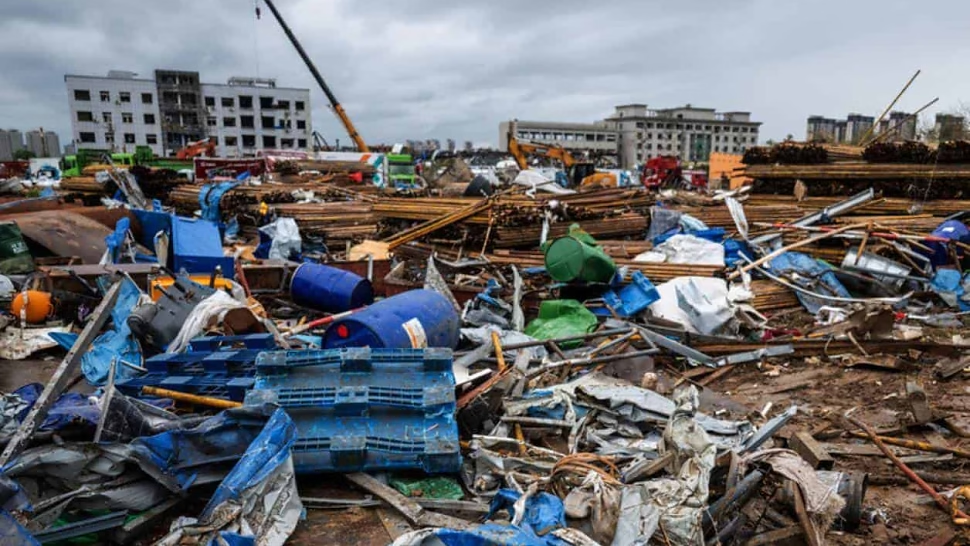
At least 11 people died and more than 330 were injured after several tornadoes and storms hit the central province of Hubei, according to the official Xinhua agency. The bad weather affected 14,600 inhabitants; More than 20 homes collapsed and another 4,800 were damaged. One person remains missing.

An EF2 category tornado hit the city of Huanggang. The winds lifted trucks and moved them up to 30 meters in a warehouse and logistics area. Videos shared on social networks show the moment when strong gusts broke glass doors. Tornadoes are rare in Hubei, but the remnants of Tropical Storm Maysak contributed to their formation, according to meteorologist Wang Xiaoling.

Floods in Guangxi

In the south, six people died and eleven are missing due to record rains associated with Maysak in the Guangxi region. The water affected 375,000 people; 130,000 were evacuated. Authorities reported that 341 reservoirs exceed flood control levels and 56 monitoring stations recorded historical records.

Regional official Cai Yunge warned of leaks, landslides and structural collapses due to prolonged saturation of reservoirs and dams. Drinking water supplies, roads, electrical networks and communications suffered significant damage.

Rescue work

More than 8,000 rescuers were deployed with 1,700 vehicles. Guangxi issued a red alert for floods, the highest category. River levels rose up to 7.5 meters above warning marks, according to Xinhua. On social networks, residents asked for help when they could not contact their relatives in the flooded areas.

Continue reading

Attack on oil tanker in Strait of Hormuz fuels tensions

An oil tanker is hit by a projectile off Oman. Tensions grow with Iran.

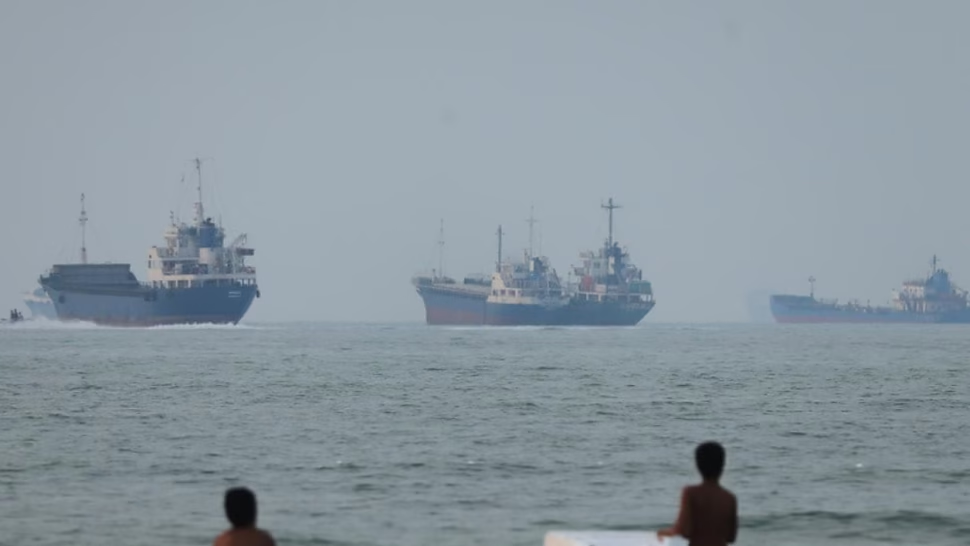
An oil tanker sailing off the coast of Oman, in the Strait of Hormuz, caught fire early Tuesday after being hit by a projectile, the British Army reported.

It is the most recent attack against a vessel on that strategic route, through which in peacetime a fifth of the oil and natural gas traded in the world transited. Suspicions point to Iran, which has already been accused of previous attacks in waters near the Omani coast.

Negotiations on pause and mass funeral

The United States seeks to resume negotiations with Iran to fully reopen the strait, reduce Tehran’s nuclear program and permanently end the war that began on February 28. However, the attacks on vessels have provoked military responses from Washington, followed by Iranian responses against Gulf Arab states, raising the risk of escalation.

The talks appear suspended until the funeral of Iran’s supreme leader, Ayatollah Ali Khamenei, who died in the first hours of the conflict, is concluded. His body was airlifted to the city of Qom, where a crowd honored him on Tuesday.

Attack details

The UK’s Maritime Trade Operations agency said the ship was attacked near Limah, Oman. The projectile hit the port side while trying to exit the narrow course towards the Gulf of Oman. No environmental impact was reported and authorities are investigating.

Previously, Iran’s joint military command warned that all tankers must use approved routes. “Any non-compliance will have an immediate response,” said an Iranian statement, which also threatened to react to US interference.

As part of a provisional pact, both countries agreed to free navigation for 60 days, but Tehran insists on controlling the routes and charging for passage, which Washington and several Arab countries reject. Previous attempts by Oman and the UN to establish an alternate route sparked attacks in the Middle East.

The Kpler firm reported that at least 108 ships crossed the strait over the weekend using various routes.

Khamenei’s funeral

Iranian state television showed live hundreds of thousands of people walking towards the Jamkaran mosque for a funeral service. Banners featured images of Khamenei and his son, Moytabá Khamenei, named the new supreme leader, although he has not yet appeared at the ceremonies. He is believed to be in custody after being injured in the attack that caused his father’s death.

Authorities closed streets and airspace for mourning, which ends Thursday, when Khamenei will be buried in Mashhad. He was 86 years old.

Continue reading

Canada chooses Germany for its largest military purchase: 12 submarines

Canada appoints German firm to build up to 12 submarines, the largest military acquisition in its history.

Canada chooses ThyssenKrupp for its largest military acquisition

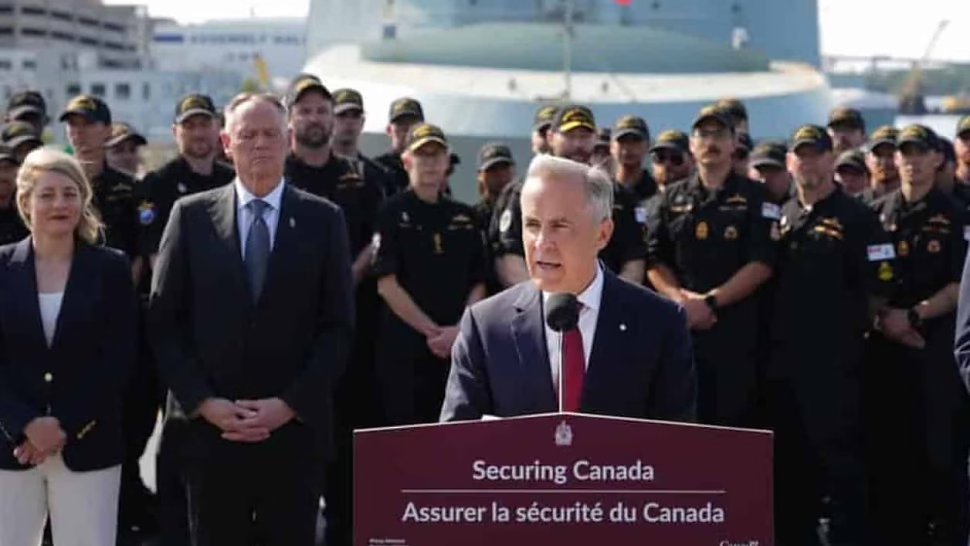
Canada selected the German company ThyssenKrupp Marine Systems (TKMS) as a preferred supplier for the construction of up to 12 submarines. Prime Minister Mark Carney called the operation the largest military acquisition in the country’s history.

The announcement comes days before Carney attends a NATO summit, where allies face pressure to increase their defense spending. The president affirmed that the TKMS platform is optimal for Arctic waters and for the alliance.

“The submarine is proven and capable,” declared Carney.

TKMS supplies submarines to more than a third of NATO members. Carney declined to reveal the exact price, but said it will involve an investment of “tens of billions of dollars.”

German Chancellor Friedrich Merz thanked Carney and stressed:

“This is a strong signal for our transatlantic and European alliance.”

The German company beat the South Korean Hanwha Ocean. ThyssenKrupp said its submarines will strengthen interoperability, as many NATO allies already operate conventionally powered vessels.

Canada has committed to increasing its military spending after years of lagging behind NATO goals. Carney promised to raise defense spending to 5% of GDP by 2035, after reaching 2% of GDP this year, the alliance’s previous goal. The Canadian fiscal plan foresees spending reaching 4% of GDP by 2030.

Germany and Norway, countries that design the submarines together, will open production spaces to speed up deliveries. Canada would receive four submarines by 2034, two years earlier than projected. The new fleet will replace the four Victoria-class submarines, purchased second-hand from the United Kingdom in the late 1990s.

No American company submitted a bid, as the United States only builds nuclear-powered submarines, while Canada was looking for conventional vessels.

“The sovereignty of our country, bounded by three oceans and the longest coastline in the world, depends on our maritime capabilities,” concluded Carney.

Continue reading