
SEP advances return to school date for the 2026-2027 cycle

The return to classes would be August 31, 2026, according to the SEP.

Summer holidays and back to school

The SEP 2026-2027 school calendar is not yet published in the Official Gazette of the Federation. However, the agency has already advanced the scheduled date for the start of the next cycle.

According to the Ministry of Public Education, preschool, primary and secondary students — both public and private schools — would return to the classrooms on Monday, August 31, 2026.

RelatedSEP confirms return to school date after winter holidays

In recent days, versions have circulated about a possible adjustment that would delay the return to September in some entities. Until now there is no official modification, so it is recommended to wait for the publication of the final calendar.

Closing and rest activities

Current classes will conclude on Wednesday, July 15. That day the summer holidays begin for the students.

The break will last approximately six weeks. Many families take the opportunity to travel, do recreational activities or live together at home.

Teaching staff, on the other hand, will have additional work days. On July 16 and 17, they will participate in an Intensive Continuing Training Workshop, focused on academic updating and planning for the next cycle. After that, they will also begin their vacation period.

The SEP reminds that the official calendar will be published soon. Until then, the tentative return date is August 31.
Reform against sexual abuse takes effect in 24 states

24 states have already published the reform that unifies the crime of sexual abuse at the federal level.

The Women’s Secretariat reported that 24 federal entities have already approved, enacted and published the reform to harmonize the crime of sexual abuse in their local legislation. He described it as a “transcendental advance” within the Comprehensive Plan against Sexual Abuse.

What changes with this reform?

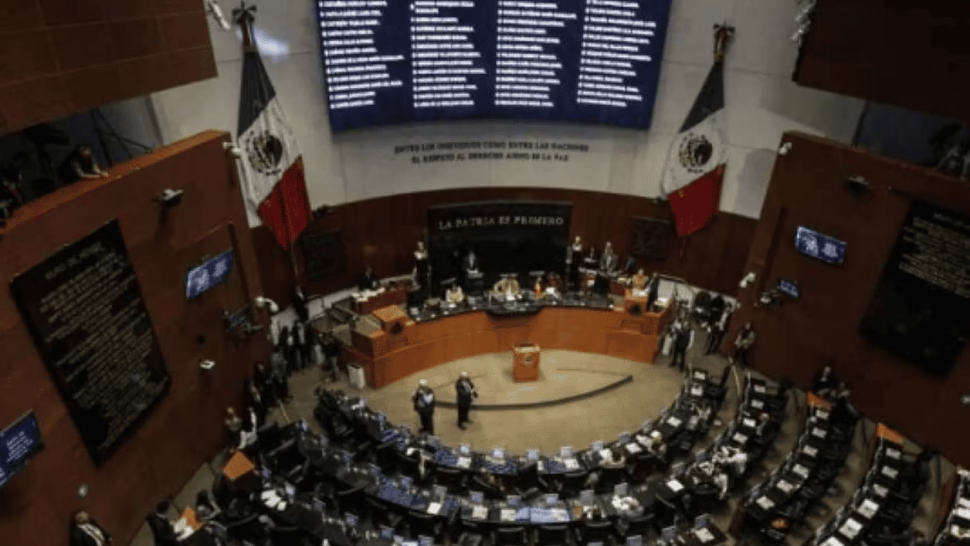
The initiative was approved by the Senate, the Chamber of Deputies and published in the DOF on March 13, 2026. By unifying the criminal type, the disparity in criteria between states is eliminated. The actions considered as sexual abuse in both the public and private spheres are clarified.

The decree, presented by President Claudia Sheinbaum, reforms articles 260 and 266 Bis of the Federal Penal Code. It defines sexual abuse as any act of a sexual nature without the consent of the victim and without the purpose of copulation. Includes touching, caressing, body rubbing, exhibitions or explicit sexual representations. It is also considered sexual abuse when the victim is forced to expose her body.

Consent cannot be presumed from silence, passivity or lack of physical resistance. The penalties range from three to seven years in prison, a fine of 200 to 500 times the UMA, and the obligation to attend re-educational workshops with a gender perspective or provide social service. Compliance with this obligation is key to the conditional suspension of the process.

The crime will be prosecuted ex officio. The penalties increase by a third if circumstances such as physical, psychological or moral violence occur; participation of two or more people; unpopulated place; relationship of trust, sentimental, work or educational between the aggressor and the victim; when committed by a public servant, professional or religious minister taking advantage of his position; when the victim is under the influence of alcohol or drugs; in a state of pregnancy or postpartum; due to sexual orientation, gender identity or expression; or when the victim is in a state of defenselessness.

In the case of public servants, dismissal and disqualification are added for the same term of the sentence. For professionals and ministers of worship, disqualification from exercising their profession or position.

Continue reading

UN-DH: freedom of expression at risk after the death of two journalists

UN-DH and Amnesty condemn murders of two journalists; They demand justice with a gender perspective

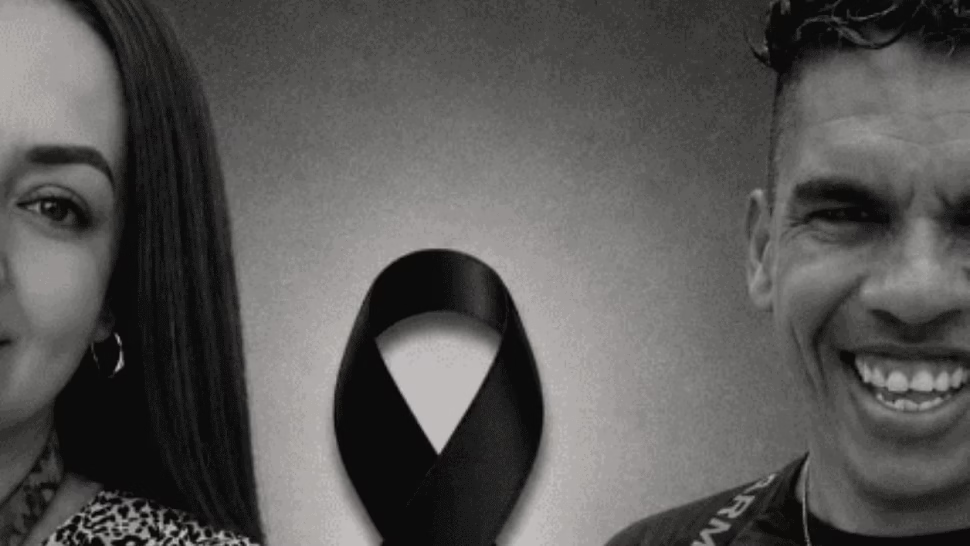
The Office in Mexico of the UN High Commissioner for Human Rights (UN-DH) expressed its dismay at the disappearances and subsequent lifeless findings of journalist Roxana Guzmán and journalist and environmental activist Alex Serna, which occurred in June in Veracruz and Guerrero. The organization called on the authorities to clarify the facts, considering the exercise of freedom of expression as a line of investigation.

The case of Roxana Guzmán

Roxana Guzmán ran a digital media outlet and was allegedly the only woman who covered the police source in the south of Veracruz. The UN-DH highlighted the need to protect freedom of expression with a gender perspective, due to the differentiated risks that women journalists face. The Veracruz Prosecutor’s Office confirmed on July 3 the identification of his remains through expert evidence. Eight people were arrested for their probable participation in his kidnapping and deprivation of life.

The case of Alex Serna

Alex Serna investigated environmental issues on the Costa Grande of Guerrero and defended water and land, in addition to denouncing possible acts of corruption. His disappearance was reported at the end of June; He was later found dead in Zihuatanejo. Human rights organizations indicated that he had reported threats arising from his investigations into projects with environmental impact.

The UN-DH stressed that clarifying both cases is essential to combat impunity and guarantee comprehensive reparation to the families.

Amnesty International condemned the deprivation of Roxana Guzmán’s life and demanded an exhaustive investigation with a gender and human rights perspective. The organization warned that in Veracruz at least three journalists have been killed this year.

“No attack against the press can go unpunished,” the organization emphasized.

He also called to adopt effective security measures for those who practice journalism and to investigate the structural causes of these attacks.

“Each murdered journalist is a voice that is being tried to be silenced,” said Amnesty International when reiterating its demand for guarantees of non-repetition.

Continue reading

The US accuses ‘Carlitos Rugrats’ of narcoterrorism

Lieutenant of the Sinaloa Cartel faces charges of fentanyl trafficking and violence.

The United States government presented a formal accusation against Carlos Páez Pereda, alias “Carlitos” or “Carlitos Rugrats”, for narcoterrorism and material support for terrorism. He is identified as an alleged high-ranking lieutenant of the Sinaloa Cartel, responsible for trafficking fentanyl, cocaine and methamphetamines into US territory.

The accusation was filed in the court of the Southern District of California. According to authorities, Páez led a violent faction known as the “Rugrats”, linked to the structure of Ismael “El Mayo” Zambada.

“Today’s indictment underscores the FBI’s determination to dismantle the most violent elements of the Sinaloa Cartel,” said Mark Remily, special agent in charge of the FBI’s San Diego office. “The Rugrats have fueled brutal violence in Mexico that extends to the United States, along with a relentless flow of deadly drugs into our communities.”

Details of the accusation

According to court documents, Páez ran a methamphetamine, fentanyl and cocaine manufacturing and distribution network. He is also accused of resorting to homicides, kidnappings and armed groups to impose the cartel’s orders in Sinaloa and Tijuana. The DEA noted that his organization used violence to protect its operations.

DEA Special Agent James Nunnallee said: > “For years, Pereda allegedly fueled the drug crisis by trafficking lethal drugs into the United States, while using violence, intimidation and fear to protect his criminal organization.”

It is estimated that Páez has imported tens of thousands of kilograms of these substances and has laundered hundreds of millions of dollars. In September 2025, the Office of Foreign Assets Control (OFAC) designated him a drug kingpin, blocking his assets in the US.

Possible penalties

For the narcoterrorism charges, “Carlitos Rugrats” could receive a minimum sentence of 20 years in prison and up to life in prison, in addition to a fine of $20 million. The accusation is based on the designation of the Sinaloa Cartel as a terrorist organization by the Donald Trump government.

Prosecutor Adam Gordon commented: > “You can’t capture a cartoon character. But you can capture a narco-terrorist,” alluding to the name of the faction inspired by the Rugrats cartoon.

Páez, 30 years old and originally from Laguna Colorada, Sinaloa, used to show off weapons on social networks. He has been linked to René Arzate García, head of the “Los Mayos” plaza in Tijuana.

Continue reading