Referee controversy clouds Argentina’s passage to the quarterfinals

An annulled goal against Egypt sparks controversy in the 2026 World Cup against Argentina.

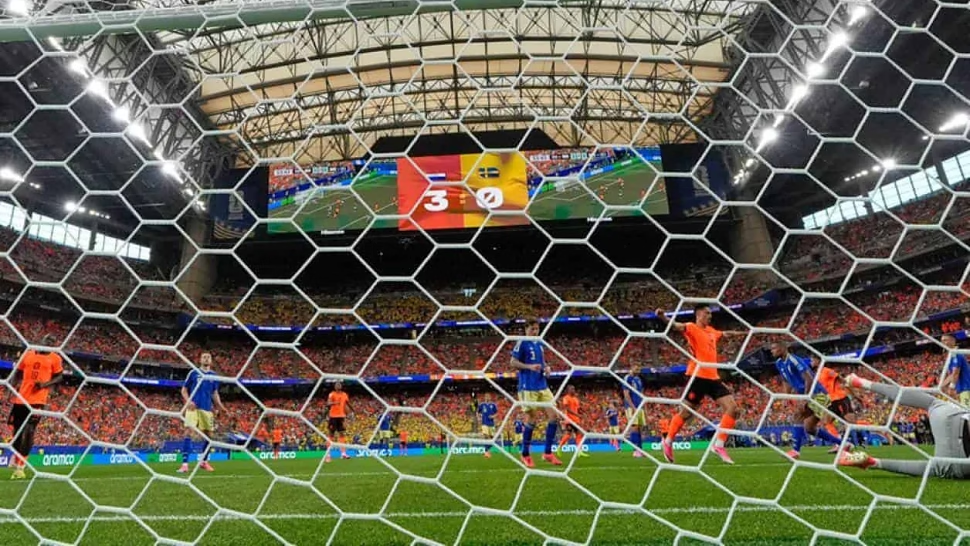
Egypt’s elimination against Argentina in the round of 16 of the 2026 World Cup unleashed a strong controversy. The reason: a goal disallowed for the African team and two referee decisions that marked the match.

Argentina came back from 2-0 down to win 3-2 and advance to the quarterfinals. Lionel Messi led the reaction of the two-time world champion, who is seeking the two-time championship. In the 58th minute, Egypt found the score 2-0, but the VAR reviewed the previous play and annulled the score due to an alleged foul on Lisandro Martínez.

RelatedArgentina vs Egypt: duel for the ticket to the quarterfinals

Is it missing or not?

The play divided opinions. For Egypt, there was no violation. For Argentina, the decision was correct. Social networks lit up with comments for and against.

Egypt’s reaction

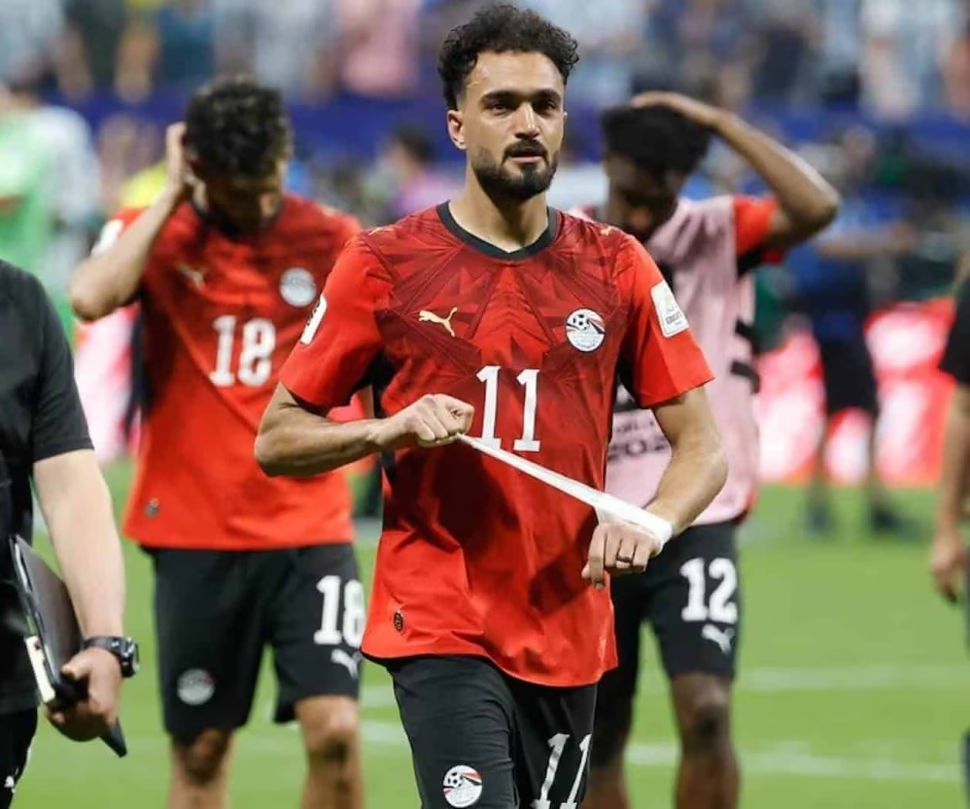
At the end of the match, footballer Mostafa Ziko expressed his discomfort:

“Congratulations to Argentina for the World Cup, the tournament was rigged, they didn’t need anything else… the referee was unfair, unfair, unfair, unfair. The Cup is directed towards Argentina.”

The statement reflects Egyptian frustration over the refereeing decisions in a match that defined the first place in the quarterfinals.
Enner Valencia says goodbye to Pachuca after the World Cup

Enner Valencia leaves Pachuca after the World Cup. His next destination would be the MLS.

The 2026 World Cup featured several representatives from Liga MX. Among them, the Ecuadorian Enner Valencia stood out, who defended the colors of his team with the hope of winning the highest FIFA trophy.

His participation was complicated. Ecuador faced Mexico in the round of 16 and was eliminated. Despite this, the forward maintained his hierarchy as a leader and scorer.

Until a few hours ago, Valencia belonged to Pachuca, a club where he arrived as a star figure. But the Hidalgo board officially announced his departure through social networks.

The legacy of ‘Superman’ in Pachuca

The Tuzos dedicated a message of gratitude to the attacker. They recognized his professionalism, commitment and dedication.

“Enner, thank you for all the effort and talent you have contributed to defending this shield, becoming a fundamental part of this history. We wish you the greatest success in your future projects, with the certainty that your legacy remains marked in the hearts of our fans,” the club wrote.

Valencia leaves with 26 goals in 47 games. His departure leaves a void in the blue and white attack.

According to Ecuadorian media, the 35-year-old player’s future points to the MLS. He has experience in Europe and would now define his next destination in the following days.

Continue reading

France faces Morocco in the World Cup quarterfinals

France is seeking the semifinals against Morocco, which is seeking revenge in 2022.

Moroccan revenge on the horizon

France and Morocco will meet on Thursday in the World Cup quarterfinals. The duel relives the 2022 clash in Qatar, when Morocco made history as the first African team in the semifinals. That time, France won 2-0.

Now, the African team is the only one from its continent still in contention in North America. Les Bleus want to confirm their favoritism and reach their third consecutive semi-final.

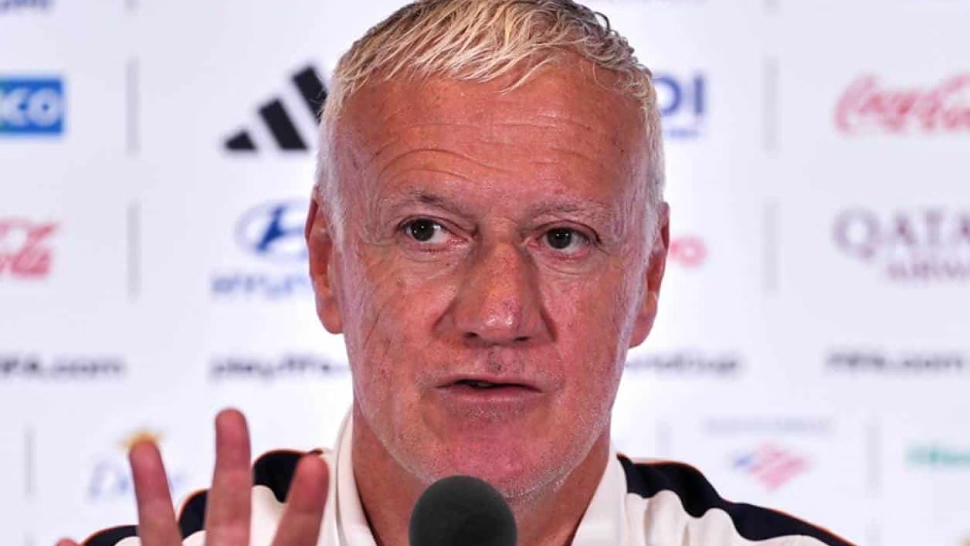
Didier Deschamps, French coach, anticipates a complex match. “Morocco’s profile is not that of Paraguay. They are an excellent team, with top-level individuals. They are not here to play just to play. They are here to win,” he declared on Tuesday.

Olise’s appeal, unsuccessful

FIFA rejected France’s appeal on Wednesday for the yellow card Michael Olise received against Paraguay. The card was shown at 97 minutes due to a struggle with Matías Galarza Fonda. Replays showed Olise holding the opponent’s jersey.

Deschamps confirmed the news: “There was no change regarding Olise’s yellow card. We received this morning the decision from FIFA that it would stand.” If Olise receives another yellow card on Thursday, he would miss a possible semi-final.

The case drew comparisons with US President Donald Trump’s intervention before Gianni Infantino so that Folarin Balogun was not suspended. FIFA lifted the sanction, but the United States lost 4-1 to Belgium and was eliminated.

Mbappé, on the margins of the controversy

Deschamps also addressed Paraguayan senator Celeste Amarilla’s insults against Kylian Mbappé on social networks. The French prosecutor’s office investigates hate speech. “Kylian is strong and nothing affects him. He is at a high level,” said the coach.

Regarding the refereeing – three yellow cards for France and none for Paraguay in the round of 16 – Deschamps was cautious: “It is out of our control. I trust the refereeing. Our rival is Morocco, not the referee.”

Asked about his future after the tournament, as he will leave the national team after 14 years, he responded: “I’m not thinking about that. I’m focused on the Moroccan team to win that match.”

Continue reading

The World Cup ball: technology that you cannot take home

Why should fans return the ball? Technology and tradition explain it.

A memory that gets out of hand

The World Cup balls have made headlines for their technology, but also for a rule that surprises many: fans must return them to the field immediately. Curiosity is great, especially for those who spend fortunes on trips and tickets.

“With the amount of money I spent, I should definitely be able to keep a ball,” said England fan Jack Goodwin, who used his house down payment to travel with his father from London.

In football, the tradition is different from baseball, where catching a ball is a lifelong memory. One Congo fan summed it up: “We didn’t come here for an award, we came to see our country.”

Why does FIFA demand to return them?

FIFA did not officially respond, but historian Charles Cutton points to economic reasons and the pace of play: “In the past there used to be only one ball per game. You had to recover it to continue.”

Official balls cost between $60 and $180 in stores, but the real cost of match balls is higher due to their technology. The Adidas Trionda of this World Cup has a 500 Hz motion sensor that sends data to the VAR to determine offsides and goals.

Professor Jud Ready of Georgia Tech explains: “They have evolved from leather to polyurethane. It doesn’t absorb moisture, it improves performance.” His colleague Manos Tentzeris adds that the sensor has 99.99% accuracy and works with cameras to locate any point on the field.

Technology that does not work outside the stadium

Ready points out that the ball depends on the stadium infrastructure to communicate. Additionally, it must be charged before the game with a wireless system similar to that of a smart watch. This makes it almost impossible for a fan to take advantage of it as a functional souvenir.

“The balls have radio frequency transmitters and accelerometers,” details Ready. But outside the stadium, those components are useless.

Although some dream of keeping one, FIFA remains firm in its policy. The ball, for now, only shines on the court.

Continue reading