The Canicula 2025 begins on July 3 with 40 days of extreme heat

The hottest period of the year will bring risks to health and agriculture in Mexico.

The phenomenon of the Canicula and its impact in Mexico

After the Summer Solstice and an intense rainy season, Mexico is preparing to face another significant climatic event: the Canicula. This period, also known as intra-summer drought, is characterized by a drastic increase in temperatures, reaching up to 45 degrees Celsius in some regions. According to data from the National Meteorological Service (SMN), this phenomenon will begin on July 3, 2025 and will last for approximately 40 days, concluding around August 11.

Causes and characteristics of the Dog Days

The Dog Day is the result of excessive heating of the air, combined with more intense trade winds that inhibit cloud formation. This process significantly reduces precipitation, creating clear skies and arid conditions. Unlike traditional droughts, this phenomenon is temporary, but its impact can be severe, especially in sectors such as agriculture, where the lack of rain affects crop cycles.

RelatedCanicula 2025 in Mexico what you should know according to AI

The exact dates of the Dog Days vary each year due to factors such as:

  • The intensity of the winds in the Gulf of Mexico and the Pacific.
  • Local oceanic and atmospheric conditions.
  • The previous behavior of rainfall in each region.

Most affected regions and health effects

Southeast Mexico will be the most impacted area, with states such as Campeche, Yucatán, Quintana Roo, Tabasco, Veracruz, Guerrero and Oaxaca experiencing the highest temperatures. On the contrary, regions such as Sonora, Sinaloa, Zacatecas, Baja California and Mexico City will feel minor effects.

This period carries significant health risks, including:

  • Heat stroke due to prolonged exposure to high temperatures.
  • Dehydration, especially in children and older adults.
  • Skin damage due to intense solar radiation.

Recommendations to mitigate the effects

To reduce the risks associated with the Canicula, health authorities recommend:

  • Constant hydration: consume at least 2 liters of water a day.
  • Avoid sun exposure between 11:00 a.m. and 4:00 p.m., when UV rays are most intense.
  • Wear light, light-colored clothing, as well as hats and protective glasses.
  • Apply sunscreen and moisturizing creams to take care of the skin.
  • Prioritize spaces with adequate ventilation and air flow.

Conclusion and call to action

The Dog Day 2025 represents a climate and public health challenge that requires preparation. Knowing its dates, effects and preventive measures is key to minimizing its impact. Share this information on your social networks to help more people face this period of extreme heat. If you want to delve deeper into meteorological topics, explore our related content.
National Guard: 125 thousand elements and decrease in homicides

Sheinbaum led the National Guard's seventh anniversary with deployment numbers and results.

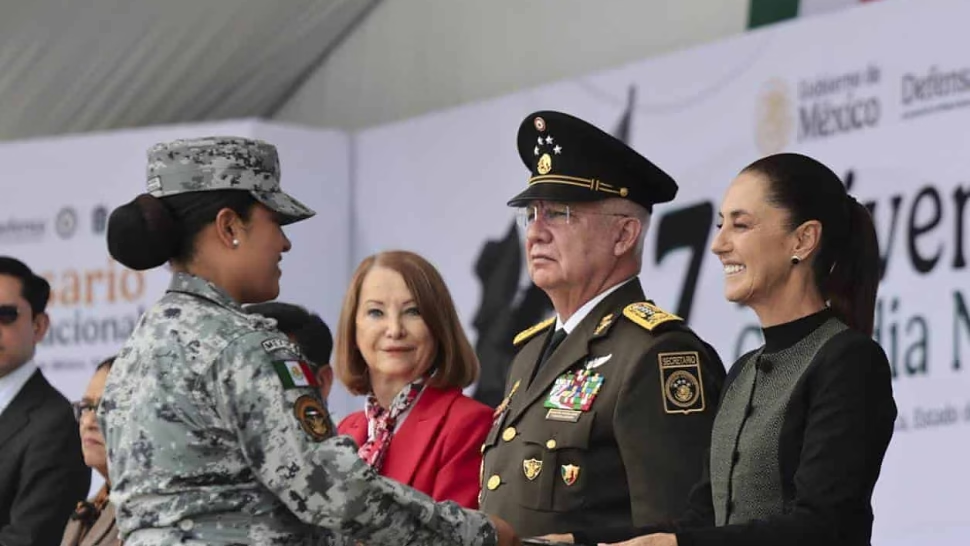
In Huehuetoca, State of Mexico, President Claudia Sheinbaum led the ceremony for the seventh anniversary of the National Guard, created in 2019.

Sheinbaum reported that the corporation has 125 thousand elements deployed in 53 coordinations and 590 barracks built by the Army. He highlighted that intentional homicide decreased 46% since October 2024, as part of the National Security Strategy.

Operating figures

Commander Guillermo Briseño Lobera explained that in the current six-year term, 45 thousand people have been arrested for crimes, 23 thousand firearms have been seized, more than 213 tons of drugs have been seized and two thousand clandestine laboratories have been dismantled.

He announced that Sedena is promoting a plan to reach 170,000 troops and 886 facilities by the end of the six-year term.

The president presented decorations to the personnel outstanding in security, training and confiscations, with special recognition to the elements of the Teotihuacan archaeological zone for their performance last April.

Continue reading

Mother of ABC Daycare victim demands justice from FGR

Victim's mother denies that the case is closed and demands that FGR resume investigations.

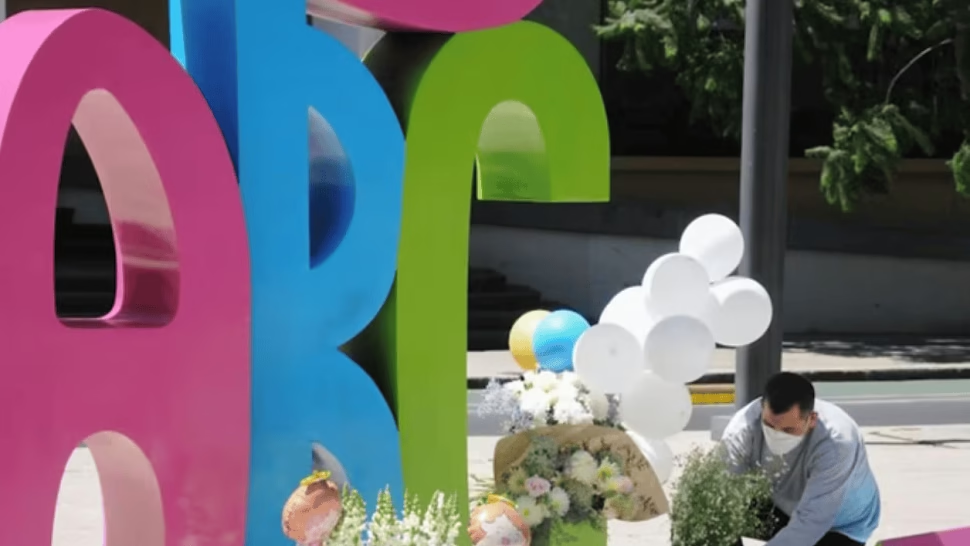
Juanita Luna, mother of one of the victims of the ABC Daycare, responded to the statements of President Claudia Sheinbaum. He clarified that the judicial file has never been closed and demanded that the Attorney General’s Office (FGR) continue the investigations.

The recent resolution of the Supreme Court of Justice of the Nation (SCJN) did not order reopening the case, Luna said. What it ruled is that crimes committed against minors are imprescriptible. Therefore, those responsible for manslaughter still need to be prosecuted.

Gabriel Alvarado Serrano, legal representative of the Manos Unidas por Nuestros Niño collective, explained that this judicial criterion strengthens the demand for justice. It marks a historical precedent for Mexican children, he noted.

Now it is up to the FGR to accelerate the current investigation files, the lawyer warned. If new evidence emerges, other public servants who were not originally included may be called to account regardless of the time that has passed.

During her morning conference, President Sheinbaum stated that the Prosecutor’s Office must reach the ultimate consequences in this case. He promised to deliver all the information required by the IMSS.

Sheinbaum also pointed out that the surrogate daycare model implemented during Felipe Calderón’s six-year term was marked by corruption, nepotism and serious security deficiencies. These failures led to the tragedy that claimed the lives of 49 minors in 2009.

Continue reading

They seek to hire substitute teachers during strikes in Oaxaca

Morena's initiative seeks to guarantee educational continuity during teacher strikes in Oaxaca.

Morenoist proposal in response to teacher strikes

The local representative of Morena, María Eulalia Velasco Ramírez, presented an initiative to reform the Oaxaca Education Law. Their objective: to force the state government to hire substitute teachers during teacher strikes.

The legislator seeks to provide continuity to the educational service. To this end, it proposes immediate response mechanisms in the event of any suspension of teaching activities. The proposal now remains in the hands of the local Congress.

The reality of the protests in the state

Every year, Section 22 of the SNTE carries out staggered strikes as part of its union pressure strategy. In 2024, the protests lasted a month and mainly affected basic education schools. It is not the only union: there are also recurring strikes at the “Benito Juárez” Autonomous University of Oaxaca (UABJO) and other high school campuses.

Velasco Ramírez —mother of the Secretary of Tourism, Saymi Pineda— maintains that her initiative protects the right to education under the principle of the best interests of children. According to the representative, the most vulnerable students are the ones who suffer the most from suspensions.

Measures that the IEEPO would authorize

The reform empowers the State Institute of Public Education of Oaxaca (IEEPO) to take administrative, academic and extraordinary measures when the service is interrupted due to the unjustified absence of teaching staff. Among the permitted actions are: immediately designate substitute staff, enable alternative in-person care locations in nearby facilities, or implement academic strategies to avoid the loss of the school year.

The initiative emphasizes social justice for rural, indigenous communities or areas without internet access. In these cases, the educational authority must always prioritize the in-person modality to guarantee learning.

Continue reading