T-MEC: total uncertainty and tougher US stance, according to the CCE

The CCE reveals a tougher US stance on the T-MEC and possible Trump departure.

The theater of the T-MEC: act of uncertainty

José Medina Mora, president of the Business Coordinating Council (CCE), dropped a bomb at the 35th Insurers Convention. The review of the T-MEC is no longer a simple diplomatic procedure. It is a drama with a changing script.

Until March, everything seemed to be going smoothly. But April came with another script. The United States trade representative, Jamieson Greer, landed in Mexico with a position that, according to Medina Mora, was “much harsher.”

“President Trump wanted to get out of the treaty, that he did not believe in free trade, that there were going to be tariffs for everyone” — the leader confessed.

But not everything is darkness. Greer left a gap: “a space for Mexico, if we work on rules of origin and reduce Asian purchases to increase North American ones.”

RelatedCCE denies institutional links with Raúl Rocha Cantú

The only certainty: uncertainty

Medina Mora said it clearly: uncertainty is already part of the business landscape. Investments don’t stop, but now they carry extra risk.

On July 1 there will be no closing of the treaty. Just an announcement that “we are doing well.” The final decision, as in any work by a single actor, depends on Donald Trump. Renewal for 16 years with six-year reviews? Or only 10 years with annual reviews? Nobody knows.

Meanwhile, companies are learning to dance in the rain of uncertainty. Because in this theater, the curtain has not yet fallen.
Ernesto Ruffo arrested for alleged prosecutor huachicol

Former PAN governor arrested in Ensenada for alleged fuel smuggling. The FGR links him to the Ingemar company.

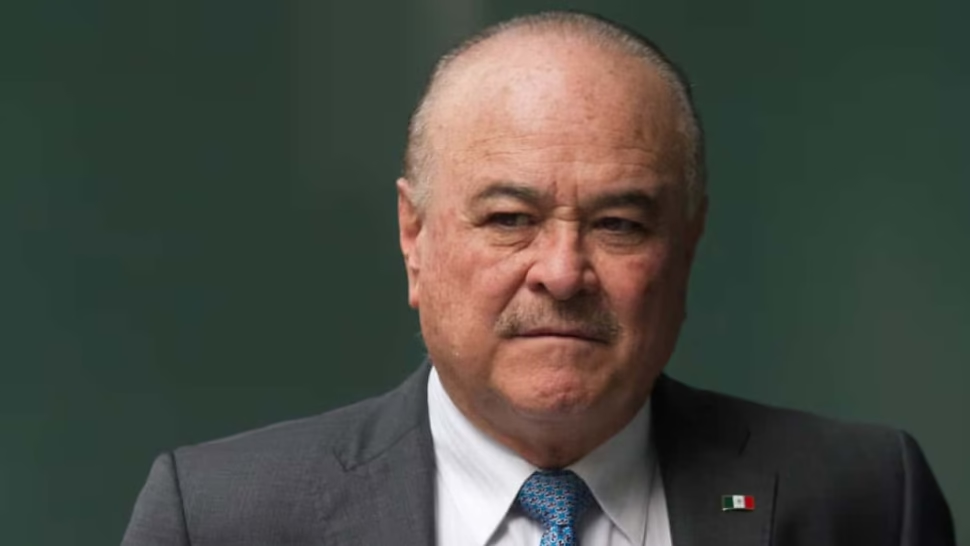
The Attorney General’s Office of the Republic (FGR) arrested the former PAN governor Ernesto Ruffo Appel, 74, this Thursday in Ensenada, Baja California. He is accused of crimes related to organized crime and fuel smuggling, a modality known as huachicol fiscal. The arrest stems from a “highly complex” investigation against the company Ingemar, founded by Ruffo and dedicated to customs procedures.

Charges and background

The case dates back to July of last year, when authorities seized nearly 15.5 million liters of fuel and 129 tanker trucks in Coahuila. It was the largest hydrocarbon seizure during Claudia Sheinbaum’s government. After that operation, the Secretary of Federal Security, Omar García Harfuch, identified Ingemar as one of the companies under investigation for its possible link with the transfer of fuel.

Ruffo acknowledged being a shareholder in Ingemar, although he said he did not have a majority stake. In interviews, he stated that the company only carried out imports and reported irregularities at customs. “We imported some of the volumes,” he declared, rejecting direct responsibility for smuggling.

Research and reactions

According to the FGR, the arrest warrant was obtained after gathering investigative elements. The case also includes Ricardo Thompson, one of the founders of Ingemar, who asked to investigate his partners and accused that in 2021 Ruffo and José Merino Valdés stripped him and his son of shares and administrative positions.

The National Action Party (PAN) expressed support for the former governor and trusted that he will clarify the allegations. The PAN leadership questioned the arrest and asked for justice without partisan distinctions. Ruffo, a historic member of the PAN, was the first state governor in opposition to the PRI in 1989, and then a senator and federal representative. His case adds to the investigations into hydrocarbon smuggling networks in border areas, especially Tamaulipas.

Continue reading

SNTE confirms disappearance of USICAMM in Congress

The SNTE announces the end of USICAMM and the opening of a national teaching consultation.

End of USICAMM and national consultation

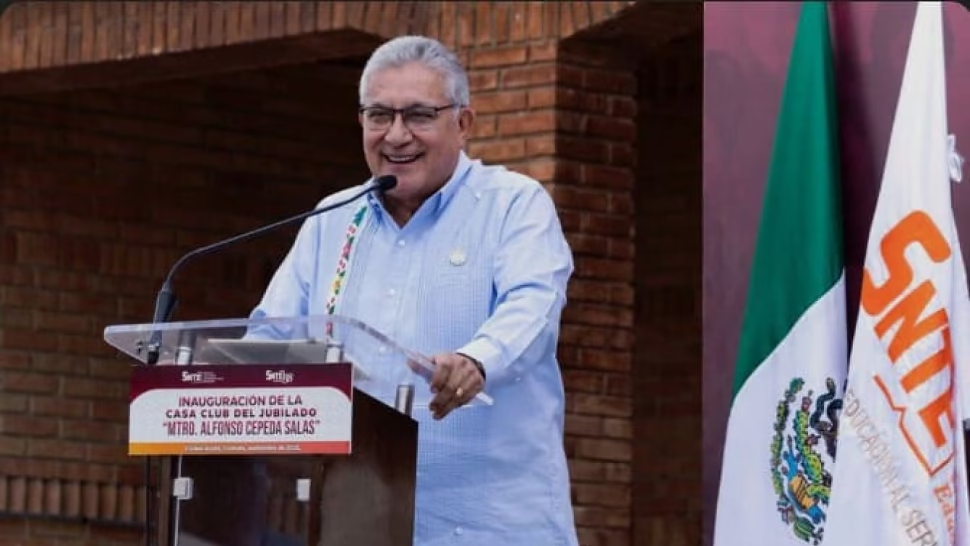
The general secretary of the SNTE, Alfonso Cepeda Salas, stated that the System Unit for the Career of Teachers (USICAMM) will be eliminated during the next regular session of the Congress of the Union. The statement occurred in a meeting with the union structure of sections 9 and 10 in Mexico City.

Cepeda highlighted that the permanent dialogue with the federal government has strengthened teacher representation and allowed us to recover spaces for participation in labor decisions. He also thanked President Claudia Sheinbaum for the support of the SNTE as the legal representative of education workers.

The leader pointed out that one of the union’s central objectives is to build a new mechanism that replaces USICAMM. To this end, the federal government will begin a national consultation in August with the purpose of collecting proposals from teachers. The goal is to design a more transparent, equitable and respectful model of labor rights.

Advances in working conditions

Cepeda also highlighted that, thanks to the recovery of bilaterality between the SNTE and the Ministry of Public Education (SEP), progress has been made in basification, labor mobility, promotions, recategorizations, payment of benefits and respect for acquired rights. The national consultation seeks to consolidate these achievements and address historical demands of the teaching profession.

Continue reading

Navy deploys amphibious and aerial operations in Veracruz

Navy carries out tactical exercise with semi-submersible scenarios and high-value capture.

Naval exercise in Veracruz

Elements of the Mexican Navy-Secretariat of the Navy carried out a Level V training exercise in the First Naval Region, based in the port of Veracruz. The activity combined naval, air, amphibious and special operations interventions to evaluate the capacity for coordinated response to maritime and national sovereignty risks.

Two tactical scenarios

The exercise, called “Defense in Depth”, included two scenarios representative of real operations. In the first, a semi-submersible vessel allegedly linked to illicit activities was detected, followed and intercepted. An ocean patrol, a Panther helicopter and an interceptor patrol participated. Marine Corps personnel carried out the boarding using rope techniques and neutralized the alleged offenders.

In the second scenario, the capture of a high-value target was simulated. Hours earlier, combat divers carried out reconnaissance and marking safe areas. Subsequently, Marine Corps troops were inserted into Zodiac boats and used fast rope, rappelling, and low-altitude infiltration parachuting techniques. Direct action allowed the target to be secured and extracted.

During the operation, the target received support from other violators, which were controlled with covering fire from Texan aircraft. The phased integration of capabilities reflected the tripartite division of assault teams, security with amphibious commands and paratrooper support.

The exercise demonstrated effectiveness in detecting, identifying and neutralizing threats from offshore through successive layers of surveillance, presence and intervention.

Continue reading