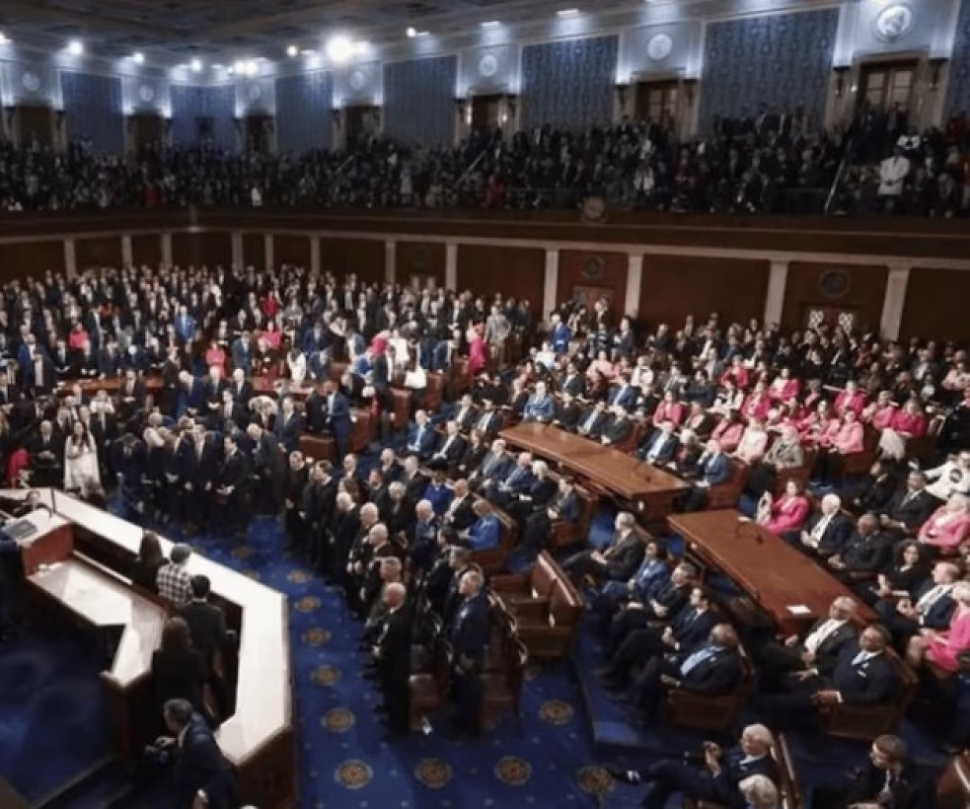
Business initiative against the revision of the T-MEC
In a context marked by the upcoming review of the Treaty between Mexico, the United States and Canada (T-MEC) and the commercial pressures of the US administration, the Business Coordinating Council (CCE) announced a strategic mission to Washington, D.C., for October 2025. The objective: to reinforce the narrative of economic complementarity in the region and mitigate the impact of possible measures tariffs.
Details of the bilateral agenda
Francisco Cervantes, president of the CCE, confirmed that a mixed delegation — made up of representatives of the federal government and leaders of the private initiative— will hold key meetings with legislators, the Office of the US Trade Representative (USTR) and the Department of Commerce. “We seek to demonstrate the advances in post-pandemic productive integration, especially in sectors such as automotive, steel and advanced manufacturing,” he highlighted during the Expo Trastienda 2025.
This effort responds to two immediate challenges: the absence of a permanent office of the Secretary of Economy in the US—closed in the previous six-year term—and the lobbying of other countries (such as Brazil and Canada) to obtain preferential tariff treatments. Currently, Mexico only has one commercial link in the United States, which limits its ability to communicate.
Priority sectors and communication strategy
The agenda will include sensitive topics such as:
- Regional supply chains and their resilience.
- Harmonization of labor and environmental standards.
- Preservation of profits for strategic products (aluminum, auto parts, heavy transportation).
Cervantes emphasized that the central message will be economic interdependence: “40% of the content of Mexican exports to the US comes from US inputs. This is not a zero-sum game.” Data from the Bank of Mexico supports this position: in 2024, bilateral trade will exceed $780 billion dollars.
Political context and risks
The visit coincides with an election year in the US, where figures from the Republican Party have proposed reviewing clauses of the T-MEC. Experts consulted point out that the success of the tour will depend on:
- The ability to articulate a unified position between business chambers.
- The support of technical data on binational job creation.
- Coordination with border state governments.
A recent report from the Wilson Center warns that, without a proactive strategy, Mexico could face trade disputes in 2026, especially in energy and agriculture.
Call to action
The economic integration of North America is a pillar for global competitiveness. Share this analysis on your social networks and explore more content on how trade agreements impact your industry. #TMEC #ForeignTrade
Sources: CCE, Banco de México, Wilson Center.