Navy deploys amphibious and aerial operations in Veracruz

Navy carries out tactical exercise with semi-submersible scenarios and high-value capture.

Naval exercise in Veracruz

Elements of the Mexican Navy-Secretariat of the Navy carried out a Level V training exercise in the First Naval Region, based in the port of Veracruz. The activity combined naval, air, amphibious and special operations interventions to evaluate the capacity for coordinated response to maritime and national sovereignty risks.

Two tactical scenarios

The exercise, called “Defense in Depth”, included two scenarios representative of real operations. In the first, a semi-submersible vessel allegedly linked to illicit activities was detected, followed and intercepted. An ocean patrol, a Panther helicopter and an interceptor patrol participated. Marine Corps personnel carried out the boarding using rope techniques and neutralized the alleged offenders.

RelatedSheinbaum highlights the role of the Navy in the defense of sovereignty

In the second scenario, the capture of a high-value target was simulated. Hours earlier, combat divers carried out reconnaissance and marking safe areas. Subsequently, Marine Corps troops were inserted into Zodiac boats and used fast rope, rappelling, and low-altitude infiltration parachuting techniques. Direct action allowed the target to be secured and extracted.

During the operation, the target received support from other violators, which were controlled with covering fire from Texan aircraft. The phased integration of capabilities reflected the tripartite division of assault teams, security with amphibious commands and paratrooper support.

The exercise demonstrated effectiveness in detecting, identifying and neutralizing threats from offshore through successive layers of surveillance, presence and intervention.
PAN denounces AMLO’s son for derailments of the Interoceanic Train

PAN files a complaint against AMLO's son for train accidents in Oaxaca.

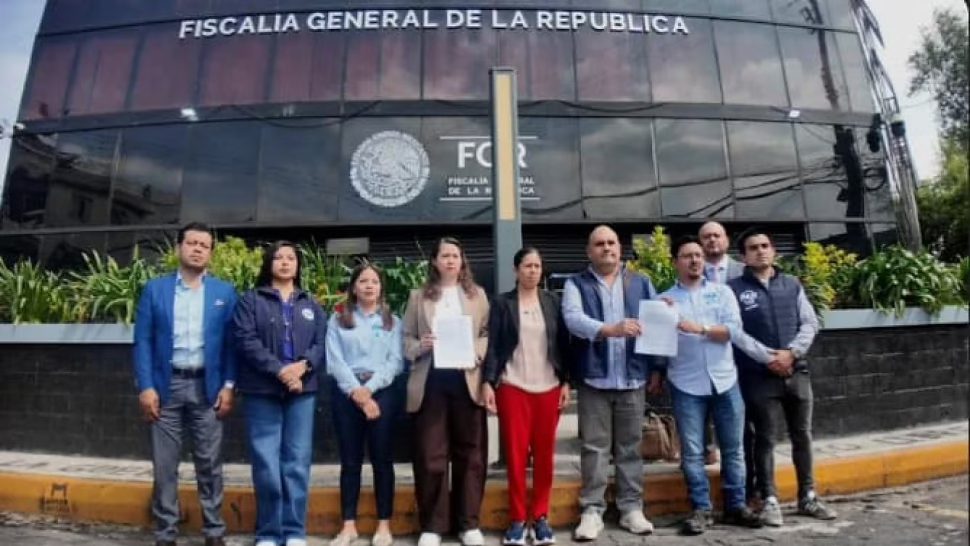
The PAN filed a complaint with the FGR against Gonzalo “Bobby” López Beltrán, son of former president López Obrador, for the derailments of the Interoceanic Train. The PAN members point to him as the main supervisor of the construction of the project.

The complaint also reaches authorities of the Ministry of the Navy, in charge of the operation of the railway system.

Accidents

The first derailment occurred on December 28, 2025 in Oaxaca, with 14 people dead and 109 injured. The second was on July 14, 2026, without victims.

Priscila Vera Hernández, national coordinator of the Environment of the PAN, stated that those responsible for the construction or the supervisors have not been summoned. Deputy Federico Döring accused the federal government of minimizing the first mishap and asked to investigate contracts.

Request to the FGR

The legislators ask for a broad investigation that is not limited to the driver for alleged excessive speed, but rather reviews rehabilitation works, construction processes and operating conditions of the Interoceanic Train.

Continue reading

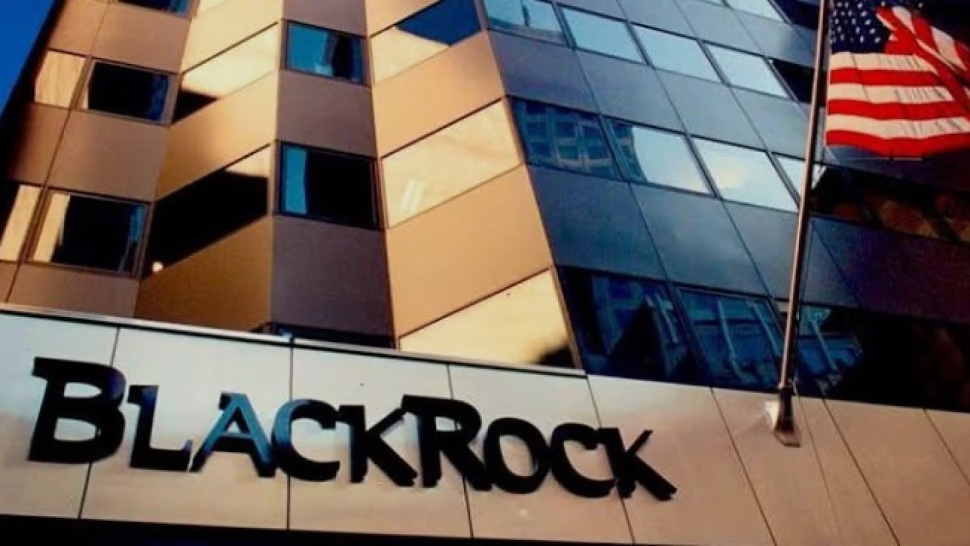
BlackRock points out Mexico as a strategic investment pole

The global investment fund sees opportunities in energy, logistics and infrastructure.

The areas of opportunity according to BlackRock

Mexico needs more investment to sustain its economic growth in the coming decades. This is what BlackRock considers, one of the largest investment funds in the world, which identifies strategic opportunities in energy, logistics and infrastructure.

Sergio Méndez, general director of BlackRock Mexico, indicated that there is interest in participating in the development of the country, as long as there are conditions of certainty. Companies look for scenarios where they can measure risks and make long-term decisions.

The Mexican energy sector is one of the main areas of opportunity, thanks to efforts to promote new investments in electricity generation. In addition, the country’s geographical location favors logistics, manufacturing and data center projects.

The T-MEC and the trilateral relationship

Regarding the Treaty between Mexico, the United States and Canada (T-MEC), Méndez said that the economic relationship between the three countries is highly integrated. A breakup would be complicated for all parties. He considered that, with or without the agreement, the foreign presence in strategic sectors will continue.

BlackRock will maintain its focus as an asset manager, but will continue to integrate technology to improve its services. The firm develops new digital tools to facilitate investment and help savers build more complete portfolios.

Continue reading

Fuel smuggling grew in militarized customs

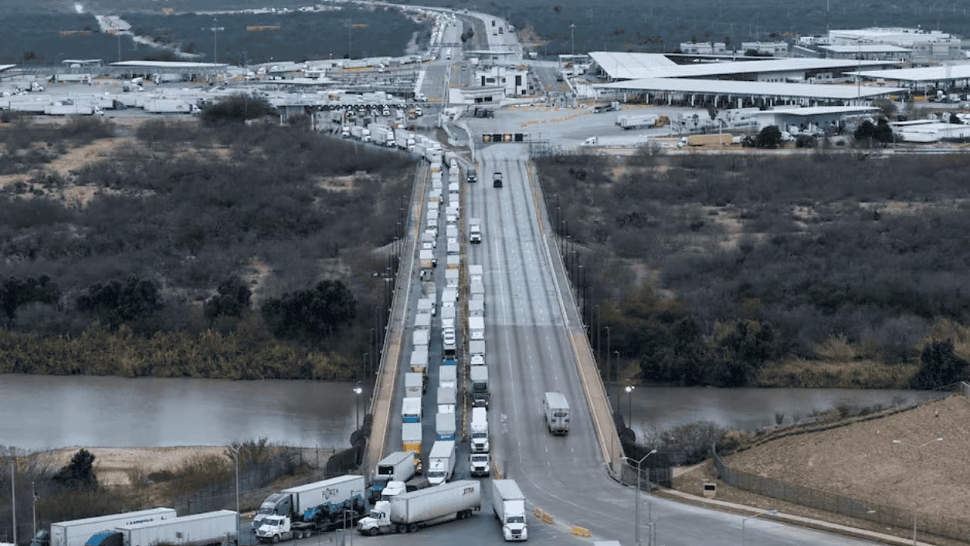
Imports of additives have skyrocketed in Matamoros since the Army took control of customs.

Smuggling in Matamoros: growth under military control

Fuel smuggling from the United States to Mexico, a practice that intensified during the six-year term of Andrés Manuel López Obrador, now involves three high-ranking soldiers from the Secretariat of National Defense (Sedena). The Attorney General’s Office (FGR) accuses them of facilitating the illegal entry of gasoline into the customs office in Matamoros, Tamaulipas, between June 1, 2024 and July 15, 2025.

An investigation by EL PAÍS, based on confidential documents and foreign trade databases, reveals that crime has multiplied in that border area since Sedena assumed control in mid-2020. The militarization of customs, justified by the former president as a measure to guarantee honesty and efficiency, did not prevent the fiscal huachicol – as hydrocarbon smuggling is known – from finding new ways of operating.

Ghost companies and figures that explode

Records show that in 2019 and 2020, suspicious imports of additives and lubricating oils did not exceed 2 million liters. Starting in 2021, with customs in military hands, the volume skyrocketed. That year, the company Nafta Aditivos Orgánicos, indicated in military documents as linked to illegal trade, imported 80 million liters of additives supplied by the American Hevi Logistics.

In 2022, Hevi Logistics shipped another 80 million liters. But the biggest jump occurred in 2023, when imports reached 690 million liters. Most of it came from Hevi Logistics and the rest from Ikon Midstream, another export firm under investigation by US authorities. The importers were old acquaintances, such as Sensive Solutions, which shares management with companies linked to the network of the Ministry of the Navy, or JSC Servicios Aduanales, which received millions of pesos from Ahavat Logistics Solution, identified as an intermediary for the Jalisco New Generation Cartel.

By 2024 and 2025, the numbers fell to pre-2021 levels. However, the FGR discovered a new method: using calcium chloride solution as a disguise. The JR Customs Services company would have smuggled 144 million liters of fuel between June 2024 and July 2025 with the complicity of the three fugitive soldiers.

Official response and previous evidence

Sedena responded to EL PAÍS that operational control of customs corresponds to the National Customs Agency of Mexico, although it reiterated its willingness to collaborate with the FGR. The prosecution described the case as “one of the largest smuggling schemes detected in the country.”

Internal documents leaked by Guacamaya Leaks indicate that the Government had information since January 2020 about the unusual increase in lubricant imports without economic support. In recent weeks, the United States Department of the Treasury sanctioned companies and individuals complicit in a tax huachicol network linked to the Jalisco Nueva Generación Cartel, with 160 reports of suspicious activities worth $7 billion from Texas and Florida.

Continue reading