Cyclospora outbreak linked to Taco Bell lettuce in five states

US health authorities link Taco Bell's shredded iceberg lettuce to a record cyclospora outbreak.

Cyclospora outbreak linked to Taco Bell lettuce

U.S. health officials have identified shredded iceberg lettuce served at Taco Bell restaurants in five states as the possible source of a widespread outbreak of cyclospora, a parasite that causes severe diarrhea. The Centers for Disease Control and Prevention (CDC) recommended avoiding this ingredient in establishments in Indiana, Kentucky, Michigan, Ohio and West Virginia.

Taco Bell measures and origin of the outbreak

The Food and Drug Administration (FDA) reported that the traceback identified a single supplier of the lettuce used by the chain. Although authorities did not officially reveal its name, an official said it is Taylor Farms, a company based in California. In response, Taco Bell voluntarily recalled the potentially contaminated lettuce and announced it will switch suppliers in the affected states.

RelatedCyclospora outbreak in the US sets an all-time high

The outbreak has reached a record number of cyclosporiasis cases in more than 30 states. Michigan alone reports more than five thousand infections and more than one hundred hospitalizations, with no recorded deaths. Authorities are also investigating whether other restaurants and businesses received lettuce from the same supplier.

Cyclospora is a microscopic parasite that is transmitted by food or water contaminated with fecal matter and causes severe diarrhea, abdominal pain and other gastrointestinal discomfort. Specialists point out that the increase in cases in the last decade is due to better detection of the disease and factors related to climate change.
Latin America reinforces emergency plans for El Niño

Countries in the region activate protocols in response to the strengthening of El Niño in the Pacific.

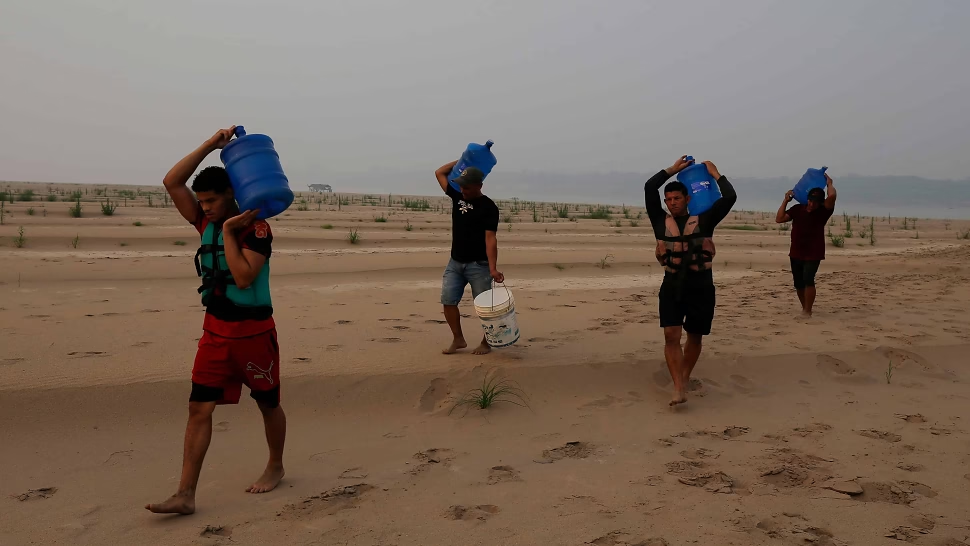
The governments of Latin America are accelerating their emergency plans in the face of the strengthening of the El Niño phenomenon in the Pacific. The World Meteorological Organization (WMO) confirmed that the event is already underway and warned that countries must act early to reduce impacts.

Governments take action

Brazil reinforced its brigades against forest fires. Colombia activated water monitoring systems. Other Central American nations are working on plans to protect vulnerable communities and guarantee basic services. Experts point out that, although the phenomenon develops gradually, authorities usually delay preventive actions until emergencies are already underway.

Expected impact

Droughts, extreme heat, fires, floods and impacts on water, energy and transportation systems are expected. Agricultural production and access to drinking water could be seriously damaged, especially in the most vulnerable communities. The WMO insists that early preparation is key to mitigating the adverse effects anticipated in the coming months.

Continue reading

Xi Jinping calls for global AI governance without unilateral dominance

China proposes international cooperation in artificial intelligence and offers training to developing countries.

China bets on global governance of AI

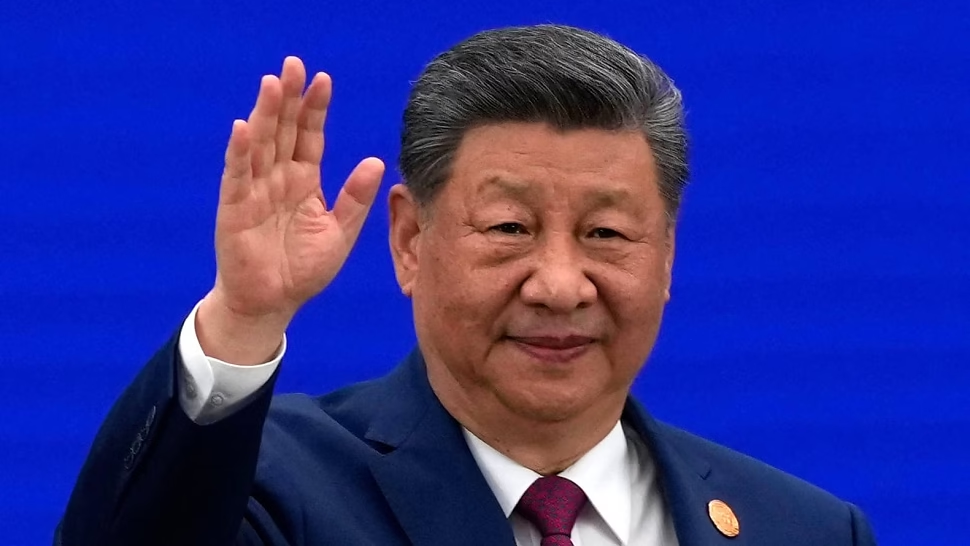
Chinese President Xi Jinping urged the promotion of global governance of artificial intelligence (AI) and stated that its development should not belong to a single country. During the opening of the World Conference on Artificial Intelligence in Shanghai, he questioned what he called an “overreach” of the concept of national security in this area, in clear reference to the technological restrictions imposed by the United States.

“Artificial intelligence must become a symphony of global cooperation, not an isolated competition between nations,” Xi said.

As part of its strategy, China will strengthen AI collaboration with organizations such as ASEAN, the Arab League, the African Union, CELAC and the BRICS countries. In addition, it will offer five thousand training opportunities for developing countries in the next five years.

Multilateral agreement in Shanghai

Before the event, 29 countries—including Russia, Pakistan and Kazakhstan—signed an agreement with Beijing to create a World Artificial Intelligence Cooperation Organization, based in Shanghai. Analysts interpret this initiative as China’s response to the US Pax Silica framework, which seeks to strengthen AI supply chains with its allies.

Continue reading

The US reduces visas for foreign journalists to 240 days

Trump administration shortens visa validity for foreign correspondents to 240 days.

Donald Trump’s administration implemented a drastic change to the visa system for international correspondents. From now on, visas for foreign journalists will have a maximum validity of 240 days, compared to the several years allowed by the previous scheme. In the case of Chinese journalists, the stay permit is reduced to only 90 days.

Reactions and justifications

The Department of Homeland Security explained that the “duration of status” system, which allowed correspondents to remain in US territory as long as they met their visa requirements, is eliminated. Instead, renewable fixed periods are established, with the aim of facilitating the supervision and review of each case.

Organizations such as Reporters Without Borders and the Committee to Protect Journalists pointed out that the measure restricts press freedom and hinders information coverage by international media in the United States. From Beijing, the Chinese government described the decision as discriminatory and warned that it will take response measures.

The new regulations also impact students and other visitors under similar schemes. At a time when Washington and Beijing seek to stabilize their bilateral relations, this immigration hardening could fuel tensions between both powers.

Continue reading