Sheinbaum promotes transformation in the Attorney General’s Office of Mexico

The president is looking for an effective institution that strengthens the security strategy and addresses stalled emblematic cases.

A Strategic Change in the Mexican Justice Department

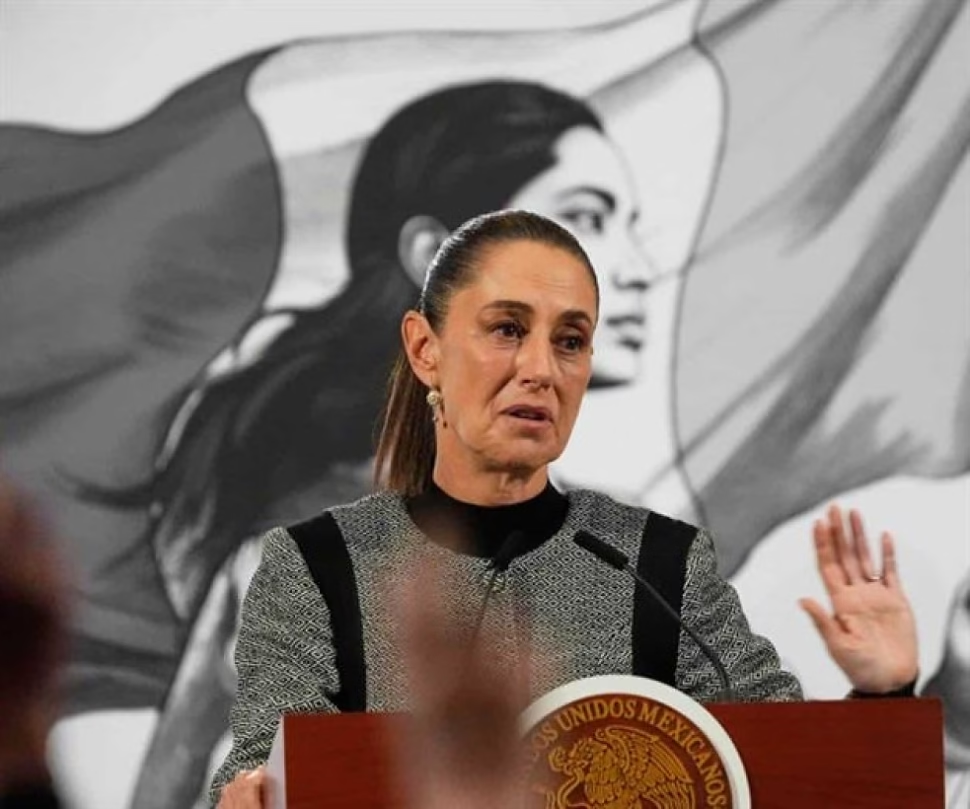
The President of Mexico, Claudia Sheinbaum, stated on Friday that the departure of Alejandro Gertz Manero from the Attorney General’s Office (FGR) represents a historic opportunity to reorient the administration of justice in the country. According to his statements at a press conference, the central objective of this change in leadership is to establish a more transparent prosecutor’s office, which strengthens the government’s security strategy and, fundamentally, demonstrates concrete results in the administration of justice.

The president emphatically expressed that, from her personal perspective, the institution requires a deep transformation for the benefit of the nation. His statements hinted at the possibility that there are aspects of the operation of the FGR during the previous mandate that deserve detailed analysis, although he specified that the focus should not be a punitive investigation of the past, but rather the assumption of an irrevocable commitment to citizens to advance security, peace and the goal of zero impunity.

RelatedGodoy promotes a comprehensive reform in the Attorney General’s Office

Appointments and Institutional Coordination

Prior to his departure, Gertz Manero appointed Ernestina Godoy Ramos, a figure of extreme trust for President Sheinbaum, as legal advisor in charge of the institution on an interim basis. Godoy, who served as prosecutor of Mexico City, will lead the organization until the Senate of the Republic, with a pro-government majority, appoints a new head permanently. Sheinbaum did not hide his preference, describing Godoy as “an extraordinary woman, of principles, honest, of many convictions and she demonstrated her results when she was prosecutor of Mexico City.”

The Chief Executive trusts that this new stage will allow synergistic coordination with the Ministry of Public Security, the National Guard and the state prosecutor’s offices, in order to strengthen investigation capabilities. As examples of this new priority, he mentioned two cases of high national relevance that have faced significant obstacles: the investigation into the smuggling of hydrocarbons, which implicates senior Navy commanders, and the investigation into the forced disappearance of the 43 students from the Ayotzinapa Rural Normal School in 2014. The latter, an emblematic case, experienced serious obstacles during the administration of Andrés Manuel López Obrador due to the lack of collaboration from the Armed Forces.

Background and International Context

Alejandro Gertz Manero, an 86-year-old veteran lawyer who held the position of Attorney General for almost seven years of a nine-year term, was a figure constantly involved in controversy. His management was the subject of numerous criticisms for the alleged use of the institution for political and personal purposes, in addition to generating recurring tensions in the bilateral relationship with the United States. His departure from the FGR materialized to assume the position of ambassador of Mexico in a destination that has not yet been revealed, a transition that was requested by President Sheinbaum herself.

The need for Mexico to carry out more effective criminal investigations is a demand that has been insistently reiterated by the United States government. This point was one of the central axes discussed during the visit to Mexico of the Secretary of State, Marco Rubio, in the month of September, underlining the international dimension and the geopolitical importance of a successful reform in the Mexican justice system. The transformation of the FGR is not only a domestic promise, but a crucial element for security cooperation between the two nations.

This analysis concludes that the replacement of Gertz Manero and the potential appointment of Ernestina Godoy symbolize a strategic turning point in the security policy of the Sheinbaum government. The success of this reorientation will be measured by the prosecutor’s office’s ability to distance itself from previous practices, resolve high-impact cases that have eroded public trust, and establish a new paradigm of transparency and effectiveness in the administration of justice for all Mexicans.

Do you think this change in the Attorney General’s Office will mark a before and after in Mexican justice? Share this news on your social networks and explore more analysis on the transformation of public institutions on our site.

IMSS Tamaulipas ofrece vasectomía sin bisturí en jornada gratuita

Jornada gratuita de vasectomía sin bisturí del 15 al 27 de junio en Reynosa y otros municipios.

El Instituto Mexicano del Seguro Social (IMSS) en Tamaulipas invita a hombres de 20 a 59 años a participar en la Jornada de Vasectomía sin Bisturí, del 15 al 27 de junio. La actividad se realizará en varias ciudades, incluyendo Reynosa.

Procedimiento ambulatorio y seguro

Laura Patricia Martínez Lima, coordinadora de Primer Nivel de Atención del IMSS, explicó que la estrategia está dirigida tanto a derechohabientes como a la población en general.

“El objetivo es fomentar la planificación familiar responsable y ofrecer a los hombres una alternativa segura, eficaz y permanente para el control de la fertilidad”, afirmó.

La vasectomía sin bisturí es un procedimiento ambulatorio que no requiere hospitalización. Se realiza en pocos minutos y permite retomar actividades cotidianas en un plazo de 48 a 72 horas. Es un método anticonceptivo permanente para quienes han decidido concluir su etapa reproductiva y contribuye a distribuir de manera más equitativa la responsabilidad en la planificación familiar.

“Es un procedimiento seguro, efectivo y de rápida recuperación. Con estas jornadas buscamos acercar el servicio a más hombres, promoviendo una paternidad responsable y una participación activa en la planificación familiar”, añadió Martínez Lima.

Sedes en Tamaulipas

Las jornadas se llevarán a cabo en las Unidades de Medicina Familiar (UMF): número 40 de Reynosa, 17 de Río Bravo, 24 de Ciudad Mante, 33, 36 y 39 de Matamoros, 38 de Tampico, 67 de Ciudad Victoria, 77 de Ciudad Madero y 78 de Nuevo Laredo. También en el Hospital General de Subzona con Medicina Familiar número 7 de Pánuco, Veracruz.

RelatedJulión Álvarez conquers Reynosa with a historic concert

Los interesados pueden acudir al área de Trabajo Social de cualquiera de estas unidades para recibir información y programar el procedimiento. No se requiere ayuno ni estudios previos.

Continue reading

Jóvenes Construyendo el Futuro: 3.5 millones de beneficiarios en ocho años

Sheinbaum detalla los alcances del programa social en Xalapa, Veracruz.

La presidenta Claudia Sheinbaum informó que el programa Jóvenes Construyendo el Futuro ha beneficiado a más de 3.5 millones de personas entre 2019 y 2026. El anuncio lo hizo durante una asamblea en el Museo Kaná de Xalapa, Veracruz.

Cifras del programa

El programa ofrece un año de experiencia laboral pagada por el gobierno. Los participantes son considerados aprendices y reciben un apoyo mensual equivalente al salario mínimo, además de seguridad social.

“Ese año de experiencia a los jóvenes les ha permitido encontrar de mejor manera un empleo”, afirmó Sheinbaum.

La subsecretaria de Empleo, Quiahuitl Chávez Domínguez, precisó que la inversión total supera los 170 mil millones de pesos en los últimos siete años.

RelatedYoung People Building the Future opens 45 thousand training places

Inversión educativa

Sheinbaum también destacó que su administración trabaja en la creación de 200 mil nuevos espacios para Educación Media Superior y 330 mil para Educación Superior, a través de instituciones públicas.

A la reunión asistió la gobernadora de Veracruz, Rocío Nahle García, quien reconoció el impacto de la estrategia en la entidad. El beneficiario Diego Armando Gallardo Castillo agradeció la continuidad del apoyo económico para el sector de las artes escénicas.

Continue reading

70% de alumnas en medicina, pero solo 30% en puestos directivos

Persisten brechas de género en el sector salud pese a la feminización de la matrícula.

La matrícula de la Facultad de Medicina de la UNAM está compuesta en un 70% por mujeres. Sin embargo, en los puestos directivos del sector salud apenas alcanzan el 30%. Así lo informó la directora de esa entidad, Ana Carolina Sepúlveda Vildósola.

Al encabezar la graduación de la primera generación del Programa de Formación de Liderazgos de Mujeres Médicas, señaló que persisten barreras estructurales que limitan el acceso femenino a la toma de decisiones.

“La medicina se está feminizando”, subrayó.

El programa, impulsado junto con Aúna y Roche, capacitó a 48 médicas y profesoras de pregrado y posgrado para fortalecer su liderazgo. Sepúlveda Vildósola las invitó a proyectarse como futuras directoras de hospitales, jefas de servicio y diseñadoras de políticas públicas.

RelatedUNAM protects its Faculty of Medicine from attempted takeover

La directora general de Roche México, Mónica Palomanes Seoane, destacó la relevancia de incorporar más liderazgos femeninos en un sector donde la participación de las mujeres es cada vez mayor. Su directora médica, Maryet Pérez Barahona, señaló que el programa busca mejorar la atención a pacientes y fortalecer equipos de trabajo.

Mónica Tapia Álvarez, coordinadora estratégica de Aúna A.C., consideró que México vive un momento favorable para ampliar la presencia femenina en liderazgo, gracias a generaciones con mayor escolaridad y participación en espacios públicos.

Continue reading