Ernestina Godoy assumes leadership of the FGR

A lawyer with an unstoppable career assumes command at a crucial moment for justice, marking a before and after.

Ernestina Godoy: The boss that the FGR did not know it needed

It seems that the Attorney General’s Office (FGR) finally updated its software and went from an archaic operating system to one with, you know, female representation at the highest level. At 71 years old and with a career that has more twists and turns than the plot of a soap opera, Ernestina Godoy has just been appointed prosecutor for jurisdictional control, breaking that glass ceiling that in Mexican politics sometimes seems to be made of reinforced concrete. The farewell gesture of Alejandro Gertz Manero before leaving for his new life as ambassador was, basically, passing the baton to the first woman to lead the institution. A plot twist that no one saw coming, but that we were all waiting for.

The lawyer, proud graduate of UNAM, is not going to settle into the chair too calmly. For now she is in charge of the office, waiting for the Senate to give her the definitive ‘yes’ in the coming days, a procedure that promises to be more entertaining than the TikTok feed. Its arrival is not an isolated movement; It is the key piece to reinforce the security cabinet of President Claudia Sheinbaum, consolidating that National Security Strategy that sounds good on paper and that now needs strategic allies in key positions to stop being a nice slogan and become a reality.

RelatedErnestina Godoy assumes the interim leadership of the FGR

From the bases of Morena to the top of the FGR

To understand the new boss, we must trace her political roots, which are more intertwined with the fourth transformation than the Instagram algorithm is with our data. Godoy has been a close figure to both Andrés Manuel López Obrador – with whom he founded Morena – and to Claudia Sheinbaum during her tenure as head of Government of Mexico City. His time at the Capital Prosecutor’s Office was not a simple procedure; made her a fundamental piece in Mexican political chess, the one that moves the pieces without making noise but with a clear strategy.

Her resume is as long and diverse as the to-do list of a functional adult: local deputy for the PRD, federal deputy for Morena, capital prosecutor from 2018 to 2020 and, later, legal advisor for Sheinbaum. In each of these positions, he played a decisive role in negotiations and legal strategies of the federal government, demonstrating that he knows the system from the inside and knows exactly where to tighten the screws to make things work, or at least, to stop them creaking.

A career with high-impact cases

But let’s talk about the juicy part: his achievements. During his tenure at the Mexico City Prosecutor’s Office, Godoy did not dedicate himself to filing papers. It prompted high-profile investigations that sounded louder than a K-pop group in a stadium. Among them, the case of the so-called Real Estate Cartel stands out, which involved leaders of the PAN, demonstrating that the threads of power and real estate are sometimes woven with the same needle. Another case that marked his management was that of the Justice prosecutor of Morelos, Uriel Carmona Gándara, linked to the feminicide of Ariadna Fernanda López. It is these antecedents that paint the profile of an official who does not shy away from thorny cases, those that others prefer to file in the ‘too complicated’ drawer.

His appointment is more than a simple change in the government payroll; It’s a message. A message that the rules of the game in the administration of justice are changing, with a leader at the helm whose career suggests that she came to make waves, not to be a footnote in the history of the FGR. The challenge is not small: leading an institution that bears the weight of citizen distrust and transforming it into a pillar of credibility. Something like trying to get your ex to return the books you lent him: a difficult mission, but not impossible.

Do you think this appointment will mark a turning point in the administration of justice in Mexico?Share this note and let’s make the conversation reach more people on your social networks. And if you are interested in staying up to date with the key movements in national politics, explore more related content on our site.
Massive security reinforcement and alcohol ban at the Azteca

56,000 police officers and alcohol restriction for the game at the Azteca.

Measures for the Mexico-Czech Republic match

The government of Mexico City announced an unprecedented security operation for this Wednesday’s game at the Azteca stadium. 56,000 personnel will be deployed, five times more than the 11,219 employed last week.

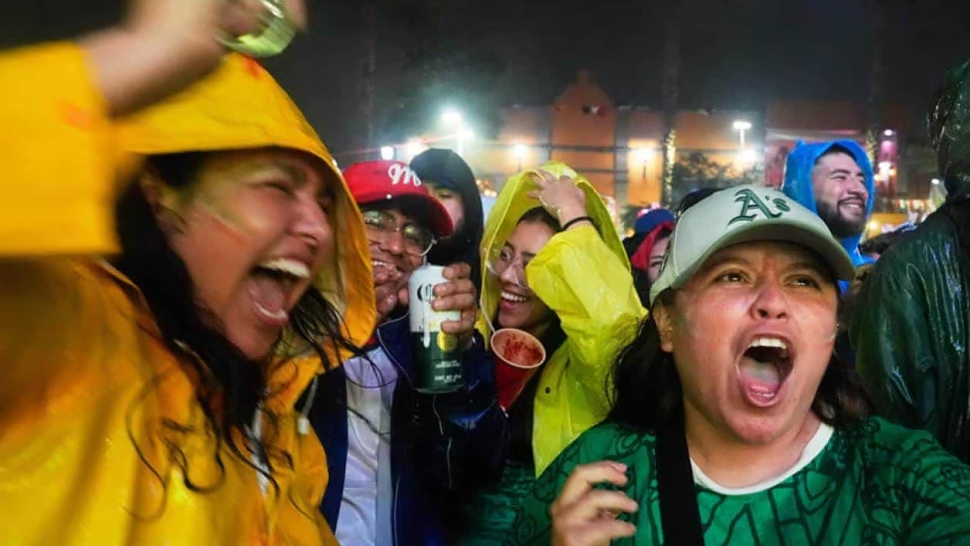
The decision responds to the celebrations of the previous Thursday, when some 700,000 people gathered in the capital after Mexico’s victory over South Korea. Although there were no injuries, nearly 40 tons of garbage were collected in the Ángel de la Independencia and the Zócalo.

The Secretary of Security, Pablo Vázquez, detailed that 7,500 police officers will guard the Azteca stadium. Another 3,275 will be in the Zócalo and 4,200 on Reforma Avenue. The objective is to protect players, referees, authorities and fans.

In addition, the Secretary of Government, César Cravioto, reported that starting at 3 p.m. on June 24, a ban on the sale of alcohol will take effect for sixteen hours. Applies to the Historic Center and five neighborhoods of Cuauhtémoc.

Sales will only be allowed in restaurants, hotels and private clubs, accompanied by food. Convenience stores and supermarkets are excluded. The fines for non-compliance amount to up to 293,275 pesos (about $17,251).

The Mexican Alliance of Transporters Organization (AMOTAC) called for mobilizations on highways in the 32 states and blockades in the capital to protest against the violence. The operation also considers these protests.

Continue reading

UNAM, new WHO collaborating center in oral health

The WHO recognizes UNAM as a reference in oral health and aging.

International recognition for UNAM

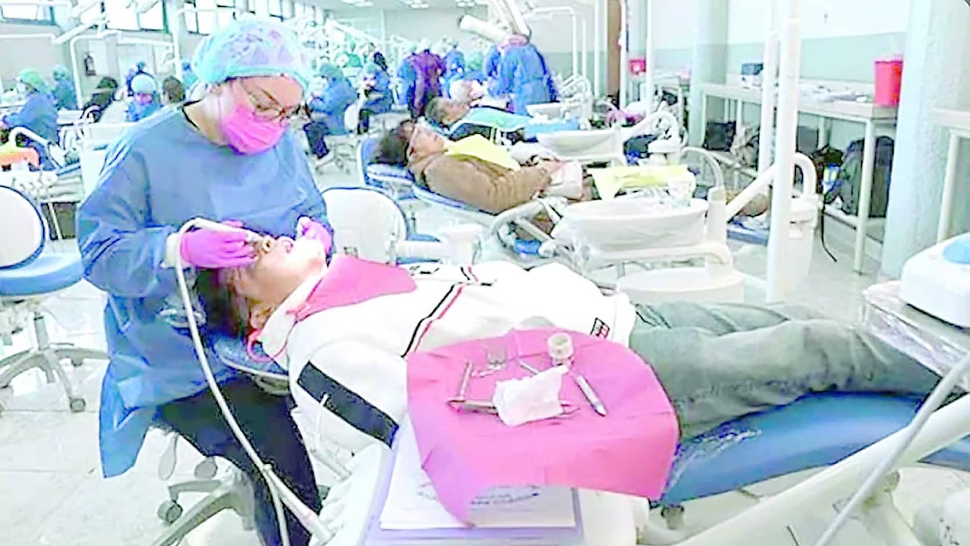
The World Health Organization (WHO) designated the Department of Oral Public Health of the UNAM Faculty of Dentistry as a Collaborating Center in Oral Health and Aging. The distinction is valid for four years.

With this appointment, the highest educational institution consolidates itself as a regional reference in the comprehensive care of older adults.

Implications of the appointment

The recognition will allow university specialists to participate in the development of public policies focused on improving the quality of life of the elderly.

In addition, they will promote strategies to promote among older adults and caregivers the importance of maintaining adequate oral health as an essential part of general well-being.

The designation places UNAM on a level of technical cooperation with the WHO, which opens opportunities to influence global guidelines on aging and oral health.

Continue reading

Digital sexual exploitation affects 1.6 million adolescents in Mexico

1.6 million adolescents in Mexico suffer online sexual exploitation every year.

The report reveals alarming figures

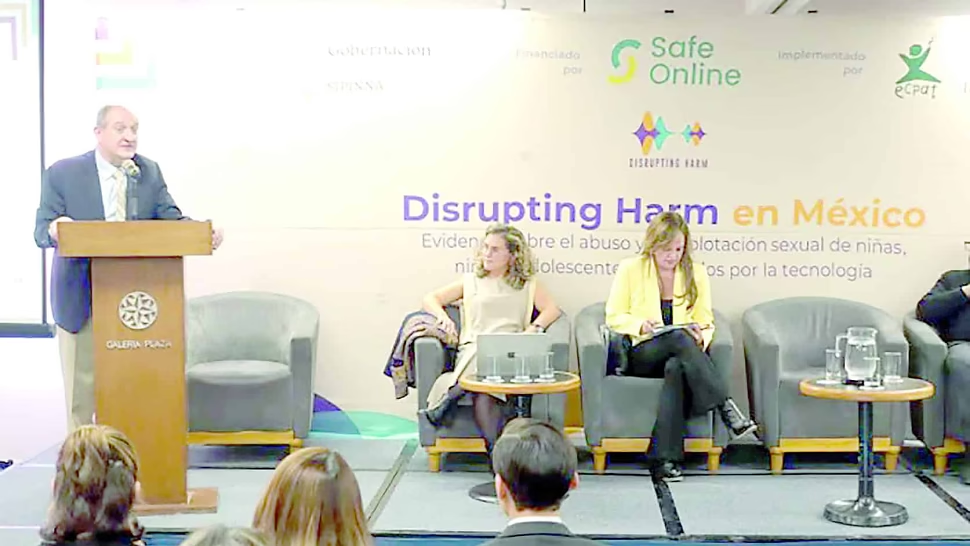
Unicef, ECPAT International and Interpol published the study “Disrupting Harm México”, which indicates that one in eight adolescent Internet users in the country – around 1.6 million – experienced sexual exploitation facilitated by digital technologies for a year.

67% of cases occurred online only, mainly on social networks and platforms. However, violence is not limited to the virtual sphere: in almost two out of every three situations, the victims knew their attackers, who were usually friends, partners or family members.

The report documents serious under-reporting. 32% of victims did not tell anyone what happened out of shame or fear, and less than 1% filed a formal complaint. This reflects normalization and silence around these attacks.

Consequences and call to action

In mental health, the consequences are profound. Those who suffered this type of violence are 15 times more likely to self-harm and 12 times more likely to have thoughts about their own death, compared to those who did not have that experience.

Fernando Carrera, Unicef ​​representative in Mexico, asked to reinforce prevention and responsibility of digital platforms. Lorena Villavicencio Ayala, from SIPINNA, stated that the State must guarantee the safety of girls, boys and adolescents in digital environments.

Continue reading