Ernestina Godoy attends her first public event as attorney general

The new head of the FGR participates in her first official act, in a key session where a national strategy against a rising crime will be defined.

The Official Presentation of the New Attorney General in a Context of National Security

In an act of high institutional significance, Ernestina Godoy Ramos made her first public appearance in her capacity as Attorney General of the Republic (FGR). The setting was the 52nd Ordinary Session of the National Public Security Council, held in the National Palace and chaired by the president Claudia Sheinbaum Pardo. This meeting, which brought together all of the country’s governors, marks the operational beginning of the mandate of Godoy, who took office on December 3 after its ratification by the Senate of the Republic, succeeding Alejandro Gertz Manero.

The presence of the new head of the federal Public Ministry in this forum is not circumstantial. The Council represents the highest coordination body in matters of public security, which underlines the expectation about the role that the FGR will play under its direction. The session was attended by key members of the security cabinet, including the Secretary of the Interior, Rosa Icela Rodríguez Velázquez; to the secretary of Security and Citizen Protection, Omar García Harfuch; to the head of the Secretariat of National Defense, General Ricardo Trevilla Trejo; and Admiral Raymundo Pedro Morales Ángeles, Secretary of the Navy.

RelatedThe Senate elects Ernestina Godoy as attorney general of Mexico

The Fight against Extortion: Central Axis of the Security Strategy

The analysis of the context reveals that the meeting transcended protocol to address a specific criminological challenge. Previously, during the monthly report of her security cabinet, President Sheinbaum had identified extortion as the fastest growing crime in the country. In her statements, the president presented a two-phase strategy: the application of a legal reform that allows this crime to be prosecuted ex officio (without the need for a prior complaint from the victim, a historical obstacle) and the urgent harmonization of this legislation in all state criminal codes.

This approach places the new prosecutor Godoy before one of her first and most complex tests of inter-institutional coordination. The effectiveness of ex officio criminal prosecution depends on a perfect operational and regulatory synergy between the FGR, state prosecutors’ offices and security forces. The session with state leaders sought, precisely, to generate a consensus to standardize criminal types and action protocols, creating a unified front against a crime that, by its nature, tends to spread in environments of lack of coordination.

Godoy’s ratification by the Senate and his immediate immersion in the planning of national criminal policy indicate a transition designed to maintain continuity in security priorities. Your participation in this council is not merely symbolic; It constitutes the formal integration of the highest investigative authority of the country in the core where the guidelines of the public security policy are outlined. The success of the announced strategy against extortion will depend, to a large extent, on the ability of the new prosecutor to translate these political agreements into effective investigative actions and agile procedural coordination with her state counterparts.

Analytical rigor forces us to observe that the fight against extortion requires not only robust legal frameworks, but also a profound transformation in the methods of financial intelligence and victim protection. The deterrent capacity of the new regulations will be subject to the allocation of sufficient resources and the implementation of technologies to track communications and money flows associated with this scourge. Ernestina Godoy’s management will begin, therefore, under the scrutiny of her ability to operationalize a state policy in a terrain undermined by complexity and social urgency.

Are you interested in understanding how security strategies evolve in Mexico?Share this analysis on your social networks and explore more content on criminal policy and justice on our site.
Sheinbaum highlights record in clean energy and economic rebound

Sheinbaum reports historic growth in renewables and low inflation at 3.55%.

Economy and energy: the president’s announcements

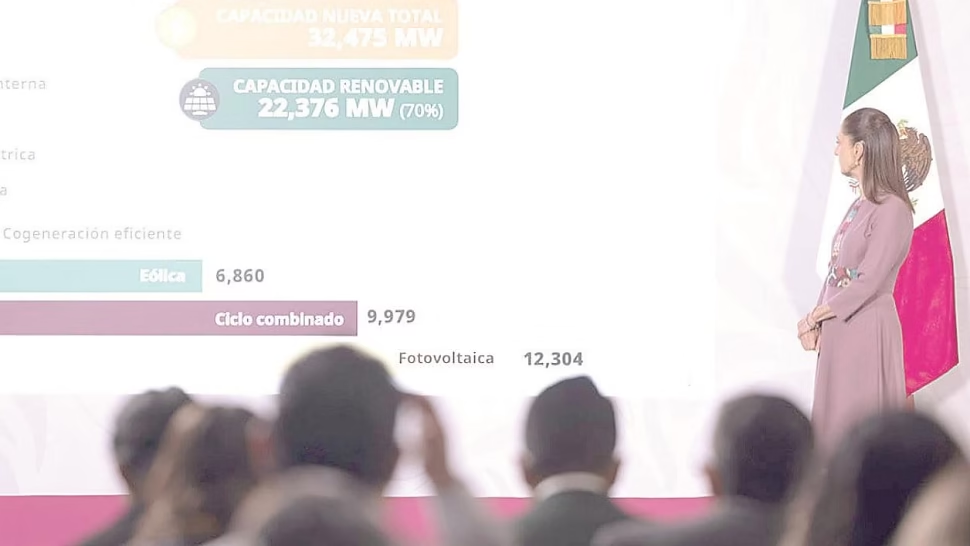
President Claudia Sheinbaum reported that, for the first time, Mexico has projects for 32 thousand megawatts of additional electrical capacity, of which 70% are renewable. “When we leave the government, natural gas consumption will decrease and energy generated by renewable resources will increase,” he stated.

Sheinbaum also highlighted economic growth. According to Inegi, the Global Indicator of Economic Activity (IGAE) rose 1.2% in April compared to March, the best advance since 2021. The annual rate reached 2.2%. The president attributed this to the boost in construction, especially the housing program.

Regarding inflation, the president pointed out that it fell to 3.55% annually in the first half of June, its lowest level since October 2025. This is due, she said, to agreements with gas stations to set maximum fuel prices and the Package Against Inflation and Scarcity (Pacic) to control the basic basket.

Energy transition with 32 thousand megawatts

The Secretary of Energy, Luz Elena González, explained that by 2030 32 thousand megawatts will be added; 22 thousand will be renewable. The goal is for at least 38% of generation to be clean to meet climate commitments. He assured that the CFE will maintain its majority participation, providing 61% of the electricity at the end of the six-year term.

The director of CFE, Emilia Calleja, explained the projects. In Baja California Sur, the Oasis System will combine solar energy, batteries and green hydrogen to supply Mulegé and 40 thousand homes. It includes a 72 megawatt plant, 20 megawatt storage and will produce 120 cubic meters of water per year, avoiding 94 thousand tons of CO2.

In Sonora, the “Rafael Galván” photovoltaic plant in Puerto Peñasco will reach one thousand megawatts of capacity and 246 megawatts of storage. It currently provides 400 megawatts. The investment exceeds 1.4 billion dollars. “They are environmental benefits that strengthen energy sovereignty,” concluded Secretary González.

Continue reading

Controversy over an interview with Monsiváis reaches the Senate and the Palace

The republication of a 1999 interview unleashes accusations between the Executive and legislators.

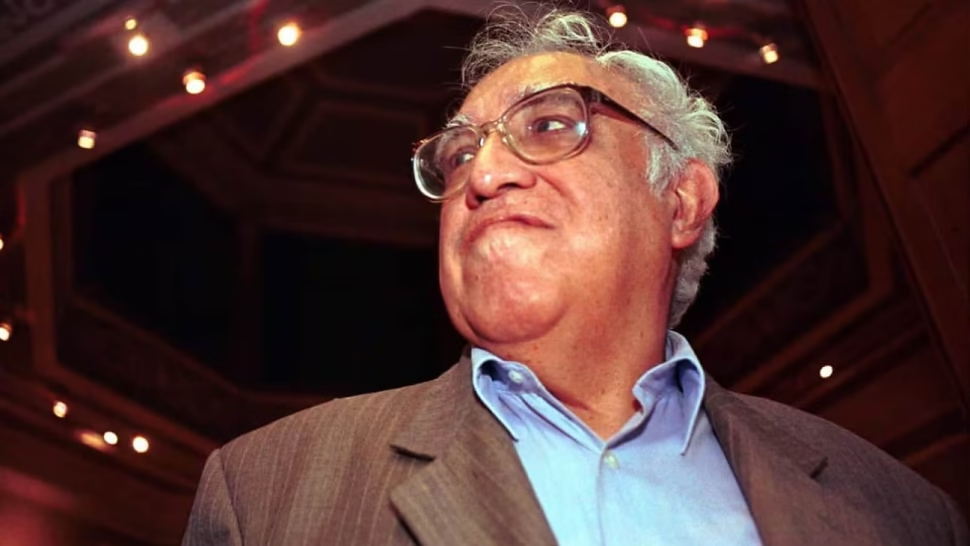
The republication of an old interview attributed to Carlos Monsiváis climbed to the center of the Mexican political debate this Wednesday. The issue was discussed both in the Senate and in President Claudia Sheinbaum’s morning conference.

The original text was written by journalist Edmundo Cázares in 1999 and recently republished by El Universal. It contains statements about the then head of Government Andrés Manuel López Obrador. Its veracity and context have been questioned, generating conflicting positions.

Sheinbaum describes the content as “grotesque”

During her conference, the president harshly criticized the publication. He described the content as “grotesque” and accused the medium of generating a controversy that distorts the tribute to the Mexican intellectual.

Reactions in the Senate

The issue also reached Congress. Senator Lilly Téllez read fragments of the text on the platform. In response, Gerardo Fernández Noroña rejected its use and maintained that it was a false publication with the intention of political attack.

The exchange reflects the polarization around the figure of López Obrador and the use of historical documents as partisan weapons.

Continue reading

PRI demands urgent action against violence in Guerrero

They denounce an incursion of armed civilians in Coyuca de Catalán; party calls for state intervention.

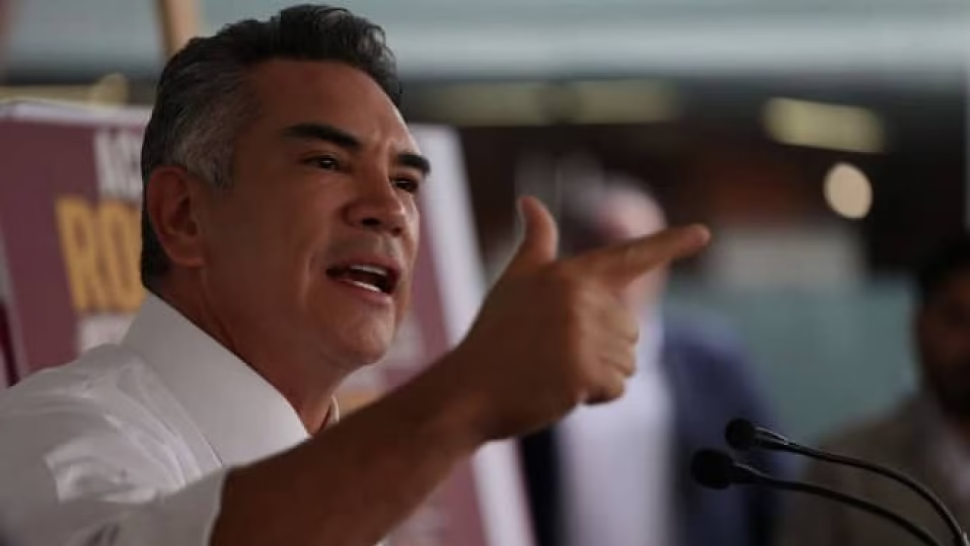
The national leadership of the PRI demanded that the Mexican State intervene urgently in response to the complaint by inhabitants of the Guajes de Ayala ejido, in Coyuca de Catalán, Guerrero. The residents reported the incursion of armed civilians into their community in the Sierra.

Call for safety

Alejandro Moreno Cárdenas, president of the party, asked the authorities to guarantee the safety of the families. He warned that these events should not be normalized due to the risk they represent for the civilian population.

The leader pointed out that in various communities in Guerrero they live under siege by armed groups. This has caused displacement, confinement of inhabitants and a constant climate of fear and uncertainty. He considered an immediate response from the State necessary.

Moreno Cárdenas also criticized the federal government for minimizing the situation of violence in the country. He affirmed that the population faces conditions of insecurity that require priority attention to restore the rule of law in the region.

Continue reading