The Senate elects Ernestina Godoy as attorney general of Mexico

The Senate quickly defines the new head of the FGR, who promises an autonomous institution without impunity, setting a course in the fight against organized crime.

The senatorial ‘fast track’ has a new protagonist: Ernestina Godoy arrives at the FGR

It seems that in the Senate of the Republic they discovered the fast forward button. In a movement that combined parliamentary speed and an overwhelming majority, the plenary session voted yes to Ernestina Godoy to become the new head of the Attorney General’s Office. The vote, with the support of Morena, PT, PVEM and Movimiento Ciudadano, was the express procedure that many expected and many others feared. Thus, the former legal advisor to the Presidency went from advisor to top head of the federal public ministry.

The session, worthy of a chapter of political drama, ended with an eloquent score: 97 votes in favor against 19 against (courtesy of the PRI and PAN) and 11 ballots that, apparently, went on a mystical journey and ended up in the limbo of the null. What was needed was a qualified majority, and boy did they get it. A lightning procedure that makes it clear what the strength of the coalition is in the Upper House.

RelatedErnestina Godoy attends her first public event as attorney general

Promises, autonomy and the shadow of coordination

Before receiving the position, Godoy Ramos appeared in front of the senators and gave the speech that everyone wanted to hear (and many others wanted to dissect). He assured, with the solemnity of someone who promises not to eat more sugar on New Year’s, that no blame will be made and that there will be no political persecution. But, be careful, he also warned that impunity will have no place in his administration. Come on, the classic “not so much that it burns the saint, nor so much that it does not illuminate him” applied to the administration of justice.

He recognized that the historical debt with society in matters of justice is still there, as long as the queue for processing your license. He said that Mexico is in a new stage, but that the FGR must rise to the occasion of a complex reality, promising to relentlessly combat organized crime. However, the most viral moment came when he clarified, almost with a wink, that “coordination does not imply subordination”. A phrase directly addressed to the opposition’s questions about his closeness to President Claudia Sheinbaum and the possible impact on the constitutional autonomy of the Prosecutor’s Office.

In his speech, Godoy painted a picture of a strong and modern prosecutor’s office, where scientific research, applied intelligence and the prioritization of high-impact crimes will be the norm. He talked about transparency, accountability, gender perspective and, something that always sounds good in speeches, “zero tolerance for torture.” A complete checklist of good intentions for an institution that carries the heavy burden of citizen distrust.

The underlying message is clear: Godoy’s FGR intends to be a strategic body, autonomous but aligned with the project of the current administration. The task is not simple; It is about transforming a historically questioned institution into a pillar of credibility. Your challenge will be to demonstrate that these words translate into concrete actions, solid investigations and tangible results in the fight against crime and corruption. Time, and the statistics of impunity, will have the last word.

Do you think this change will mark a before and after in Mexican justice? Share this note on your social networks and tell us what other politics and justice topics you would like us to explore.
Massive security reinforcement and alcohol ban at the Azteca

56,000 police officers and alcohol restriction for the game at the Azteca.

Measures for the Mexico-Czech Republic match

The government of Mexico City announced an unprecedented security operation for this Wednesday’s game at the Azteca stadium. 56,000 personnel will be deployed, five times more than the 11,219 employed last week.

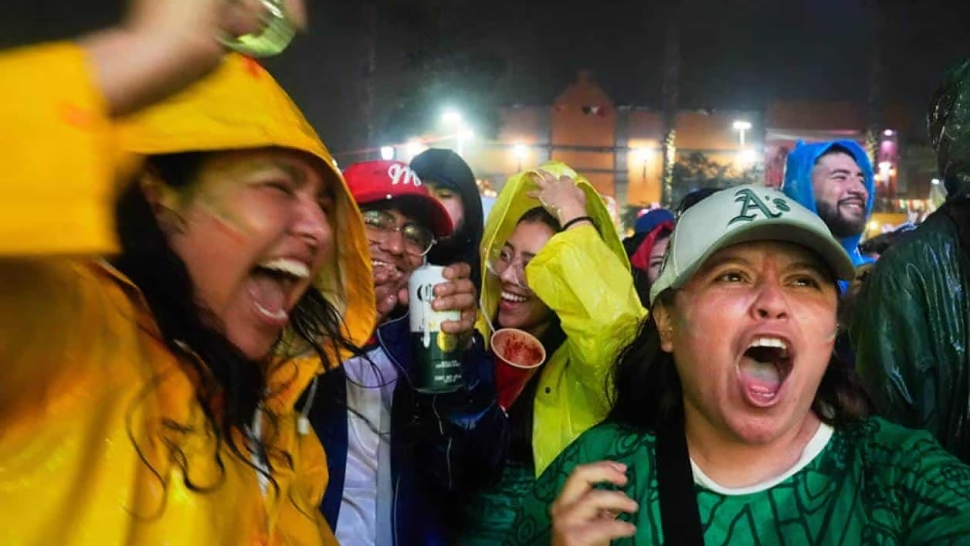
The decision responds to the celebrations of the previous Thursday, when some 700,000 people gathered in the capital after Mexico’s victory over South Korea. Although there were no injuries, nearly 40 tons of garbage were collected in the Ángel de la Independencia and the Zócalo.

The Secretary of Security, Pablo Vázquez, detailed that 7,500 police officers will guard the Azteca stadium. Another 3,275 will be in the Zócalo and 4,200 on Reforma Avenue. The objective is to protect players, referees, authorities and fans.

In addition, the Secretary of Government, César Cravioto, reported that starting at 3 p.m. on June 24, a ban on the sale of alcohol will take effect for sixteen hours. Applies to the Historic Center and five neighborhoods of Cuauhtémoc.

Sales will only be allowed in restaurants, hotels and private clubs, accompanied by food. Convenience stores and supermarkets are excluded. The fines for non-compliance amount to up to 293,275 pesos (about $17,251).

The Mexican Alliance of Transporters Organization (AMOTAC) called for mobilizations on highways in the 32 states and blockades in the capital to protest against the violence. The operation also considers these protests.

Continue reading

UNAM, new WHO collaborating center in oral health

The WHO recognizes UNAM as a reference in oral health and aging.

International recognition for UNAM

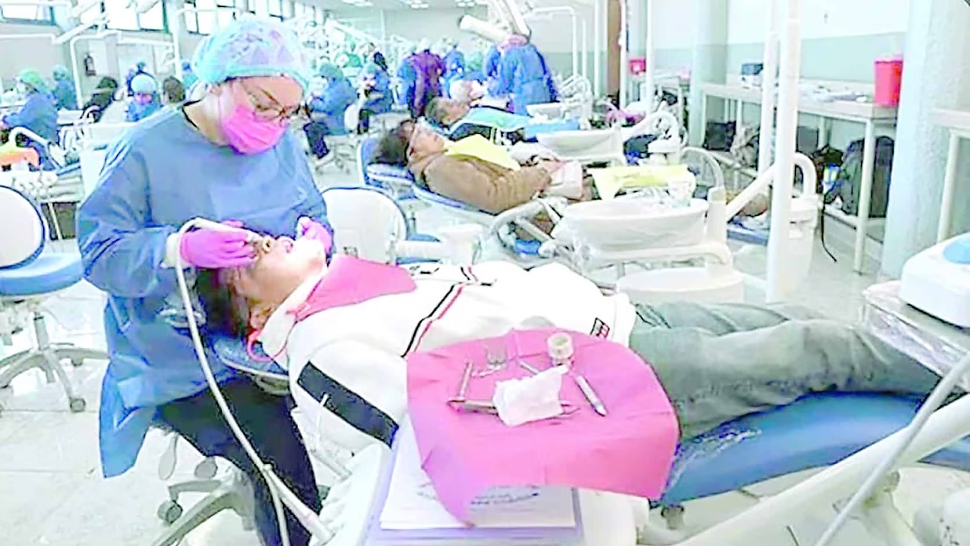
The World Health Organization (WHO) designated the Department of Oral Public Health of the UNAM Faculty of Dentistry as a Collaborating Center in Oral Health and Aging. The distinction is valid for four years.

With this appointment, the highest educational institution consolidates itself as a regional reference in the comprehensive care of older adults.

Implications of the appointment

The recognition will allow university specialists to participate in the development of public policies focused on improving the quality of life of the elderly.

In addition, they will promote strategies to promote among older adults and caregivers the importance of maintaining adequate oral health as an essential part of general well-being.

The designation places UNAM on a level of technical cooperation with the WHO, which opens opportunities to influence global guidelines on aging and oral health.

Continue reading

Digital sexual exploitation affects 1.6 million adolescents in Mexico

1.6 million adolescents in Mexico suffer online sexual exploitation every year.

The report reveals alarming figures

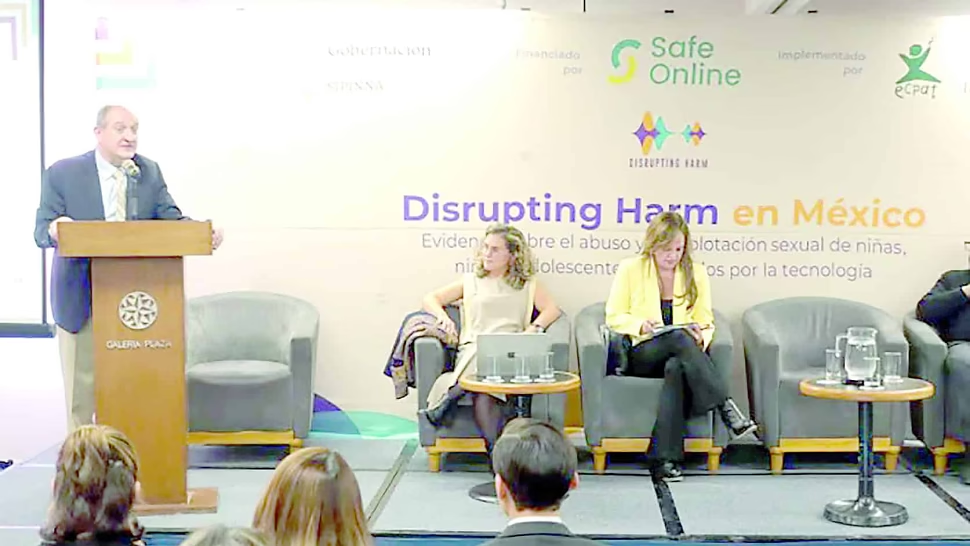
Unicef, ECPAT International and Interpol published the study “Disrupting Harm México”, which indicates that one in eight adolescent Internet users in the country – around 1.6 million – experienced sexual exploitation facilitated by digital technologies for a year.

67% of cases occurred online only, mainly on social networks and platforms. However, violence is not limited to the virtual sphere: in almost two out of every three situations, the victims knew their attackers, who were usually friends, partners or family members.

The report documents serious under-reporting. 32% of victims did not tell anyone what happened out of shame or fear, and less than 1% filed a formal complaint. This reflects normalization and silence around these attacks.

Consequences and call to action

In mental health, the consequences are profound. Those who suffered this type of violence are 15 times more likely to self-harm and 12 times more likely to have thoughts about their own death, compared to those who did not have that experience.

Fernando Carrera, Unicef ​​representative in Mexico, asked to reinforce prevention and responsibility of digital platforms. Lorena Villavicencio Ayala, from SIPINNA, stated that the State must guarantee the safety of girls, boys and adolescents in digital environments.

Continue reading