The Senate analyzes 43 profiles for the succession in the Attorney General’s Office

The Senate begins the complex process to appoint the next attorney general from among dozens of legal profiles. A crucial decision that will define the direction of justice in Mexico.

A Constitutional Process After a Historical Resignation

The formal resignation of Alejandro Gertz Manero from the Attorney General’s Office (FGR), effective as of November 27, activated a constitutional mechanism of capital importance for the Mexican rule of law. In accordance with the legal framework, it is up to the Senate of the Republic to manage the appointment of the successor. In response, the Upper Chamber immediately issued a public call, establishing the criteria and calendar for this extremely responsible procedure. This is not a mere administrative procedure, but a deliberative process designed to guarantee that the country’s highest law enforcement institution remains in the hands of a suitable professional.

The requirements established in the call are the first objective filter. The applicant must have a Law Degree with a minimum of ten years’ experience, have experience in the public sector or in the administration of justice, and, fundamentally, “have a good reputation and commitment to democratic values.” This last point, although subjective in its evaluation, is the cornerstone of the desired profile, since the credibility and independence of the institution depend on it. The analysis of the 43 registrations received within the deadline reveals a first significant variable: gender representation is markedly unequal, with only six women nominated, which represents approximately 14% of the total.

RelatedSenate defines final list to designate the next Attorney General

Profiles and Procedure: From List to Shortlist

The list of candidates constitutes a mosaic of trajectories within the legal and political field. Figures such as Ernestina Godoy Ramos stand out, former legal advisor to the Presidency and current office manager of the FGR, whose internal knowledge of the institution is a factor to consider. Likewise, profiles with experience in public administration are identified, such as the former general administrator of Customs, Ricardo Peralta Saucedo, and in the legislative field, such as the former federal deputy Hamlet García Almaguer. The list also includes renowned academics such as Jorge Nader Kuri and jurists who have participated in selection processes for high positions, such as César Mario Gutiérrez Priego, former candidate for minister of the Supreme Court of Justice of the Nation (SCJN).

The process, however, is far from concluded with the receipt of records. The Political Coordination Board (Jucopo) of the Senate has before it the meticulous task of evaluating the files and selecting a small group of at least ten candidates. This set will be sent to the Federal Executive, led by President Claudia Sheinbaum Pardo. She, exercising one of her most relevant powers in judicial matters, must refine that list to integrate a final shortlist of three names. This shortlist will be returned to the full Senate, where legislators will carry out a process of appearances, interrogations and, finally, a vote to elect the next head of the FGR.

The depth of this analysis lies in understanding that each stage is loaded with political and technical implications. The selection of the shortlist by the Presidency will reflect the priorities of his government in matters of security and justice. Subsequently, the public and legislative scrutiny to which the three finalists will be subjected will test not only their professional credentials, but also their ability to articulate a clear project for an institution that faces challenges of effectiveness, transparency and citizen trust. The final decision, therefore, is not simply the appointment of an official, but the definition of the roadmap for the administration of justice in the coming years.

Do you consider that this process guarantees the selection of the most suitable profile? Share this analysis on your social networks to expand the conversation on a crucial issue for Mexico. Explore more content related to transparency and institutional processes on our site.
PRI urges to reinforce prevention in the face of intense rains

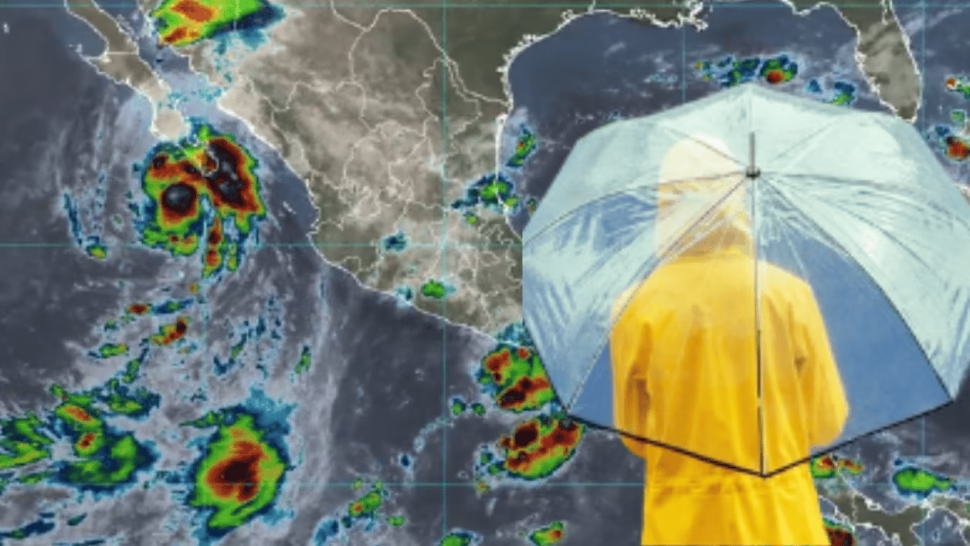
PRI senators ask to reinforce warning and preparation for the heavy rain season.

Call from the PRI due to risks of heavy rains

PRI senators requested to strengthen prevention, monitoring and dissemination of early warning actions to face possible emergencies due to heavy rains. The request arises after the failures of federal Civil Protection during Hurricane Otis in Acapulco, where the population and tourists were not adequately alerted.

The point of agreement, published in the Gazette of July 22, is based on forecasts from the National Meteorological Service (SMN) of Conagua. For the next few days, the interaction of the Mexican monsoon, low pressure channels, humidity from the Pacific, Gulf of Mexico and Caribbean Sea is expected, in addition to the possible development of cyclonic systems.

These conditions, they warn, will favor intense rains with electric shocks, gusts of wind and high waves. The risk includes urban flooding, overflowing of rivers and streams, landslides in mountainous areas, severe flooding, falling trees and interruptions in communication routes.

Concrete actions requested

The PRI group requests that the National Civil Protection Coordination (CNPC), together with state and municipal authorities with heavy rain forecast, reinforce the identification of vulnerable areas, cleaning of channels, sewers and drainage systems. They also request to enable temporary shelters when necessary and disseminate self-protection measures.

In addition, they propose that the Ministry of Infrastructure, Communications and Transportation intensify the supervision and preventive maintenance of highways, bridges and federal roads susceptible to damage due to rain, floods, landslides or landslides.

Continue reading

Senate will review regulation of militarized schools after fatal cases

Senator promotes review of 1943 regulations after deaths of minors in private military-type schools.

Review of regulations after fatal cases

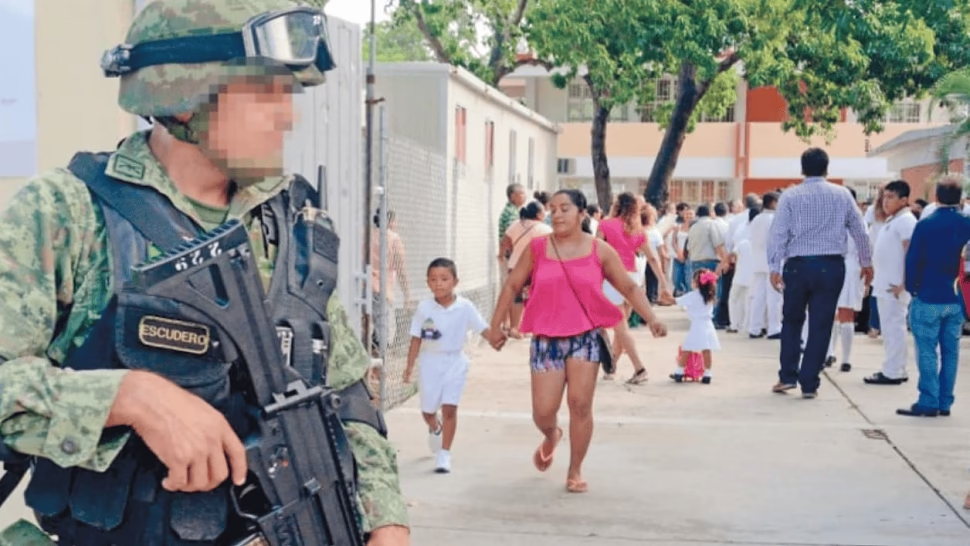
Given the death of a 13-year-old girl in a private militarized school, Senator Guadalupe Chavira announced that the Senate will review the Regulations for Private Military-Type Academies, in force since 1943. The legislator described the ordinance as anachronistic and incompatible with the current protection of children’s rights.

The regulations allow military instruction from primary to technical levels, including shooting classes in secondary school and the use of grades that grant authority to certain students over others. Chavira pointed out that these are not isolated cases; In 2025, another 13-year-old minor died at the Ollin Militarized Academy, in Morelos, after suffering serious abuse during a camp.

“The tragedy that occurred with Dafne, whose suffocation under water is being investigated, should call us to reflection and action. These schools do not have the power to organize summer camps or to authorize practices such as hazing, which ended in the death of a 13-year-old girl,” declared the senator.

The Ministry of Public Education (SEP) reported that the academy where the case occurred was operating with a 2022 incorporation agreement. After being closed for investigations, the school resumed online classes claiming the students’ right to continue their training. The agency faces at least eight additional complaints of mistreatment.

Chavira demanded a new legal framework that grants the SEP clear regulatory powers, since the 1943 regulation leaves responsibility to the Secretariat of National Defense. Specialists warn that in these private schools discipline is imposed through violence and hierarchical submission, unlike official schools where there are human rights areas and supervision of the CNDH.

Continue reading

Defense distances itself from the academy after death at a young age

The agency cited the Internal Regulations to justify its position

The Secretariat of National Defense (Sedena) disclaimed any responsibility for the “Marina Doenitz” Militarized Academy, in Ciudad Madero, Tamaulipas, after the death of the young Dafne Zapata.

Through a statement, the agency stated that it lacks the power to authorize, supervise, inspect or regulate educational institutions of this type.

“It is reported that the Secretariat of National Defense lacks the power to authorize, supervise, inspect or regulate the operation of educational institutions of this nature, in accordance with the Internal Regulations of this agency, issued by the Presidency of the Republic through its publication in the Official Gazette of the Federation, on December 29, 2008, where any administrative provision that contravenes this order was repealed,” the agency wrote.

He added that, in accordance with these regulations, Sedena “has no relationship with the aforementioned academy, nor with any other establishment of this type.”

No clear supervision

The case has put the operation of private militarized schools under scrutiny. In several states of the country they have proliferated without there being a federal body that explicitly regulates them.

To date, no state or federal authority has assumed the responsibility of supervising these schools. The Tamaulipas Prosecutor’s Office investigates the events.

Continue reading