Sheinbaum studies moving the judicial election to 2028

The president is analyzing postponing the election of judges until 2028, a move that requires changing the Constitution.

The board moves: Will the judges wait until 2028?

The political scene has a new script in development. This Wednesday, President Claudia Sheinbaum confirmed what many in the halls of Congress were already whispering: her government is seriously analyzing postponing the first judicial election until 2028.

“We are analyzing it, it has to do with resources,” Sheinbaum said in his morning conference, making it clear that the economic factor weighs. But the warning came later: > “There would have to be a constitutional reform for this.”.

That’s the crux of the matter. It is not a simple change of date. It is moving the foundations. The current Constitution establishes that election for 2027, as part of the great judicial reform approved by Congress.

RelatedSheinbaum defends judicial election and rejects accusations of manipulation

An initiative with a name and surname

The draft is already on the table. It was presented by Morena heavyweights: deputies Alfonso Ramírez Cuéllar and Olga Sánchez Cordero, along with senators Javier Corral and Susana Harp. His proposal modifies transitional articles so that the vote is “the first Sunday of June 2028”.

But this isn’t just about calendars. It is a multi-level strategic play. The initiative also seeks to change the rules of the game for who can be a judge.

Imagine this: it would no longer be enough to have a good academic average. The project requires mandatory certification from the National Judicial Training School. And it places historical locks: those who have been secretaries of state, attorneys general, federal or local deputies, municipal presidents… not even political party militants during the year prior to the call cannot be magistrates.

For five of the nine ministers of the Supreme Court, half of their professional experience (5 out of 10 years) would be required to have been within the Judiciary itself.

Sheinbaum said that the Secretary of the Interior, Rosa Icela Rodríguez, is already holding talks with the INE. The message between the lines is clear: they are measuring the terrain, calculating forces in Congress for a constitutional battle.

Why move the pieces now? Some see a strategy to decouple the judicial election from other electoral processes and give it greater weight of its own. Others perceive an attempt to gain time and better polish the candidates of the official project.

My father always said that in politics, when they talk about ‘resources’, they rarely mean just money. They refer to political capital, time, and the necessary alliances. This announced pause smells like that: a tactical recalibration.

The theater of power has its new act. And we are all watching the curtain.
They capture someone involved in the kidnapping of a journalist in Veracruz

Family of the kidnapped journalist demands official information after the arrest of José N.

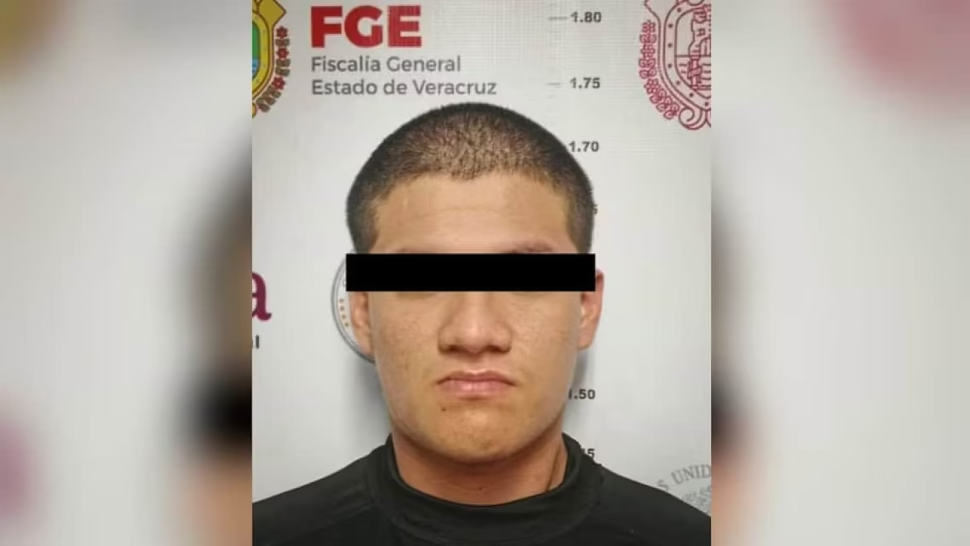
The Veracruz Prosecutor’s Office arrested José N, identified as one of the alleged perpetrators of the kidnapping of journalist Roxana Guzmán, founder of the medium Pulso Informativo del Sureste. The capture was confirmed this Tuesday, although the victim’s family assured that they have not yet received complete official information about the progress of the investigation.

The events of June 2

The attack occurred on June 2 in Nanchital, in the south of the state. An armed group broke into the Guzmán family home during the early hours of the morning. At least four men subdued the family members and also entered the journalist’s brother’s house.

Roxana’s mother, Rubicelia Ramírez, fully identified the detainee in a video released after the kidnapping. “He was at my house,” he declared.

Video that documented the attack

In a 35-second recording, the attackers are seen trying to force entry into a home while a person warns them that there are minors inside. The attackers managed to take Roxana Guzmán, as well as the family’s cell phones, and put her in a vehicle before fleeing.

Witnesses indicated that those responsible falsely stated that the victim would be transferred to a “command office.”

Reactions and expectations of justice

The arrest of José N represents progress in the investigation of the case, which has generated broad solidarity in the journalistic field and society. Roxana Guzmán’s family hopes that the necessary measures will be taken to guarantee the safety of all those involved and that justice will be done.

Continue reading

Volaris joins humanitarian airlift to Venezuela

The airline will transport personnel and 1.5 tons of supplies for earthquake victims.

Volaris activated its Avión Ayuda Volaris program to support the Venezuelan population after the earthquakes of June 24. The company coordinates two charter flights with the Salvadoran government.

The first flight, aboard an Airbus A320, departed on Thursday from the El Salvador International Airport to the El Libertador Air Base in Maracay. The second is scheduled for this Friday.

In total, about 141 people linked to support and logistics tasks will be transferred. In addition, 1.5 tons of humanitarian aid will be transported: medical supplies, rescue equipment, food and other essential goods for the affected communities.

The Ministry of the Interior and Territorial Development of El Salvador coordinates the logistics of the mission. This operation seeks to expedite assistance in the areas hardest hit by the earthquakes.

Continue reading

Calzada Ignacio Zaragoza partially closed due to police operation

Operation on Calzada Ignacio Zaragoza causes vehicular chaos in the east of the capital.

Operational in Calzada Ignacio Zaragoza

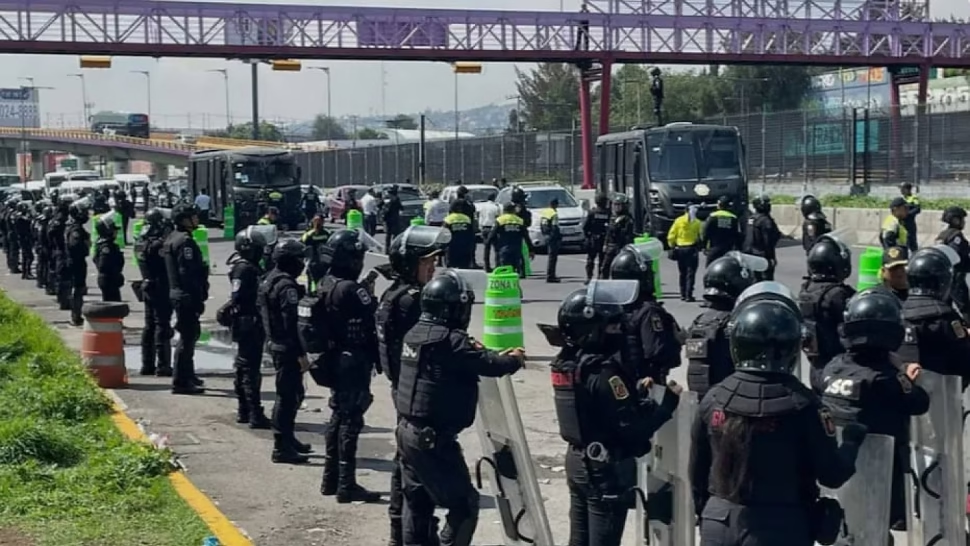
A deployment by the Secretariat of Citizen Security (SSC) this Friday caused the partial closure of Calzada Ignacio Zaragoza, near the Acatitla Metro station. The police mobilization was concentrated in the vicinity of the Concorde Bridge, where a control filter was installed.

The objective was to contain the advance of a group of protesters. The action generated severe traffic congestion in the eastern area of ​​Mexico City.

Impact on circulation

The eastbound lanes were the most affected. Long lines of vehicles and significant delays in normal traffic were reported. The authorities have not issued an official report on the number of participants or the duration of the operation.

Continue reading