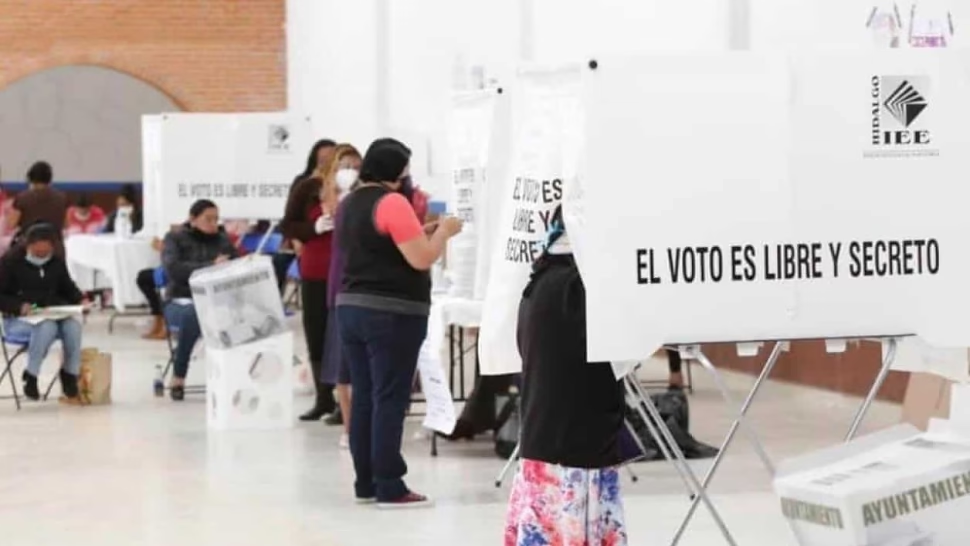
Historic election of the Judiciary exceeds expectations
The President of Mexico, Claudia Sheinbaum Pardo, described as a “resounding success” the first democratic election of members of the Federal Judiciary, where 13 million citizens participated, a figure that doubles the attendance registered in the consultation on the trial of former presidents in 2021. This figure even exceeds the individual votes obtained by the main opposition parties during the 2024 federal elections.
Revealing comparison
“The contrast is evident: 128 senators versus 13 million Mexicans exercising their right to vote. This redefines the parameters of democratic legitimacy,” Sheinbaum explained during his morning conference. The numbers support his statement: while the PAN obtained 9.6 million votes, the PRI 5.7 million and the Citizen Movement 6.2 million in the last elections, the judicial election mobilized more citizens than any opposition political force.
The president emphasized the free and informed nature of the process: “Citizens demonstrated political maturity by directly electing their judicial representatives, breaking with traditional designation schemes.”
Criticism and institutional context
Faced with questions about the process, Sheinbaum highlighted that the new model seeks to eradicate questionable practices from the current judicial system, where they have been documented:
- 169 benefits to members of organized crime in 8 months
- 70 protections granted to criminal leaders
- Decisions that hinder tax collection
- Systemic nepotism (50% of positions held by family members)
“This structural change guarantees that judicial officials are accountable directly to the people, not to the executive branch,” he stressed. The reform includes transparency mechanisms and periodic evaluation of the performance of judges and magistrates.
Long-term implications
Analysts agree that this process sets a global precedent by combining:
- Representativeness: Direct election with massive participation
- Independence: Anti-political interference mechanisms
- Professionalization: Technical requirements for candidates
Experts in constitutional law highlight that the model could inspire similar reforms in Latin America, where judicial powers have traditionally been appointed by political elites.
What’s next? The new Judiciary will begin operations next month with staggered terms of 6 to 15 years, including semi-annual citizen audits. Sheinbaum concluded: “Today Mexico writes a new chapter in the history of modern constitutionalism.”
Are you interested in learning more about democratic reforms? Share this analysis and explore our special on institutional transformations in Latin America. #JusticeForAll #ParticipatoryDemocracy