The 2026 World Cup could cancel classes in Mexico

The SEP is considering suspending classes during the 2026 World Cup matches in Mexico, following a request to reduce traffic.

Classes or football? The SEP thinks so

Mario Delgado, Secretary of Public Education, dropped the bomb: they are evaluating suspending in-person classes on the days that Mexico plays in the 2026 World Cup. Nothing has been decided, but the idea is already on the table.

“There is a request that there be no classes on match days, we are reviewing, we are analyzing,” said the official.

It sounds like someone has already done the math on the road chaos. And indeed, the head of Government of CDMX, Clara Brugada, has been asking for exactly that for months.

RelatedThe FMF and SEP join forces to eradicate illiteracy with the help of football

The traffic masterstroke

Brugada does not mince words. In March he had already launched the formal request to the SEP. Its argument is pure capital realism: fewer cars, less headache for everyone.

“We have asked the SEP to issue a definition regarding the suspension of classes on those days,” said Brugada.

The measure seeks to replicate what worked (half-way) in the pandemic: teleworking and flexibility. The idea is clear: empty the streets so that the sporting event does not collapse the city.

But here comes my trade skepticism. Do we really need to cancel education to manage traffic? Are there no other tools? It sounds like an easy solution to a complex mobility problem that we have been dealing with for decades.

The most ironic thing is the timing. Just as we are trying to make up for the learning lost to COVID, we are now contemplating interrupting it for… a football game. Historical memory is conspicuous by its absence.

The SEP says that “it is talking to the teachers.” I hope they also talk to the parents. Because in the end, they are the ones who will have to solve the family logistical puzzle while the authorities watch the game.

Roberto Lazzeri begins diplomatic management in Washington

The new ambassador of Mexico to the US begins management with a focus on protecting fellow citizens and strengthening the T-MEC.

First steps in Washington

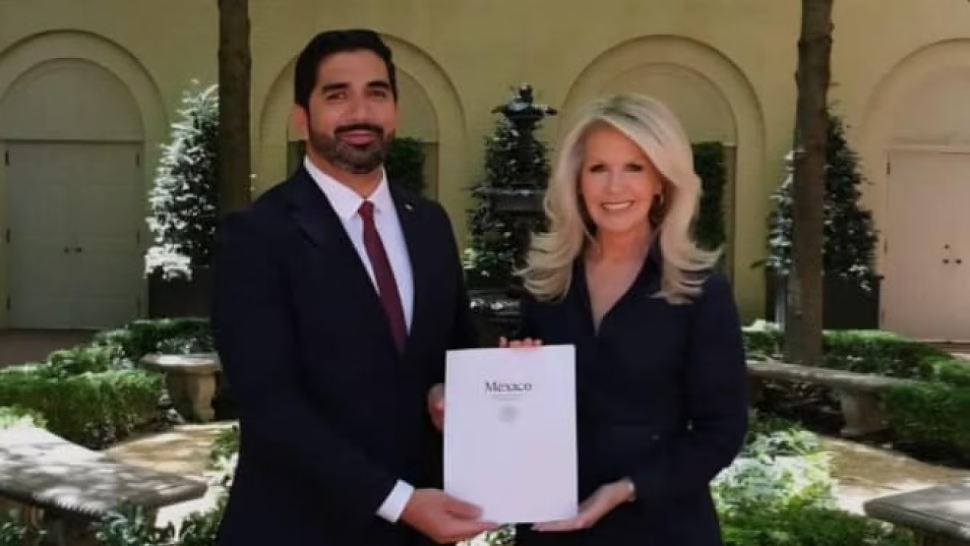
Roberto Lazzeri, Mexico’s new ambassador to the United States, delivered copies of his credentials to Monica Crowley, head of protocol at the State Department. The event marks the formal beginning of his diplomatic management in Washington.

The diplomat stressed the importance of strengthening constant cooperation between both countries, due to the historical, economic and social depth they share. The delivery was made in one of the key areas of the bilateral relationship.

Management priorities

Lazzeri highlighted that his work will be focused on generating concrete advances in the bilateral agenda. Special emphasis on protecting the Mexican community in the United States and promoting shared prosperity in North America.

In addition, he pointed out that the Treaty between Mexico, the United States and Canada (T-MEC) must continue to be the main driver of regional economic integration. Its strengthening will be a priority of his diplomatic management.

The ambassador was ratified by the Senate of the Republic before arriving in Washington. He has participated in conversations related to the review of the USMCA, in a context of growing strategic importance of the bilateral relationship.

Continue reading

Teachers’ Alliance warns about delays after ruling by the SCJN

Teaching organization warns that making evaluations more flexible could accumulate educational lags in Mexico.

Educational delays after validation of the SCJN

The Teachers’ Alliance warned about possible delays in learning after the resolution of the Supreme Court of Justice of the Nation (SCJN) that validated the agreement 09/10/23 of the Ministry of Public Education (SEP).

The agreement eliminates the minimum requirement of 80% attendance to accredit subjects, establishes automatic promotion in preschool and first grade of primary school, and creates regularization mechanisms for secondary school.

The SCJN argued that these measures seek to avoid school exclusion due to social, economic or family factors, and reduce educational dropout. However, the Teachers’ Alliance expressed reservations about its effects on learning.

The organization pointed out that, although the system already includes strategies to avoid failure, eliminating accreditation mechanisms could generate an accumulation of lags that affect subsequent educational levels and job training.

The concerns highlight the need to carefully evaluate educational policies so as not to compromise the quality of learning in the country.

Continue reading

Agreement with carriers: mobilizations without blockades

Government and transporters sign minutes to guarantee mobility without road closures.

Agreement and road effects

The Ministry of the Interior (Segob) and the Ministry of Security and Citizen Protection (SSPC) met with leaders of the Mexican Alliance of Transport Organizations (AMOTAC) to defuse the tension over the calls for protests on highways.

After the meeting, a work minute was signed. In it, AMOTAC committed to carrying out mobilizations without blocking roads. The government, for its part, offered to meet the union’s demands: more safety on roads, combating extortion and reviewing irregular charges for tow truck services and permits.

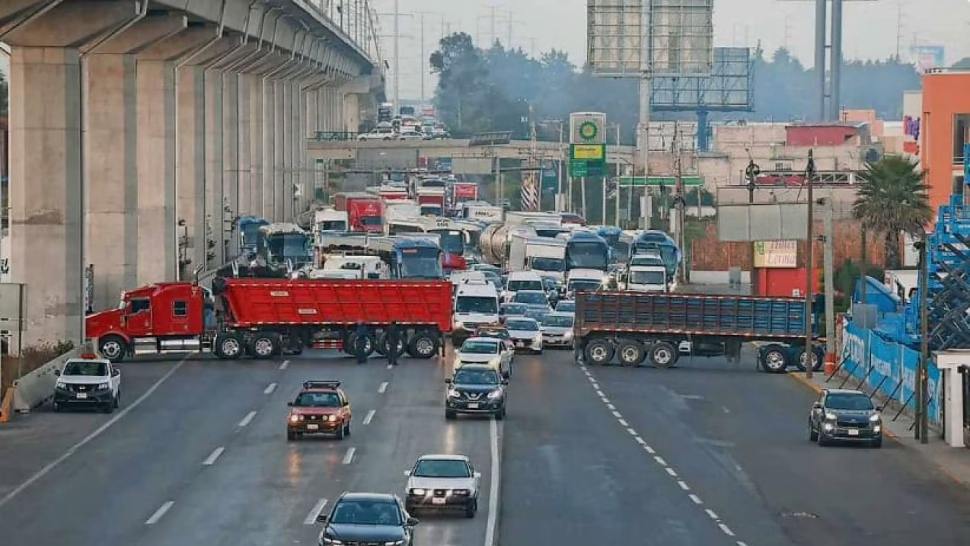
Despite the agreement, on Wednesday morning there were partial closures on the Mexico-Pachuca highway, near the Ecatepec booth. There were also damages on the Mexico-Querétaro highway and in the municipality of Tultitlán. These actions generated road complications.

The transporters had previously canceled a national mobilization that was scheduled for this Wednesday. However, they maintain their demand to stop abuses of authority, extortion and improve security at loading and unloading points in the country.

Continue reading