Sheinbaum defends the agreement with Cuba tooth and nail

The president defends the agreement with Cuba and the presence of its doctors, while criticizing the trade blockade.

The official version: solidarity, non-interference

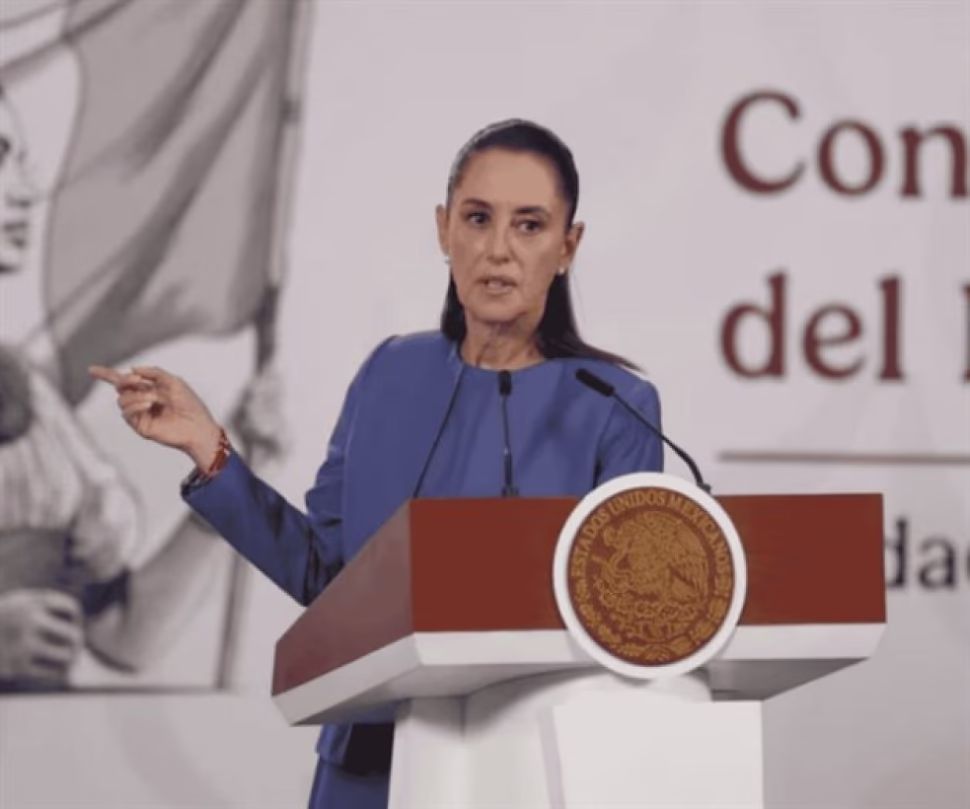
Claudia Sheinbaum came out today to defend tooth and nail the bilateral agreement with Cuba. His message was clear: Cuban doctors stay and humanitarian aid continues on its way. He said it in the morning, with that tone of someone reciting an unquestionable principle.

“There are those who say, these right-wing commentators, that: ‘well, but the Cuban people live in a dictatorship.’
There you have it. For the president, the discussion about the political regime in Havana is a separate issue. What cannot be allowed, he insists, is economic isolation.

Doctors: the jewel in the crown of the agreement

The star argument is the presence of Cuban specialists. Sheinbaum paints them as heroes of the pandemic and now as saviors of rural Mexican areas that no one else wants to serve.

“Yesterday I commented in the north of Baja California Sur, it is difficult for Mexican medical specialists to leave and Cubans are willing to work there,” he explained.

They ensure that they are paid a fair salary right here, under the umbrella of the agreement between governments. Nothing about Cuba taking the biggest cut, according to his story.

But one can’t help but wonder: how much of that salary actually ends up in the hands of doctors? The program’s precedents in other countries paint a… complex picture.

The constitutional charter and self-determination

Then came the legal recourse. Sheinbaum hid his legal training to bring out the self-determination of the peoples enshrined in our Constitution.

“That’s what the United Nations is for (…), but it is not another country that solves the problem for another,” he said, referring to the US blockade.

Curious how some principles are invoked selectively. Non-interference seems to apply only towards certain countries and in certain directions.

The finishing touch: business and own decisions

To close with a flourish, the president highlighted that Cuba now allows its compatriots to invest on the island.

“Today you can do business in Cuba. Because of a decision made by the Cuban government,” he concluded.

As if this minimal economic opening erased decades of iron state control. The message is served: Mexico will maintain its line, regardless of who it is. Government solidarity, at least with some regimes, is not in question.

Pedestrian bridge collapses on Manzanillo beach; two injured

Pedestrian bridge fall on La Boquita beach leaves two minor injuries.

Collapse in La Boquita

Two people suffered minor injuries after the collapse of the pedestrian bridge on La Boquita beach, in Manzanillo, Colima. The incident occurred on the afternoon of Saturday, July 25 and mobilized Civil Protection elements, who came to provide support.

According to the authorities, those affected did not require hospital transfer. The area was cordoned off to avoid risks to other tourists and to allow security checks.

Background and investigation

The same bridge had already collapsed in 2017 and was rebuilt. However, authorities noted that the new structure appeared to have deficiencies. An investigation will begin to determine responsibilities for its construction and maintenance.

Specialized personnel will carry out inspections to evaluate conditions and rule out other risk points. Visitors were asked to avoid the affected area. Municipal and state authorities will maintain surveillance until safe access is guaranteed.

The case revived the debate about tourism infrastructure and the need for periodic reviews in public spaces.

Continue reading

PAN accuses political persecution against Ernesto Ruffo Appel

The PAN leader denounces political use of justice against the former governor of Baja California.

Accusations of political persecution

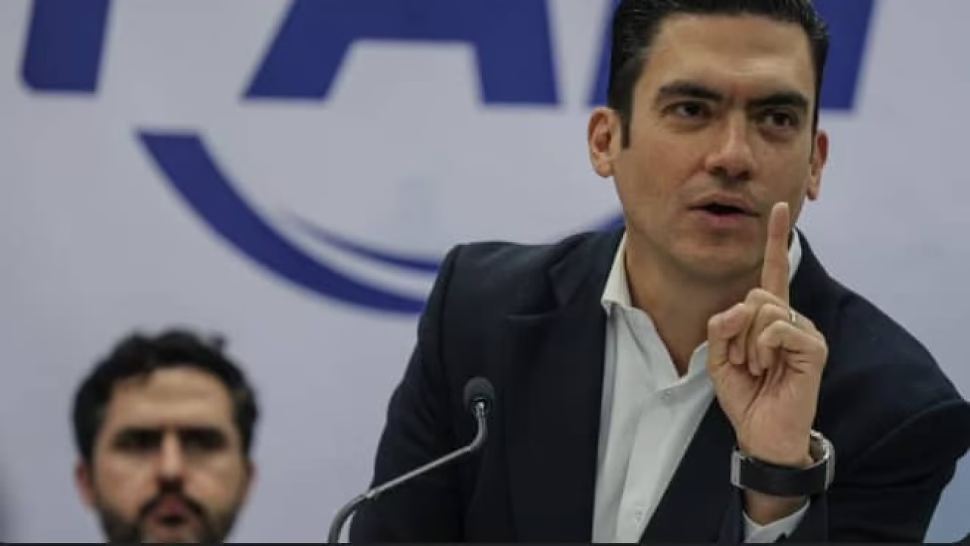
The national president of the PAN, Jorge Romero Herrera, assured that Ernesto Ruffo Appel is a victim of political persecution by the federal government. In a statement, the PAN leader pointed out that the admission of the former governor of Baja California to a maximum security prison responds to a political use of justice institutions.

Romero Herrera stated that there is not enough evidence to support the accusations against Ruffo Appel for an alleged tax evasion network. The PAN member maintained that the government has chosen to persecute opponents while ignoring accusations against Morena figures.

Comparison with Morena cases

The PAN leader mentioned Morenoist politicians such as Rubén Rocha Moya, Enrique Inzunza, Américo Villarreal and Marina del Pilar Ávila. He said that they have faced questions about possible links to organized crime without the authorities acting as quickly.

Romero Herrera insisted that the law must be applied without distinctions. He stressed that anyone who commits a crime must respond to justice, but demanded that the criminal system not be used as a tool of political persecution.

Continue reading

Afore withdrawals and unpaid loans put millions at risk

Moreira and experts warn about the impact of early withdrawals and unpaid loans.

Risk for workers’ assets

Rubén Moreira, coordinator of the PRI in the Chamber of Deputies, warned that the increase in the overdue portfolio of mortgage and consumer loans, along with the increase in withdrawals from Afores due to unemployment, puts the assets and future pensions of millions of Mexicans at risk.

During the program “With Pears, Apples and Oranges”, Moreira pointed out:

The lack of employment has forced many families to stop paying their bank loans and resort to their retirement savings to cover basic needs such as food and medicine.

The legislator criticized the fact that there is not enough information about the consequences of withdrawing resources from the Afores, since this reduces accumulated savings for retirement.

He also warned about the growth of loans granted by fintech and digital banks, some of which can handle high financial costs and represent risks for users.

Mario Di Costanzo, specialist, reported that between January and June of this year more than one million workers made partial withdrawals of their Afores due to unemployment. He added that Infonavit’s overdue portfolio reached 410 billion pesos during the first quarter of 2026, while mortgage and consumer loans in arrears exceeded 110 billion pesos.

Miguel Ángel Sulub, for his part, explained that early withdrawals from Afores not only affect the amount available for retirement, but also the weeks of contributions necessary to obtain a pension.

Continue reading