


Strategic Assessment of Threats to North American Airspace
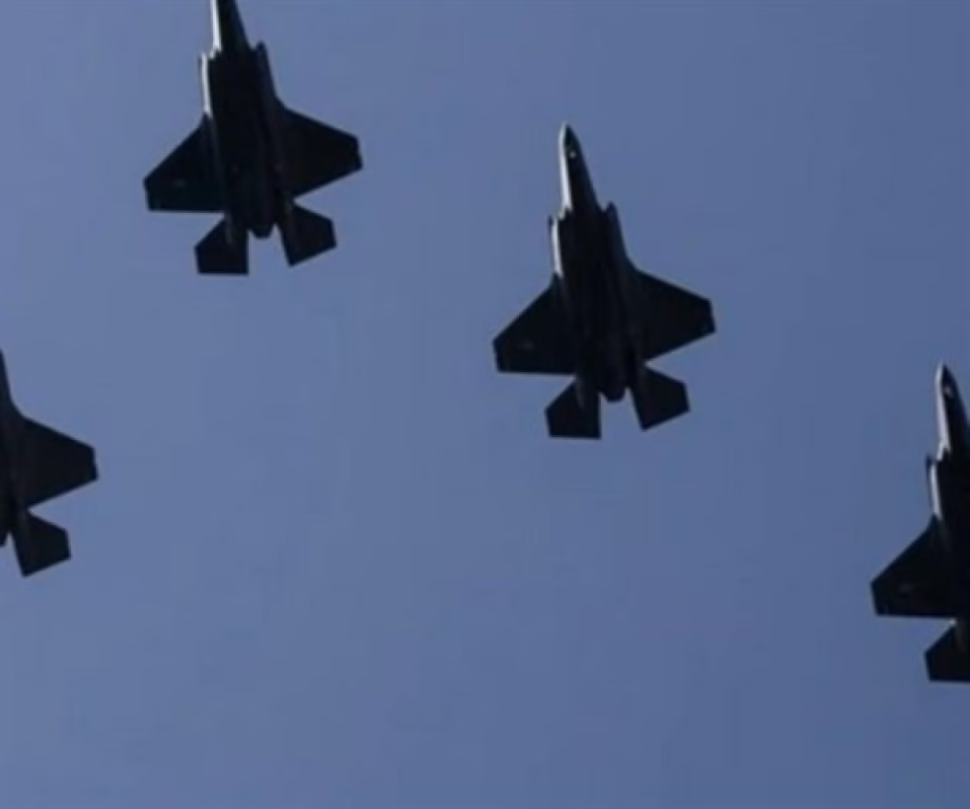
The Secretariat of National Defense (Sedena) has issued an official statement detailing the holding of the Final Planning Conference for the Multinational Air Defense Exercise “AMALGAM EAGLE 2025”. This momentous meeting, held in Cleveland, Ohio, represents a significant milestone in the collective security architecture of North America, constituting the first exercise of this magnitude in more than a decade that integrates the simultaneous and coordinated participation of Mexico, the United States and Canada. The Mexican delegation was made up of members of the Sedena and the Secretary of the Navy, who collaborated directly with their counterparts from the US and Canadian armed forces.
The central objective of this trilateral initiative is to substantively strengthen the operational coordination and technical cooperation mechanisms to effectively identify, evaluate and counter potential threats in shared airspace. The complexity and dynamism of contemporary risks, ranging from illicit trafficking to eventual security crises in large-scale events, demand a unified response and standardized action protocols. The reactivation of this three-way exercise format underscores a renewed commitment to the principle of shared responsibility in the defense of the continental territory.
Operational Framework and Geopolitical Context
During the planning sessions in Cleveland, the tactical objectives and what-if scenarios to be simulated during the “AMALGAM EAGLE 2025” exercise were precisely defined. A fact of capital importance is that these preparations are strategically aligned with the security requirements for the next Football World Cup 2026, a global scale event that will be shared between the three nations. Protecting airspace during an event of such magnitude, which will attract millions of visitors and massive international attention, requires meticulous preparation and interoperability of defense systems.
Mexico’s participation in this scheme is framed in a series of clearly established guiding principles: reciprocity, differentiated responsibility, mutual trust and, fundamentally, unrestricted respect for the sovereignty and autonomous decisions of each nation. This approach seeks to consolidate a robust preventive security architecture, designed to safeguard national interests and the well-being of the population, without ceding powers in matters of defense policy. This activity is integrated into the mechanisms of bilateral military cooperation in force between Mexico and the United States since 2016, evidencing an evolution towards a more comprehensive and complex collaboration model.
Immediate Background and Consolidation of Cooperation
The path towards “AMALGAM EAGLE 2025” has been paved by a series of high-level meetings that demonstrate sustained political and strategic will. On May 27 and 28, a highly relevant meeting was held between the heads of the National Defense and Navy of Mexico with General Gregory M. Guillot, commander of the United States Northern Command (USNORTHCOM). This meeting took place at the facilities of the National Training Center (CNA) in Santa Gertrudis, Chihuahua, where the authorities witnessed a joint training exercise with members of the Army, Air Force, Navy and National Guard, evaluating capabilities and procedures in real time.
Subsequently, from June 23 to 25, Mexican senior commanders moved to the headquarters of USNORTHCOM and the North American Aerospace Defense Command (NORAD), in Colorado Springs. The objective of this meeting was to delve into topics of common interest in matters of Security and Defense, analyzing risk scenarios and opportunities for closer strategic collaboration. NORAD, being the binational entity (EU-Canada) responsible for the surveillance and control of continental airspace, represents a key actor whose experience is vital for the triangulation of efforts with Mexico.
In the specific area of border security, from August 5 to 7, representatives of the Sedena and the Northern Army of the United States held a “Regional Board of Border Commanders” in Ensenada, Baja California. This dialogue instance operates as the fundamental platform for collaboration and tactical coordination of security efforts along the extensive border shared between Mexico and the United States, addressing specific challenges and optimizing the exchange of intelligence information.
In conclusion, the sequence of these events—from the bilateral meetings to the trinational planning conference—reveals a deliberate and structured process for building collective air defense capabilities. Mexico’s active participation in “AMALGAM EAGLE 2025” is not an isolated event, but the most recent link in a chain of initiatives aimed at raising the level of preparation and response to complex threats, positioning the country as a responsible strategic partner in hemispheric security.
Do you consider this type of trinational cooperation essential for national security?Share this analysis on your social networks and explore more content on strategy and defense on our site.


