


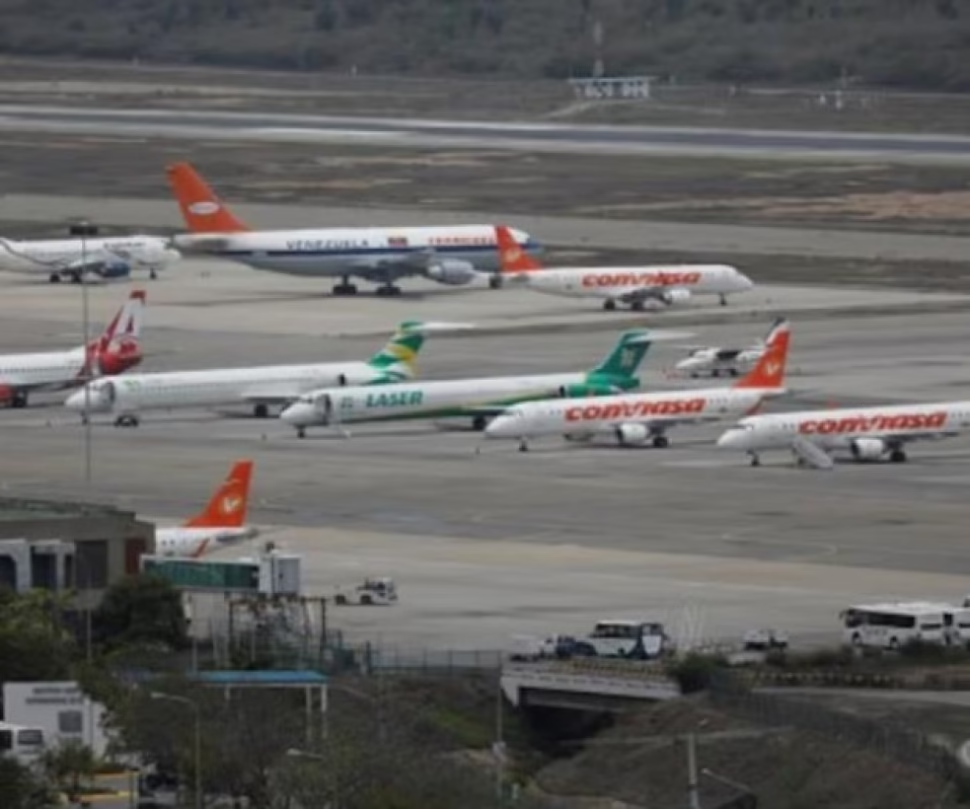
International Air Transport Association Issues Clear Guidelines
The International Air Transport Association (IATA) has issued a formal communication reaffirming the protocol that member airlines must follow in situations of airspace restriction. The organization emphasizes that each air operator must carry out an individual and exhaustive risk assessment before deciding to maintain operations in areas where closures are decreed, such as the one announced by the United States over Venezuelan airspace. This fundamental principle ensures that the operational safety of passengers and crew is the highest priority, above commercial or political considerations.
Operational Autonomy and Regulatory Compliance
In its statement, IATA was emphatic in pointing out that “safety is and will continue to be the top priority of commercial aviation.” This industry axiom implies that airlines will act strictly within applicable international and national regulatory frameworks. If an airline’s internal risk analysis determines that conditions are unsafe, suspension or cancellation of flights is not just an option, but an imperative. The association, which represents about 80% of global air traffic, urges governments and other actors to respect this autonomy in making technical and operational decisions.
IATA’s positioning seeks a complex balance. On the one hand, it defends the principle of open skies, fundamental for global connectivity and the economy. On the other hand, it recognizes that sovereignty and national security decisions can lead to restrictions. In this context, its message is clear: security and legal compliance always prevail. The willingness of the air sector to resume services to Venezuela, or to any destination, is conditioned only on the existence of verifiable guarantees of safe and efficient conditions for operations.
Context and Consequences of the US Measure
This statement responds directly to the announcement made on November 29 by the then president of the United States, Donald Trump, who declared a “total” closure of the airspace over and around Venezuela. A measure of this magnitude generates a significant disruption in commercial air routes, affecting not only flights to the South American country, but also overflight operations, which are crucial for the efficiency of routes in the region.
The impact extends beyond immediate logistics. It generates uncertainty in the market, affects airline planning and can have economic repercussions for the countries involved. IATA’s response, therefore, is not only a reminder of protocols, but a stability guide for its members in a complex geopolitical scenario. It guides companies to base their decisions on standardized technical and risk assessment criteria, isolating air operations from political volatility as much as possible.
In essence, the IATA statement reinforces the international aviation governance framework. It delegates ultimate responsibility to each air operator, supported by its experience and safety management systems, while establishing an expected standard of conduct: prudence and the preeminence of human life. This analytical and meticulous approach is the cornerstone that has allowed commercial aviation to maintain its extraordinary global safety record, even in challenging environments.
Are you interested in understanding how geopolitical decisions impact global logistics and connectivity?Share this analysis on your social networks and explore more specialized content on aviation and international transportation in our industry section.


