Mexico exports bell pepper to Japan after 16 years

After 16 years of efforts, the Mexican pepper overcomes phytosanitary barriers to reach one of the most exclusive markets in the world.

Mexico Says a Spicy ‘Yes’ to Japan (But Without Spicy, Obviously)

It seems that the Mexican bell pepper finally got his visa for Japan after a process that made the ‘Stranger Things’ bureaucracy look fast and efficient. Yes, friends, after 16 long years of negotiations, meetings and studies, the Mexican bell pepper (Capsicum annuum L. for the scientific friends) will be able to cross the pond and land in the basic Japanese basket. The reason? Demonstrate that he is not the carrier of a plague that has worried Japan since 1945. That is, since before memes existed.

The Ministry of Agriculture, Forestry and Fisheries of Japan (MAFF, because even Japanese ministries use cool acronyms) published on September 17 in its Official Gazette the resolution authorizing the import. Basically, they gave the Mexican pepper the green check. And no, it’s not a new Instagram filter.

RelatedSenasica warns about counterfeit veterinary medicines in circulation

When Science Beats Drama (And Patience)

It all started in 2009, when Senasica—the heroic National Service for Agri-Food Health, Safety and Quality—decided that it was time to show the world that the bell pepper was not the villain of the story. It turns out that Japan had (and has) a historical phobia of blue tobacco mold, a pest under quarantine since the end of World War II. Yes, as you read it: since our grandparents wore bell-bottoms.

But Mexico did not give up. The scientists from the Center for Research in Food and Development (CIAD), led by Dr. Raymundo S. García Estrada, put on their coats and embarked on the mission. After years of research, they managed to prove with scientific evidence that the Mexican pepper is not susceptible to this pest. In other words, they passed the most complicated admission exam in agri-food history.

By July 2025, both countries agreed on a “Work plan for the export of fresh bell pepper fruits“, which is basically the phytosanitary protocol that producers must follow. Now, those who comply with what is established—and register with Senasica—will be able to export. It’s like being on the VIP guest list at an exclusive club in Tokyo.

It’s Not the First Taco at the Party (But It’s the Freshest)

In case you didn’t know, Mexico already sells a lot of things to Japan: pork, beef, asparagus, grapes, avocado, tomato, mango and even orange juice. But the bell pepper joins the party like that friend who arrives late but with the best snacks. Of course, he already had experience in markets like the United States and Canada, so he is not a rookie.

This achievement is no small feat. Japan is one of the most demanding markets in the world in terms of quality and phytosanitary standards. Having the doors open for you there is like having your outfit checked at the Met Gala: if you pass, it’s because you’re really doing things right.

So, after 16 years of technical work, international dialogue and collaboration between authorities, scientists and producers, Mexico manages to place another of its agricultural products on the global stage. And all, without having to apologize for being spicy (although this one, curiously, is not spicy).

What’s next? Export guacamole to the moon? With these precedents, nothing seems impossible to us.

If you love seeing how Mexican products conquer the world, share this note and continue exploring more stories about national agriculture that is breaking it internationally. Because this is a success that deserves to be viral 🚀.
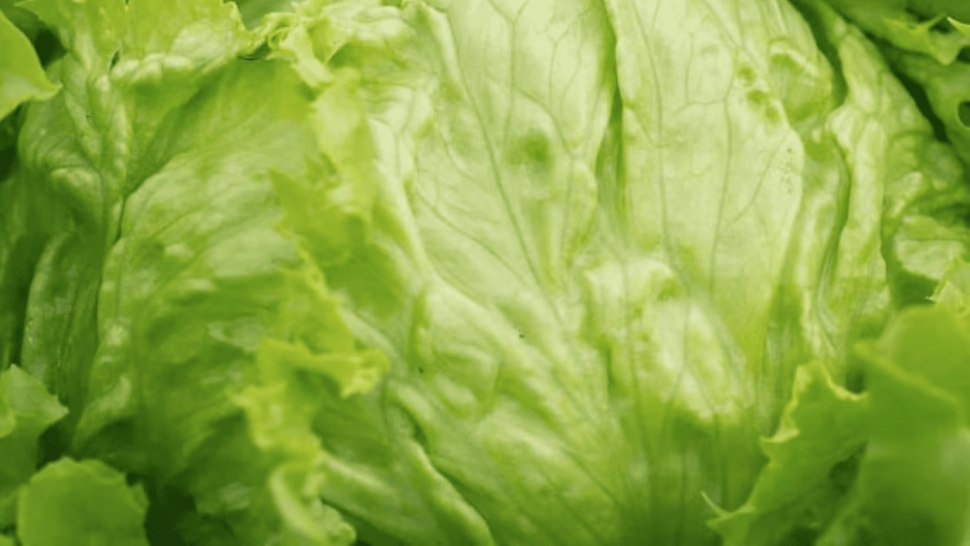

FDA recognizes false positive in Taylor Farms lettuce

Cofepris analysis rules out contamination; FDA admits error in initial sample.

Analysis results

The Ministry of Health reported that tests carried out on lettuce and water samples from the Taylor Farms Mexico plant were negative for the parasite Cyclospora cayetanensis —which causes severe diarrhea— and also for fecal coliforms. The analyses, carried out by Cofepris, confirmed that the product complies with the physicochemical parameters established in national standards.

Traceability and false positive

Taylor Farms has a traceability system that allowed United States authorities to identify the origin of the product and track a batch held at customs in Laredo, Texas. That batch never entered US territory.

The sample obtained from that batch returned a false positive, a situation that the United States Food and Drug Administration (FDA) recognized in an update published on July 19. The Ministry of Health emphasized that the product is suitable for human consumption.

Continue reading

UIF identifies 55 people in the CJNG financial network

The FIU detected 55 people linked to a CJNG financial network, including 16 front companies.

The Financial Intelligence Unit (UIF) of Mexico detected 55 people allegedly linked to a financial network of the Jalisco New Generation Cartel (CJNG). The finding was achieved through specific financial indicators, as reported by the Ministry of Finance and Public Credit (SHCP).

Release 61 details that the Office of Foreign Assets Control (OFAC) of the United States Department of the Treasury designated 55 people – 39 individuals and 16 legal entities – related to this structure. The action is part of bilateral cooperation against the finances of organized crime.

Indicators detected

The FIU identified “indicators related to possible operations with resources of illicit origin.” Among them: cash operations, acquisition of high-end vehicles, jewelry and real estate, international transfers, intensive use of credit and service cards, and inconsistencies in income reported to the SAT.

The authorities detected “possible inconsistencies between the income reported to the tax authority and the resources observed in the financial system,” which strengthened the identification of the network.

Front companies and complaints

Of the total, 16 legal entities had illegal activities. According to the FIU, some registered relevant operations, while others were front companies with “limited or no apparent economic activity.”

The UIF filed a complaint with the Attorney General’s Office (FGR) for the crime of operations with resources of illicit origin. It also included the subjects designated by OFAC on the List of Blocked Persons (LPB), and added eight additional ones—four individuals and four legal entities—linked to the same financial structure.

International coordination

The Treasury stressed that the coordinated actions with the United States seek to “prevent improper use of the financial system, combat money laundering and weaken the economic structures of organized crime.” The FIU maintains cooperation with national and international authorities, in accordance with the standards of the Financial Action Task Force (FATF).

Continue reading

US Treasury locates Florence as a drug production center

The Treasury Department identified the Zacatecas municipality as the CJNG base for fentanyl and cocaine.

The United States Department of the Treasury identified Florencia de Benito Juárez, Zacatecas, as one of the key points of the Jalisco New Generation Cartel (CJNG) to manufacture fentanyl, cocaine and methamphetamine.

According to the agency, José Octaviano García Martínez is the current head of the plaza in the area, accompanied by Cuauhtémoc Rivera Zepeda and Uriel Hernández Morales. These last two would be in charge of the clandestine laboratories in Zacatecas and Jalisco. All three report to Audias Flores Silva—alias El Jardinero—, designated as successor to the late leader Nemesio Oseguera Cervantes, El Mencho.

Criminal presence in a small municipality

Florencia de Benito Juárez barely covers 328 square kilometers in the south of the state, in the Sierra Madre Occidental, adjacent to Jalisco. Despite its size, the municipality has been the scene of organized crime operations.

In March 2025, authorities dismantled a camp used by a criminal cell. Months later, in June, they destroyed a greenhouse used for growing marijuana. Both operations sought to neutralize illegal infrastructure.

The municipal president elected in 2024 is Fortino Cortés Ramírez, who will conclude his term in 2027.

Recent violence and federal response

On Saturday, July 18, 2025, 10 bodies were found in the municipalities of Morelos, Pánuco and Sain Alto. Of the victims, six were construction, mining and entertainment businessmen. Two others were officials of the Fresnillo city council: Fidel Alvarado de la Torre, secretary of Municipal Social Development, and firefighter Jesús Gerardo Muñetón Hernández.

Given these events, the Secretariat of National Defense deployed 100 Special Forces elements on July 22. They joined the 400 Army and National Guard troops who had already been operating since July 19. They carry out ground reconnaissance and deterrent actions in Zacatecas, Guadalupe and Fresnillo.

The conflict in the region is not new. On May 20, 2011, a clash between rival groups—known as The Florence War—left 77 people dead. The journalist Alfredo Valadez Rodríguez documented this episode in the book of the same name, published by Ediciones Proceso in 2021.

Continue reading