
Meta withdraws AI tool on Instagram due to invasion of privacy

The company disabled Muse Image after massive complaints; SAG-AFTRA called it reckless.

Meta abruptly removed its generative AI tool Muse Image on Instagram. The decision came after a global wave of complaints about privacy violations.

The controversy

The function, developed by Meta Superintelligence Labs, allowed images or videos to be created and modified using faces from public accounts through mentions, without the need for prior authorization. Users found that the option was activated by default.

“This feature did not meet expectations, so it is no longer available,” Meta admitted in an official statement.

The actors union SAG-AFTRA described the implementation as “reckless” and warned about risks of non-consensual deepfakes. In a statement, they noted that “anything other than explicit and visible consent for this type of use of Instagram users’ images is unacceptable.” Actress Hannah Einbinder also joined, asking the public to review their profiles before the exhibition.

RelatedMeta withdraws controversial AI function that used Instagram images

Despite the shutdown, the debate over using user data to train AI models continues. Instagram maintains an option to manually restrict that use. The steps, according to the Help Center:

  • Enter your profile and open the settings menu (three horizontal lines).
  • Search Share and reuse.
  • Turn off the Posts and Reels toggles in the section about allowing others to use your AI-enabled content in Meta.

SAG-AFTRA celebrated Meta’s rectification and described it as a responsible action in the face of the damage that can be caused by the excessive use of graphic identities without validation filters.
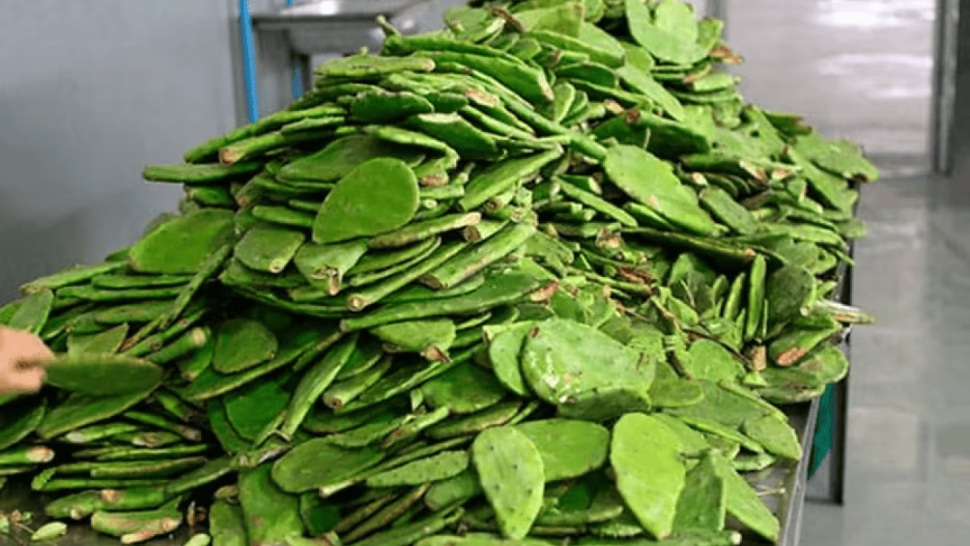

Nopal fertilizer accelerates crop growth

UNAM cactus fertilizer increases biomass by 20% and accelerates crop maturation.

The cactus waste that is usually discarded could be transformed into a tool for sustainable agriculture. UNAM researchers developed an organic fertilizer from the thorns and edges of this cactus that increased the biomass of the crops by up to 20% and accelerated their growth.

Results in Milpa Alta

The project was led by Bruno Chávez Vergara, from the UNAM Institute of Geology. Nopal digestate, a byproduct of the anaerobic digestion of organic waste, was evaluated. The research, funded between 2018 and 2020 by the Ministry of Education, Science, Technology and Innovation of Mexico City, seeks to promote sustainable practices in volcanic soils in the south of the basin.

Between 15% and 20% of the nopal processed for consumption is discarded as thorns and edges. This material is used to generate biogas and electricity, but it also produces a liquid waste that works as organic fertilizer. The tests were carried out in agricultural areas of Milpa Alta, Xochimilco and Tláhuac, in collaboration with Sustainability in Energy and Environment (SUEMA).

Chávez Vergara explained that digestate provides mineral nutrients to plants and feeds beneficial bacteria and fungi in the soil, recovering biological functions affected by years of chemical fertilizers. Unlike synthetics, this product promotes the microbial activity necessary for soil fertility. Its liquid presentation allows better use of water and faster absorption of nutrients.

In forage oat crops in Milpa Alta, the results were immediate. Since the first agricultural cycle, a 20% increase in biomass and a reduction of up to one month in maturation time was recorded. The researcher pointed out that these benefits would be especially useful for hillside and rainfed farmers, where lack of irrigation and erosion make production difficult.

Following the results, the UNAM team plans to expand the tests to corn and carrots, in addition to determining the minimum dose necessary to make the use of this fertilizer based on cactus residue profitable.

Continue reading

GTA VI scams: how cybercriminals operate

Kaspersky warns about fraud campaigns that use the anticipation of GTA VI to steal data.

The fever for the release of Grand Theft Auto VI has a dark side. Kaspersky detected multiple fraud campaigns that take advantage of expectation to compromise devices and steal personal information.

Attackers use fake pre-sales, supposed beta versions, and deceptive cryptocurrency tokens. According to the firm, the increase in reports began just after the start of the official pre-sale.

How do they deceive users?

Lisandro Ubiedo, senior analyst at Kaspersky for Latin America, explained the method. Criminals create websites that replicate the game’s visual identity. When entering data for the purchase, the information—names, emails, IDs, and card numbers—is captured. The product never arrives.

Videos are also circulating on social networks with supposed tutorials for downloading beta versions. When these files are executed, malicious programs are installed that operate in the background and facilitate access to personal accounts.

Another modality: portals that promote apocryphal cryptoassets using the brand image without authorization. This causes financial losses for investors.

Recommendations to avoid fraud

Kaspersky recommends purchasing content only from official channels. Verify URLs before entering sensitive data. Use virtual cards or prepaid methods for online transactions. And be wary of links with alleged leaks shared on digital platforms.

Continue reading

Mexico ranks 45th in AI adoption: study

Study by Accenture and IPADE places the country in 45th place globally. 66% of companies barely carry out pilot tests.

Mexico is in 45th position in the world in preparation to adopt artificial intelligence (AI), according to a study by Accenture, Empresas Globales and IPADE Business School. The report points out lags in infrastructure, research, private ecosystem and regulatory frameworks.

Business adoption still incipient

Despite the growing interest in generative AI, most organizations in Mexico are in the early stages. Of the total number of companies consulted, 66% remain in isolated tests or structured pilots. Only 34.1% have integrated or scaled technology in their processes.

The study—titled Oh, oh, oh, AI!—included interviews with CEOs and a survey of executives from 44 organizations that represent 3.3% of the national Gross Domestic Product (GDP). The business discussion is no longer whether AI will be relevant, but how quickly it will be incorporated into operations and strategic decisions.

Potential impact and challenges

Accenture Research estimates that, with a people-centered strategy, generative AI could transform 42% of working hours in Mexico and contribute up to $305 billion to GDP by 2038.

However, obstacles remain. Rafael Ramírez de Alba, professor at IPADE, pointed out that the country is in a decisive phase, but development depends on strengthening organizational, technological, regulatory and talent capabilities. The analysis identifies weaknesses in research, digital infrastructure and public policies.

At the corporate level, 43.2% of companies are still designing or adjusting their AI strategy; Only 13.8% have integrated it into the core of the business. In corporate governance, only 36.4% have a fully applied formal governance framework, and 52.3% are developing it. As a result, 68.2% report low or medium levels of confidence in using AI in relevant decisions. Furthermore, only 18% of boards of directors sufficiently understand the associated risks.

Continue reading