Mérida prioritizes social programs for women with social justice

The mayor reinforces her government strategy with a gender focus and highlights intergovernmental collaboration to promote development.

Municipal Commitment to Gender Equality in Mérida

The Municipal President of Mérida, Cecilia Patrón Laviada, actively participated in the presentation of the First Government Report of the President of Mexico, Claudia Sheinbaum Pardo. During the event, the councilor reiterated her unwavering commitment to exercising a municipal government close to citizens, based on the principles of social justice and with a priority focus on the advancement and well-being of women. His statement underscores a philosophy of public administration that seeks to transcend traditional management to implement a comprehensive and inclusive vision.

This commitment is framed within a national political context where female representation in the highest decision-making positions has reached unprecedented relevance. The presence of a woman in the presidency of the Republic acts as a symbolic and practical catalyst, inspiring and demanding greater incorporation of the gender perspective at all levels of government. Patrón Laviada’s administration is presented as a case study of this trend, aligning its local objectives with a broader national equity agenda.

RelatedMérida resurfaces with 100 km of streets after decades of abandonment

Strategies and Programs with a Gender Approach

In her statements, the mayor of Merida emphasized one of the cornerstones of her administration: the redistribution of public resources towards programs that directly benefit women. “When a woman arrives, we all arrive,” she stated, encapsulating the essence of her policy of institutional sisterhood. This maxim is translated into a concrete and quantifiable action: in the city council of Mérida, 7 out of every 10 social programs are specifically aimed at promoting the growth, personal development and economic independence of the people of Mérida.

This statistical data is not a simple figure; represents a deliberate budget decision and clear political prioritization. It involves a substantial investment in critical areas such as female entrepreneurship, access to education, health, and the prevention of gender violence. The ultimate purpose of these public policies is to generate an ecosystem of opportunities that allows women not only to participate, but to thrive and lead in all areas of the city’s social and economic life.

Intergovernmental Collaboration and Community Impact

A crucial element for the success of these local initiatives is the strategic collaboration with the federal government headed by President Sheinbaum Pardo. Patrón Laviada highlighted this synergy, pointing out that female leadership in federal spheres creates a multiplier effect. “When a woman reaches important decision-making positions, so does every girl, young woman, adult, elderly person or head of family,” she explained. This collaboration allows us to align efforts, share best practices and amplify the impact of the programs, guaranteeing that the benefits reach communities and police stations, improving the quality of life and the safety of their inhabitants.

The visit of the national president to Yucatán as part of her reporting tour was not just a protocol act; It was a reaffirmation of this shared commitment. It served as a platform to visualize the progress achieved through this coordinated governance model, where teamwork between different levels of government becomes the driving force for social transformation. The mayor emphasized that women transform their family, their home and their locality, and that this transformation is accelerated through a solid institutional support network.

The focus of the municipal administration is on governing hand in hand with other women, fostering a culture of mutual care and collective drive. This methodology, which Patrón Laviada describes as “caring for and encouraging each other,” seeks to create a more horizontal and empathetic power structure. The promise to continue to “govern with results” and “with the heart first” points to a leadership model that combines technical effectiveness with compassion and emotional connection to the needs of our people.

Was this analysis of gender policies in local government interesting to you? Share this note on your social networks to expand the conversation and explore more content related to the public agenda and female leadership in our politics section.

Did you lose your luggage? The airline must pay you this

Know the compensation amounts for lost or damaged luggage on national and international flights.

Compensation for lost luggage

If you lose your carry-on luggage on a domestic flight, the airline must pay you 6,759 pesos, equivalent to 80 UMA. For checked luggage, the compensation increases to 12,673 pesos (150 UMA). This is established by the Federal Consumer Protection Agency (Profeco).

Each checked bag must have a check with two parts: one for the passenger and another attached to the luggage. This avoids confusion and facilitates complaints.

On domestic flights, you can check in between 15 and 25 kilos free of charge, depending on the aircraft. In addition, you carry up to two hand pieces that together do not exceed 10 kilos. The maximum dimensions are 55 cm long, 40 wide and 25 high.

If your luggage exceeds these limits, the airline may charge extra, as long as there is space. It also offers reduced rates to those traveling without suitcases.

For international flights, the rules depend on the corresponding treaty.

Where to claim

Profeco has modules at the Mexico City International Airport. They operate from Monday to Sunday from 7:30 a.m. to 8:30 p.m.; on holidays, from 8:00 a.m. to 8:00 p.m. You can also call the Consumer Telephone: 55 6887 22 or 01 800 468 8722.

Knowing your rights helps you demand fair compensation in the event of loss or damage.

Continue reading

Four young Tlaxcalans missing in Veracruz are rescued

Joint operation manages to locate the victims of a false job offer alive.

The rescue operation

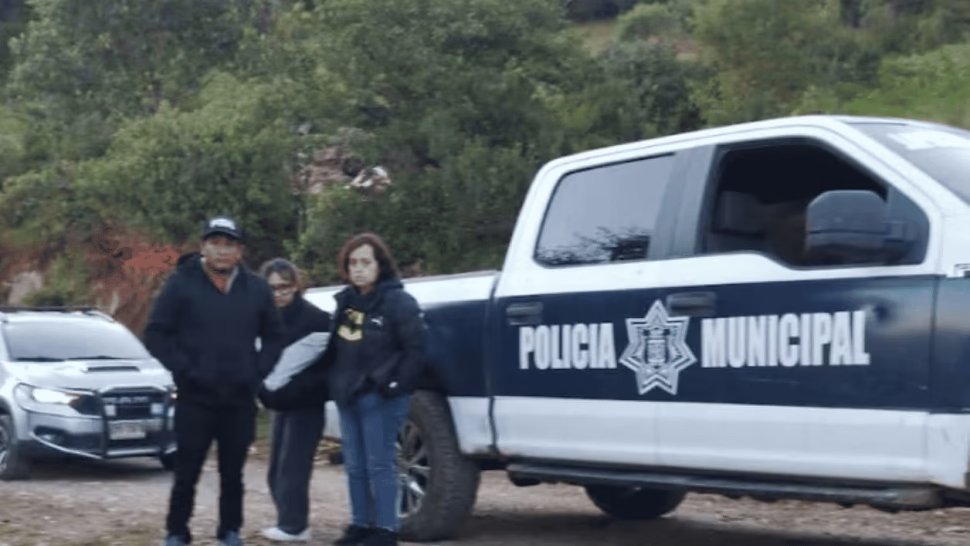
Four young people from Tlaxcala, reported missing after responding to a job offer, were located alive in the municipality of Acultzingo, Veracruz. The search activated a joint operation involving state police, the Mexican Army and the National Guard.

The group’s last known location was a point in Acultzingo. They were traveling in a white pickup truck, accompanied by a gray vehicle. They lost communication with their families when they were on their way to work, which triggered the complaint and its spread on social networks.

An anonymous call allowed authorities to locate the exact location. Elements of the State Police, National Guard, Municipal Police and Civil Protection of Acultzingo moved to the scene and found the young people, who were placed under protection.

Return to Tlaxcala

The four rescued received care in the Acultzingo Municipal DIF System. The authorities confirmed that they were in good health. Subsequently, the necessary steps were taken to facilitate his return to the state of Tlaxcala.

No arrests or clashes were reported during the operation. Investigations continue to clarify the facts and find those responsible for the false job offer that led to the disappearance.

Continue reading

Mazatlán removes eight cubic meters of garbage during a cleaning day

Eight cubic meters of waste collected in the 41st edition of the program.

Cleaning day in Mazatlán

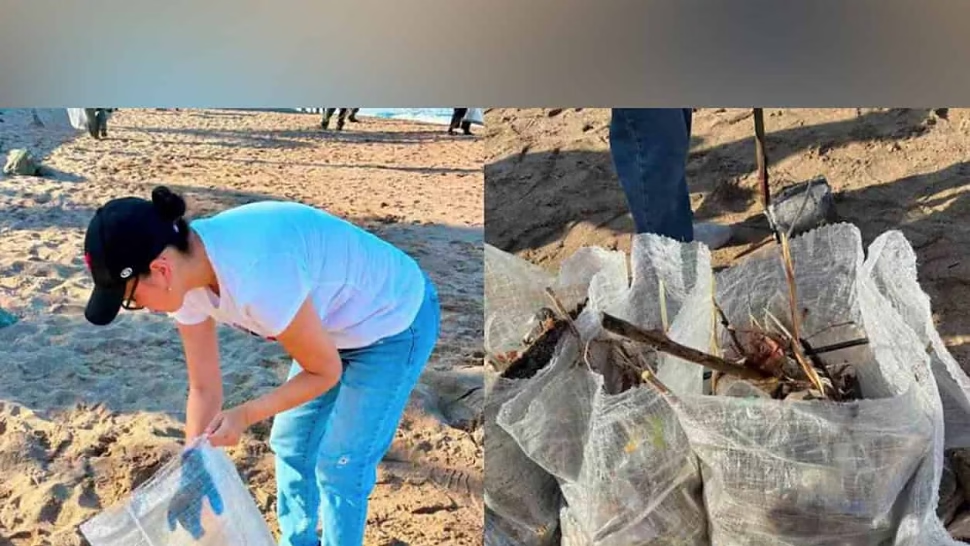
CULIACÁN, Sin.— Eight cubic meters of garbage, debris and branches were removed in a new day of cleaning beaches, parks and streets in the port of Mazatlán. The equivalent of 160 bags of waste left a renewed face in an area with a high tourist flow.

The 41st edition of the “Mazatlán I love you clean” program brought together municipal officials, hotel employees and volunteer environmentalists. The Beach Administrator was in charge of the coastal strip of Paseo de Olas Altas, where she collected forty bags to improve environmental conditions.

In the Villa Galaxia subdivision, staff from Public Services and the Drinking Water Board accumulated 120 sacks with disused furniture, leaves, debris and garbage. In addition, parks were cleaned, water leaks were repaired, and service modules were installed to quickly resolve neighborhood complaints.

The initiative not only seeks to improve the image of the port, but also to encourage citizen participation in environmental actions that benefit the community and tourists who visit Mazatlán.

Continue reading