Historical Investment in the Social Policy of Mexico
The federal administration has announced an unprecedented budget allocation for the year 2026, allocating more than one trillion pesos to the network of Pensions and Welfare Programs. This financial decision, emphasized by President Claudia Sheinbaum Pardo, represents the core of the government’s social policy and aligns with the guiding principle of “for the good of all, the poor first.” The magnitude of this resource seeks to consolidate a tangible guarantee of fundamental rights such as education, health and access to housing for the most vulnerable population.
Expansion of Coverage and New Support
According to the authorities, this injection of resources will allow expanding the coverage of social programs, benefiting an estimated total of 42.9 million beneficiaries. This expansion will add approximately 10 million additional people to the registry. A notable component of this expansion is the inclusion of around seven million families with primary school students, who will be recipients of new support.
For the 2026 cycle, two new specific incentives will be implemented. The first is a unique scholarship for supplies and uniforms aimed at all boys and girls in primary education. The second, called Gertrudis Bocanegra Scholarship, is initially focused on Higher Education students in the state of Michoacán, as part of the Michoacán Plan for Peace and Justice, and aims to subsidize transportation expenses. The stated goal is to progressively scale this mobility scholarship for young university students nationwide.
Increases in Coverage Amounts and Goals
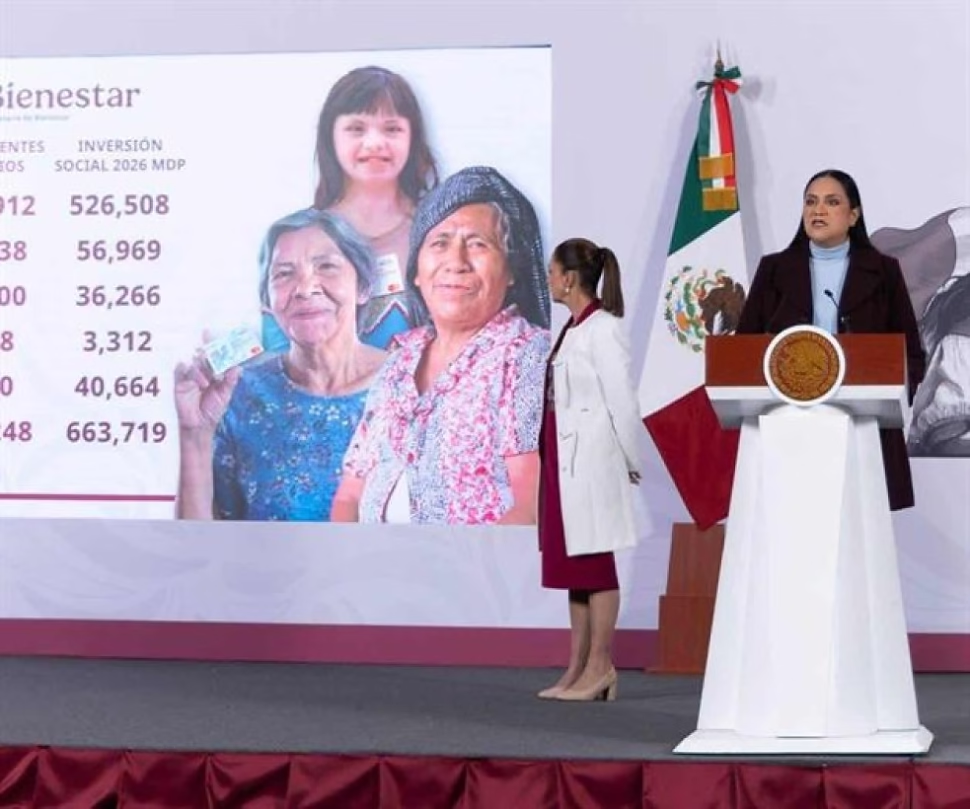
The Secretary of Welfare, Ariadna Montiel Reyes, provided a comparative analysis of the growth of the program. In 2025, social investment closed at 579,304 million pesos, serving nearly 18.5 million people. By the end of 2026, the projection is to reach 20.3 million direct beneficiaries with an investment of 663,719 million pesos, only in the pension area. Starting in the first two months of the year, significant increases will be applied to the amounts delivered:
Pension for Seniors will rise to 6,400 pesos every two months. The Pension for People with Disabilities will be set at 3,300 pesos every two months. The Women’s Welfare Pension will increase to 3,100 pesos every two months. Programs such as Working Mothers (1,650 pesos every two months) and Sembrando Vida (6,450 pesos per month) will continue and be strengthened.
Strengthening of Educational Programs
At the same time, emblematic programs such as “The School is Ours” will receive a substantial boost. Pamela López Ruiz, general director of the program, explained that a budget of 26,000 million pesos has been allocated for 2026. These resources will be distributed in approximately 78,923 educational facilities, benefiting 9.5 million students. The operation will follow a structured schedule: visits and school assemblies by National Servants between January and March, delivery of cards in April and May, and the execution of the corresponding payment in May.
Carlos Torres Rosas, general coordinator of Wellbeing Programs, stressed that this strategy of direct social investment constitutes the basis of the ongoing social transformation. By placing people at the center of government action, these programs not only recognize constitutional rights, but also seek to generate a transformative impact on the quality of life and local economic dynamics, closing historical inequality gaps.
Do you find this information about the distribution of the social budget valuable? Share it on your social networks to expand the debate and explore more content on public policies and economic development in Mexico.