Leo XIV begins his first international tour in Türkiye

The pontiff faces his first international tour with an agenda full of symbolism and delicate diplomatic balances.

The traveling debut of a Pope with a lot of diplomatic work

Well, the new tenant of the Vatican, Leo XIV, decided that his first official trip would not be to the beach, but to Türkiye. Nothing like choosing a destination with an explosive mix of geopolitics, religious tensions and a cost of living crisis to brand new suitcases. He arrived in Ankara on Thursday, where he was received with a military honor guard and a turquoise carpet that, let’s be honest, is the real protagonist of the photos. The Minister of Culture and Tourism, Mehmet Nuri Ersoy, and other officials were there for the protocol greeting, because in this matter of diplomacy, photos are the new ‘like’ on Instagram.

In his talk with journalists on board the plane (yes, the Pope also gives press conferences at 10,000 meters above sea level), he acknowledged the historic nature of his inaugural tour. Basically, it comes to commemorate the 1,700th anniversary of the Council of Nicaea, which for those who are not experts in ecclesiastical history, was like the first ‘Coachella’ of Christianity, but with less music and more theological debates. His agenda is a marathon: meeting with President Recep Tayyip Erdogan, speech before the diplomatic corps and then to Istanbul for three days of ecumenical and interreligious meetings. Come on, you don’t even have room to try a baklava.

RelatedCelebrities say goodbye to Pope Francis with emotional messages

Türkiye, the mediator with problems at home

While the pontiff sets foot on Turkish soil, the country presents itself as the key intermediary in the conflicts in Ukraine and Gaza. Ankara has hosted low-level talks between Russia and Ukraine and has even offered for a stabilization force in Gaza. All very laudable, but meanwhile, ordinary Turks grapple with a cost of living crisis that makes international politics seem like a luxury. It is not surprising that León’s visit goes almost unnoticed by most, outside of the small local Christian community.

The reaction of people on the street is a mix of indifference and ‘we’ve already seen this movie’ style skepticism. Sukran Celebi, an ordinary citizen, uttered the phrase of the day: “It would be good if it called for peace in the world, but I don’t think it will change anything.” And Metin Erdem, owner of an instrument store in the Galata district, got right to the point: “If the pope is visiting, that means the United States wants something from Turkey.” Because, of course, in the collective mind, the first American pope in history cannot be just a spiritual tourist.

The anniversary, unity and the ghosts of the past

The highlight of the trip is the commemoration of the Council of Nicaea in modern-day Iznik. There, Leo will pray with Ecumenical Patriarch Bartholomew and they will sign a joint declaration, a gesture of Christian unity that attempts to heal wounds from the Great Schism of 1054. Basically, it’s like when two friends who stopped talking due to a misunderstanding on Twitter try to reconcile 1,000 years later. But the agenda is not only ecumenical: the visit to the Blue Mosque and an interreligious meeting seek to strengthen ties with Muslims. Asgin Tunca, the imam who will receive the pontiff, hopes that the visit will help dispel prejudices about Islam. In other words, a full-fledged public relations ‘reset’.

But not everything is peace and love. The state of religious freedom in Türkiye is a thorny issue. Although Erdogan’s government has implemented reforms, Christian groups still face legal obstacles. The Catholic Church, with some 33,000 faithful in the country, has no formal legal recognition, which, according to the Rev. Paolo Pugliese, is “the source of many problems.” And then there is the potentially explosive moment: the visit to the Armenian Apostolic Cathedral in Istanbul. Francis, Leon’s predecessor, angered Turkey in 2015 by calling the massacres of Armenians “the first genocide of the 20th century.” León, more cautious in his statements, will have to navigate this minefield with the delicacy of a surgeon. Because if you drop the word ‘genocide’, the Turkish response could be an instant diplomatic block.

What does all this leave us? That Leo XIV‘s traveling debut is a cocktail of symbolism, realpolitik and hopes for peace, served in a region where nothing is simple. A millennial Pope in a world that continues to play with the rules of the last century.

Did you find this analysis of Vatican diplomacy interesting? Share this article on your social networks and explore more content on international politics on our website.
SRE rules out Mexicans affected after earthquakes in Venezuela

SRE reports that there are no Mexicans affected by earthquakes in Venezuela.

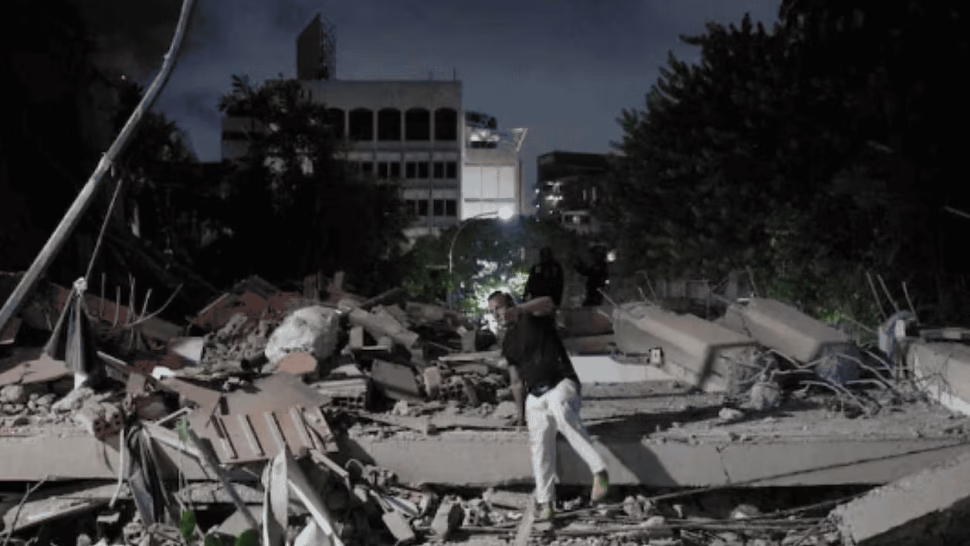
The Ministry of Foreign Affairs (SRE) reported that, as of this Wednesday afternoon, there were no reports of Mexican people affected by the earthquakes registered in Venezuela.

No effects reported

Through a statement, the Foreign Ministry expressed its solidarity with the Venezuelan people and regretted the damage that had occurred.

“The Ministry of Foreign Affairs expresses all its solidarity with the Venezuelan people and deeply regrets the damage and harm caused,” said the agency headed by Roberto Velasco.

The Mexican embassy in Venezuela remains attentive to the development of the situation. So far, there are no compatriots who have required assistance.

Support channels

For those who need consular protection, the Mexican representation has enabled the emergency number: +58 412 2524675. The authorities recommend staying calm and following local instructions.

The international organization continues to monitor possible aftershocks. For now, no changes are expected in travel recommendations for Mexicans in the region.

Continue reading

Colombia and the Amazon: a turn towards extractive development

De la Espriella's triumph in Colombia raises questions about the future of the Amazon rainforest in the region.

Abelardo de la Espriella’s victory in Colombia’s presidential elections marks a possible change in environmental policy in the region. The businessman, backed by Donald Trump, defeated Iván Cepeda by just 251,000 votes, according to official results.

What will happen to the Amazon?

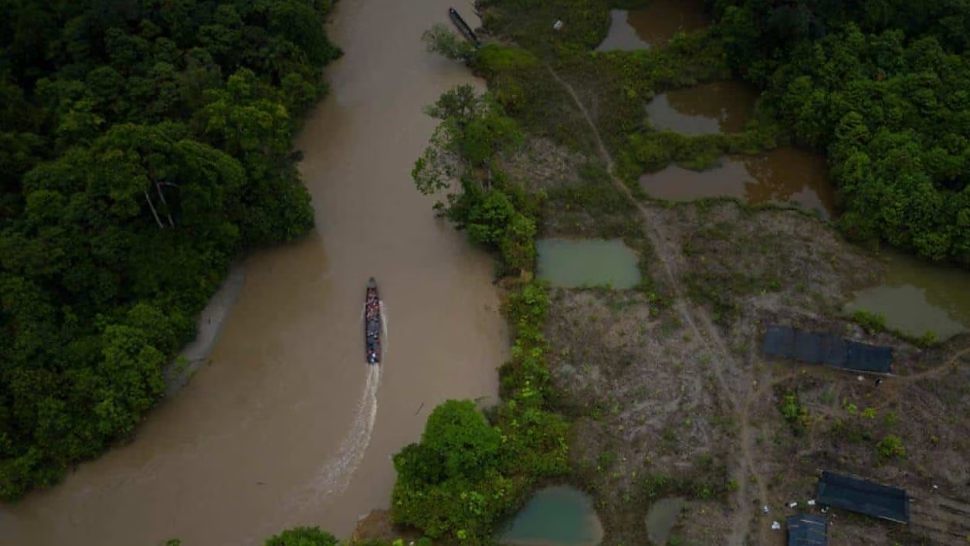
The Amazon rainforest, which absorbs carbon dioxide and slows climate change, faces a new scenario. Around 40% of Colombian territory is in the Amazon basin. During the government of Gustavo Petro, the country positioned itself as a defender of the jungle. De la Espriella promises to reactivate the oil sector, support fracking and further exploit natural resources.

Elizabeth Dickinson of the International Crisis Group noted that many governments now believe that economic development and conservation can move forward together. However, environmentalists warn that expanding fossil fuel production could increase pressure on sensitive ecosystems.

Peru and Brazil also join this trend. Keiko Fujimori, close to winning in Peru, supports mining. In Brazil, the election between Flávio Bolsonaro and Lula will define the direction of deforestation. Cristiane Mazzetti of Greenpeace Brazil said: “The elected administration sets budget priorities and regulates exploitation. The result is measurable, as shown by the rate of deforestation.”

Illegal gold mining is one of the biggest drivers of destruction in the Amazon. Dickinson added: “It’s very hard to disagree with going after illegal mining, one of the most damaging industries.” But he warned that governments often focus on seizing equipment, without dismantling criminal networks.

Julio Cusurichi, indigenous leader in Peru, stated: “Biodiversity and our territories can help climate change. In our territories we do governance for the planet.” Indigenous organizations denounce that governments do not adequately consult them before approving extractive projects.

Analysts such as Sergio Guzmán indicate that environmental concerns will compete with economic ones. “Many emissions concerns will take a backseat to energy self-sufficiency,” he said. He also mentioned that aerial fumigation of coca crops could resume, affecting Amazonian communities.

In Leticia, the Ticuna indigenous Arnaldo Rufino expressed his fear: “That means cutting down the trees that allow humanity to breathe.” The future of the Amazon will depend on the decisions made by the new governments in the region.

Continue reading

7.1 magnitude earthquake shakes Venezuela and raises alerts

7.1 tremor shakes Venezuela; tsunami warning in Puerto Rico.

7.1 tremor in Venezuela activates tsunami alert

A 7.1 magnitude earthquake was recorded this Wednesday in Venezuela, according to the United States National Oceanic and Atmospheric Administration (NOAA). The earthquake occurred at 22:04 GMT with the epicenter located 21 kilometers east of Morón, in the state of Carabobo.

The depth of the earthquake was 9.6 kilometers, which increased its perception on the surface. NOAA issued a tsunami warning for Puerto Rico and the Virgin Islands, although so far no major damage has been reported in those areas.

Aftershocks and affected areas

The tremor unleashed scenes of alarm in Caracas, where residents took to the streets after feeling the movement. It was also noticed in several cities in Colombia, such as Bogotá, Barranquilla and Bucaramanga, although without serious consequences.

Local authorities evaluate possible effects. Venezuela is located in an area of ​​moderate seismic activity, and events of this magnitude are rare. No casualties or significant structural damage have been reported as of press time.

Continue reading