Leo XIV plans his first international trip to Lebanon

The American pontiff could set foot on Lebanese soil in a geopolitical move loaded with symbolism and divine-level logistical challenges.

The American Pope Touches (Almost) Holy Land

It seems that the first American pontiff in history, Leo XIV, is about to release his passport with a Vatican seal. And your dream destination isn’t Disney World, but something with a little more… let’s say, geopolitical tension. According to a tip from a Lebanese cardinal, the Holy Father is targeting Lebanon for his first international outing. Basically, he is changing ‘Hello Kitty’ for a message of peace in one of the most complicated regions on the planet. Nothing like going on a trip from novice to expert mode.

The move would be the second stop on a tour that would include Türkiye at the end of November, to commemorate a few years – seventeen hundred, to be exact – of the First Ecumenical Council. In other words, a journey with history, symbolism and a potential for brutal memes.

RelatedCelebrities say goodbye to Pope Francis with emotional messages

The Vatican Says “I Neither Confirm nor Deny”, That is, Yes

Cardinal Béchara Boutros Raï, a kind of ecclesiastical influencer in the Middle East, dropped the bomb in an interview with Al-Arabiya. He stated that the Pope “will visit Lebanon”, although he admitted with an honesty that we do not expect even in our tinders that “it is not clear, to be honest” when. His prediction: anytime between now and December. I mean, it could be tomorrow or just after Christmas, because at the Vatican they like to maintain suspense.

As is tradition in the Holy See, a spokesperson washed his hands like Pilate and refused to confirm or deny the news. But let’s be real: these leaks never come out of nowhere. If the local church says so, it is because there are as many preparations behind it as in a real wedding. Or almost.

Leo XIV is not new to the game of advocating for peace. Like his predecessor, the beloved and missed Pope Francis, he has been sending messages calling for dialogue and a ceasefire in the Middle East, especially with the conflict in Gaza in the background. His trip to Lebanon would be his way of raising the tone: from tweets to action (or at least, to physical presence).

Why Lebanon Is Not Just Any Destination

Lebanon is that place that everyone mentions in the news but that few understand. It is the country with the highest proportion of Christians in the Middle East and the only Arab country to have a Christian head of state. Sounds cool, right? Well, reality is more complex than deciphering the hidden messages of a Christopher Nolan film.

The Mediterranean nation is burdened by a brutal economic crisis, Syrian and Palestinian refugees, and constant tension with Israel. In addition, Hezbollah has a annoying neighbor that does not want to let go of its toys (read: arsenal). The Vatican rightly fears that all this instability is a danger to the local Christian community, which is like a Catholic stronghold in the region. Come on, visiting isn’t exactly a peaceful spiritual retreat.

The last Pope who dared to visit there was Benedict XVI in 2012, on what was his last international trip. Francisco wanted it, but the political and economic situation of the country always prevented him from doing so. So if Leo XIV achieves it, it will be a historic moment and an emotional nod to his predecessor.

Also, there is the small detail that there has been no official census since 1932 (yes, you read correctly), so the Christian population figures are estimates. They are estimated to be around a third of the total, with the Maronites being the largest and most powerful sect. By tradition, the president is always a Maronite Christian. Something is something.

Meanwhile, Israel continues to occupy strategic points on the border and launch airstrikes almost daily. Hezbollah refuses to disarm until Israel withdraws. And everyone looks askance, afraid that any wrong move will spark a civil conflict. In the middle of this cocktail, the visit of a Pope would be like bringing a peace influencer into the most chaotic party of the year.

So now you know: Leo XIV does not choose simple trips. Between Türkiye and Lebanon, their agenda promises more excitement than a season finale of your favorite series. And we, here, with the popcorn prepared.

Did you like this analysis with a millennial touch? Share it on your social networks and keep exploring our news for more content that combines news and sarcasm!
Vance reports progress in negotiations with Iran in Switzerland

Progress in dialogue between Washington and Tehran due to crisis in the Middle East.

Diplomatic advances in Switzerland

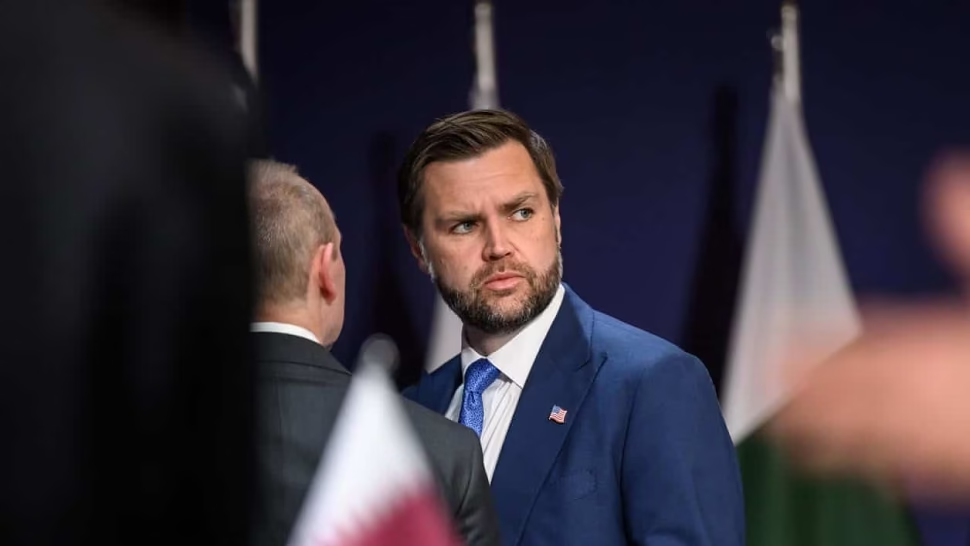
The Vice President of the United States, JD Vance, affirmed that the talks with Iranian representatives in the Bürgenstock complex, Switzerland, achieved relevant progress. According to Vance, the foundations were laid for an agreement that would reduce tensions in the Middle East.

During the meeting – which also included mediators from Pakistan and Qatar – two key issues were addressed: the reopening of the Strait of Hormuz and the conflict between Israel and Hezbollah in southern Lebanon.

The Strait of Hormuz, a strategic route for global oil transportation, had been closed by Iran after attacks by the United States and Israel. This skyrocketed international fuel prices. Although some ships have resumed transit, the main route still faces safety risks.

As part of the process, the US Treasury Department issued a temporary license allowing exceptions to sanctions related to Iranian oil. Technical talks will continue over the next 60 days.

The mediators indicated that there was progress in maintaining a ceasefire in Lebanon, but differences persist over the Iranian nuclear program and other key points of the agreement that Washington and Tehran seek to finalize.

Continue reading

Leo XIV criticizes the ease of financing wars and not hunger

The pontiff warned about the drop in financing for food assistance from 2022.

Call from the pontiff in the face of the food crisis

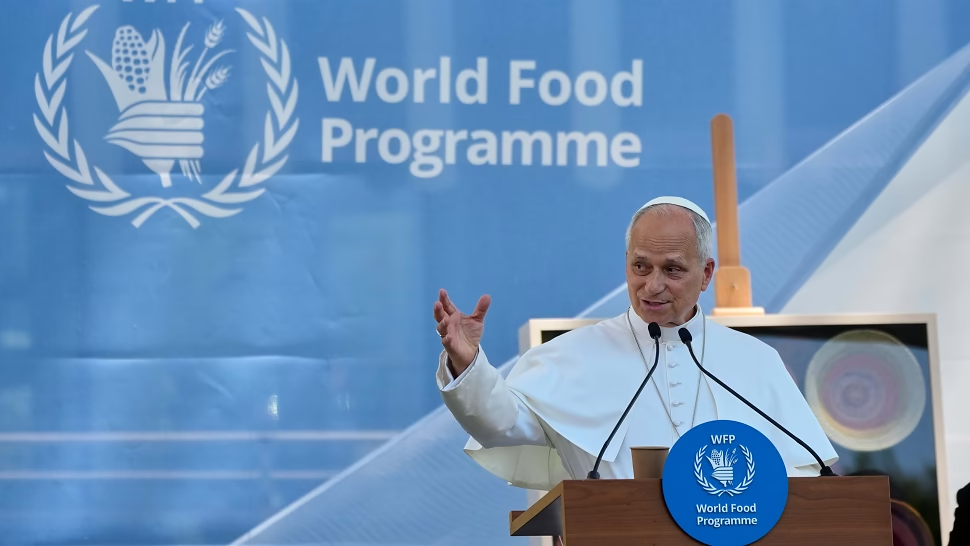
Pope Leo XIV urged governments to allocate more resources to combat hunger. During a meeting in Rome with the UN World Food Program (WFP), he pointed out that it is easier to finance armed conflicts than to guarantee food for millions of people in vulnerable situations.

The pontiff warned that political and administrative obstacles delay humanitarian aid. In contrast, military spending is advancing with fewer obstacles. This paradox reflects a serious inequality in global priorities.

Leo XIV indicated that funding for food assistance has decreased considerably since 2022. Although needs increased due to conflicts, climate crises and economic problems, funds did not grow at the same pace.

He highlighted that recent international contributions, such as the one announced by the United States for the WFP, will benefit millions of people. However, he stressed that there is still a significant gap to cover the necessary resources.

Before the UN body, the pope called on world leaders to place human dignity at the center of their decisions. Strengthening international cooperation is key to confronting hunger and inequality.

Continue reading

Explosion at gas plant in Qatar leaves 13 dead

Explosion at gas terminal in Qatar leaves 13 dead and dozens injured.

Explosion in Ras Laffan: 13 dead and dozens injured

An explosion rocked the gas export terminal in Ras Laffan, one of Qatar’s most important energy facilities. The preliminary balance is 13 people dead and dozens injured.

The incident occurred while workers were trying to resume operations in the area. Work had stopped after previous clashes related to the conflict between Qatar and Iran.

Details of the accident

State-owned Qatar Energy confirmed that the explosion originated at the Barzan gas supply facility. The full extent of the damage caused by the fire is still unknown.

Ras Laffan is home to one of the world’s leading gas liquefaction plants. Disrupting its operations could lead to tensions in global energy markets, given that Qatar is a key exporter of natural gas.

Local authorities are investigating the causes of the explosion. It is not ruled out that technical problems or human failures may have contributed to the incident.

The accident adds to a context of instability in the region. The war with Iran had already affected the Qatari energy infrastructure, and this new fact complicates the recovery of the sector.

Continue reading