Joe Biden reappears in public after prostate cancer diagnosis

The former president reappears at a family event after revealing his diagnosis, while his team clarifies key medical details.

First appearance of Joe Biden after revealing oncological diagnosis

The former president of the United States, Joe Biden, starred in his first public event this Friday after confirming his diagnosis of advanced prostate cancer. The event consisted of the graduation ceremony of his grandson, Robert Hunter Biden II, at the Salisbury School in Connecticut, where he was accompanied by his wife, Jill Biden, and his daughter Ashley.

Medical context and official statements

As reported by his medical team on Sunday, May 21, Biden underwent specific tests after manifesting persistent urinary symptoms. The results confirmed a prostate carcinoma with bone metastasis and a Gleason score of 9 (Group 5), an indicator of high aggressiveness. This finding contrasts with his previous medical history: in a subsequent statement, it was stated that the former president had not had prostate check-ups in more than ten years, which could have delayed early detection.

RelatedBiden completes radiation therapy for prostate cancer

The Mayo Clinic explains that prostate cancer with bone metastasis has an average survival of 3 to 5 years, although factors such as age (Biden is 80 years old) and access to cutting-edge treatments can influence the prognosis. The former president will soon begin a protocol that will combine radiotherapy and hormonal therapy.

Public repercussions and family reactions

The images shared by Jill Biden on Instagram show the former president smiling with his family, with a message highlighting his pride in the graduate. Experts in political communication, such as analyst Kathleen Hall Jamieson, point out that this appearance seeks to convey normality and strength in the face of a diagnosis that affects 1 in 8 men according to the American Cancer Society.

The event takes on additional relevance as it occurs days after Biden revealed his condition, a gesture that organizations such as Zero Cancer have praised for making visible a disease that many patients hide due to stigma. Data from 2023 indicates that 60% of cases in the US are diagnosed in advanced stages, partly due to men’s reluctance to undergo regular check-ups.

Analysis of the political and social impact

This episode reopens the debate on the medical transparency of public leaders. Biden, who during his presidency promoted health reforms such as the expansion of the Affordable Care Act, now faces questions about his own preventive monitoring. Historically, figures such as Nelson Mandela and John McCain have used their battles against cancer to promote awareness campaigns.

For oncologist Dr. Miguel Ángel Álvarez-Avitia, the detailed disclosure of the Biden case could increase consultations for prostate symptoms: “When public figures speak openly, the taboo is reduced and lives are saved.” Statistics from the US National Cancer Institute show that searches for early detection increased by 40% after similar announcements.

Do you want to help spread key information about men’s health? Share this article to promote the prevention of prostate cancer. Explore more content on well-being and political news in our dedicated section.

Sources: American Cancer Society, Mayo Clinic, official statements from Joe Biden’s office.
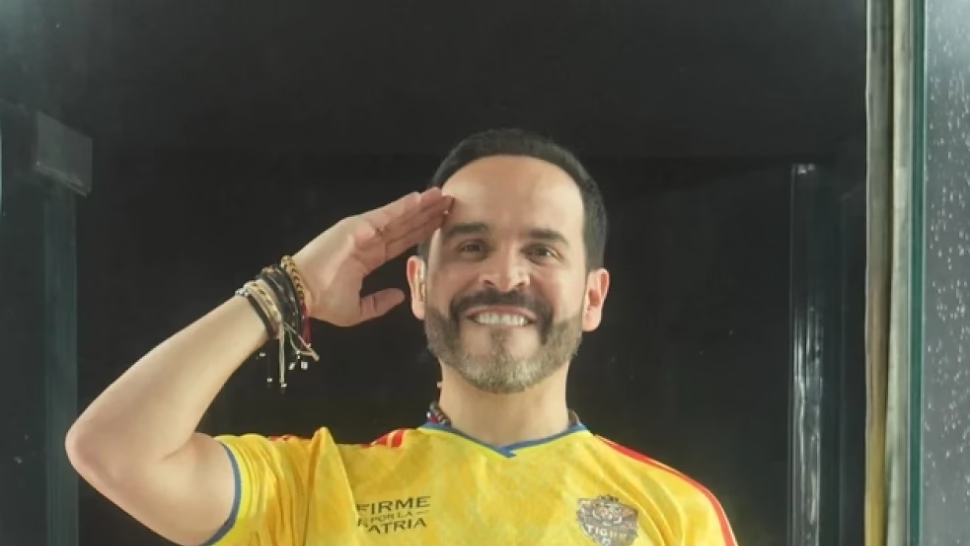
Abelardo de la Espriella is proclaimed president-elect of Colombia

The conservative narrowly leads Cepeda amid allegations of fraud.

Post-election tension in Colombia

The conservative Abelardo de la Espriella declared himself the winner of the second presidential round in Colombia. With 99.98% of the tables counted, he obtained 49.66% of the votes, compared to 48.70% for Senator Iván Cepeda. The difference exceeds 250,000 votes.

“The Colombian people have entrusted me with the supreme honor of serving as their next president,” De la Espriella said before thousands of supporters in Barranquilla. He promised to protect the freedoms and rights of everyone, even those who did not vote for him.

Cepeda asked to wait for the final scrutiny. “The pre-count is neither official nor binding,” he said, and anticipated that his party will challenge 33,000 tables throughout the country. The outgoing president Gustavo Petro wrote in X: “No one can be proclaimed president. It is the scrutiny that determines who is the president.”

De la Espriella responded: “To Mr. Petro and his heir I say: respect the will of the people of Colombia. Refrain from unleashing a social fire… pack your bags and prepare to exercise opposition.”

The 47-year-old candidate, nicknamed “El Tigre,” is a lawyer and businessman who made his fortune in wine, rum and clothing. Without political experience, he promises to take a tough line against armed groups and build mega prisons in the style of El Salvador. He was born in Bogotá but grew up on the Caribbean coast; He lived in Italy until before the campaign.

US Secretary of State Marco Rubio congratulated him as “president-elect” and said he hoped to work on regional security and reduce irregular migration.

Election day passed with high participation of more than 41 million eligible voters. Violence remains the main concern: last year 14,780 homicides were recorded, the highest number since 2015, and extortion doubled in a decade.

The saleswoman Yolanda Hernández, who voted for Petro in 2022, now opted for De la Espriella: “We want there to be a change in Colombia because it is always the same violence, always everything the same.”

The electoral judges will carry out the final count in the coming days. The country awaits the official result in the midst of a polarized environment.

Continue reading

Ramiro Valdés, key figure of the Cuban Revolution, dies at 94

Ramiro Valdés, historic Cuban leader and companion of Fidel Castro, dies.

Ramiro Valdés, the last commander of the Cuban Revolution, dies

Ramiro Valdés Menéndez, commander of the Cuban Revolution and figure close to Fidel and Raúl Castro, died this Sunday at the age of 94. This was confirmed by the Communist Party of Cuba (PCC) and the island’s government in an official statement. No details were offered about the causes of death nor was it reported how the funeral will be.

“Ramiro Valdés Menéndez is deserving of the respect and admiration of the people of Cuba for his dedication and proven loyalty to the revolutionary cause,” said the note published in Cubadebate.

Valdés was part of the group that assaulted the Moncada Barracks in 1953, the act that began the armed struggle against Fulgencio Batista. He then fought under the command of Che Guevara and received the honorary title of Commander of the Revolution. He was also declared “Hero of the Republic of Cuba.”

He held senior positions in the government, including the Ministry of the Interior, but in 1986 he stepped down from power after an argument with Fidel Castro. He remained away from public life for 17 years. In 2003 he returned to the Council of State. In 2006, Raúl Castro appointed him Minister of Information Technology and Communications, despite being over 70 years old. In 2011 he became number three in the PCC, only behind Raúl and José Ramón Machado Ventura. In 2019 he became Deputy Prime Minister, a position created by the new Constitution.

Known for his critical stance towards the Internet, in 2007 he stated: “The wild horse can and must be dominated, and infocommunications, put to work for peace and development.” He rarely appeared in public and never spoke to the press.

President Miguel Díaz-Canel reacted on social networks: “The physical departure of the commander of the Revolution, Ramiro Valdés Menéndez, hurts deeply, like that of a father. That is how I always loved and respected him. This is how I will remember his support and advice, his discreet collaboration and exemplary dedication to the service of the Homeland.”

Continue reading

Sweltering Europe: France on red alert due to extreme heat

France activates alerts and restrictions in the event of temperatures exceeding 40°C in the midst of an exceptional heat wave in Europe.

France is facing an exceptional heat wave that has forced the cancellation of trains, concerts and sporting events, in addition to restricting alcohol consumption in areas under red alert. Almost a third of the country is at that level, with thermometers reaching 40°C. An even hotter Monday is forecast.

Authorities installed misting stations at the Eiffel Tower and other points in Paris to cool the population. However, drownings are increasing: French media reported four deaths of minors on Saturday, while swimming to beat the heat. In Germany, a man lost his life in the Rhine River and three people are still missing. Health authorities warn that these incidents worsen during periods of high temperatures.

Measures and concerns

The government banned drinking alcohol outdoors in areas under red alert and asked the organizers of Music Day – a festival that brings together crowds throughout the country – to limit alcohol consumption to “preserve emergency services and allow medical personnel to concentrate on caring for the most vulnerable.”

“In this heat, it’s the only way to have fun going out,” swimmer Nicolás Cruz told The Associated Press, while splashing in the Saint Martin Channel.

Zouzou Hobbs, initially skeptical about swimming in the murky urban canal, decided to take a chance: “But it’s hot. I’m going to take my chances. We need to cool off before tonight, when we’re going to be dancing.”

The authorities are especially attentive to homeless people and older adults. Some 15,000 older people died in the 2003 heat wave in France, prompting national reflection. This year, the government mobilized emergency services and armed forces to prepare for wildfires, imposed surveillance on water supplies for nuclear reactors and ordered the closure of 845 schools on Monday.

The heat spreads across Europe

Spain began the summer with much of the country on alert, with temperatures around 40 °C, even in the interior of the Basque Country. Outdoor sports and cultural activities have been suspended. In Italy, eight cities extended heat advisories (“red flags”), with temperatures in the 30s and 40s. In Milan, farm owners installed fans and sprinklers for cows, while Fashion Week attendees fanned themselves under umbrellas.

Germany expects up to 39C on Wednesday, and the UK has issued an “extreme heat” warning for southern England and Wales, with highs of 38C possible. The British Met Office recalled that the record for June is 35.6 °C since 1976. Thunderstorms threaten Germany and Poland.

French Prime Minister Sébastien Lecornu called a crisis meeting and ordered planning for better adaptation to heat waves “through air conditioning, if necessary.” The World Health Organization said more than 200,000 people in Europe died from heat-related causes in the last four years, most of them preventable.

Continue reading